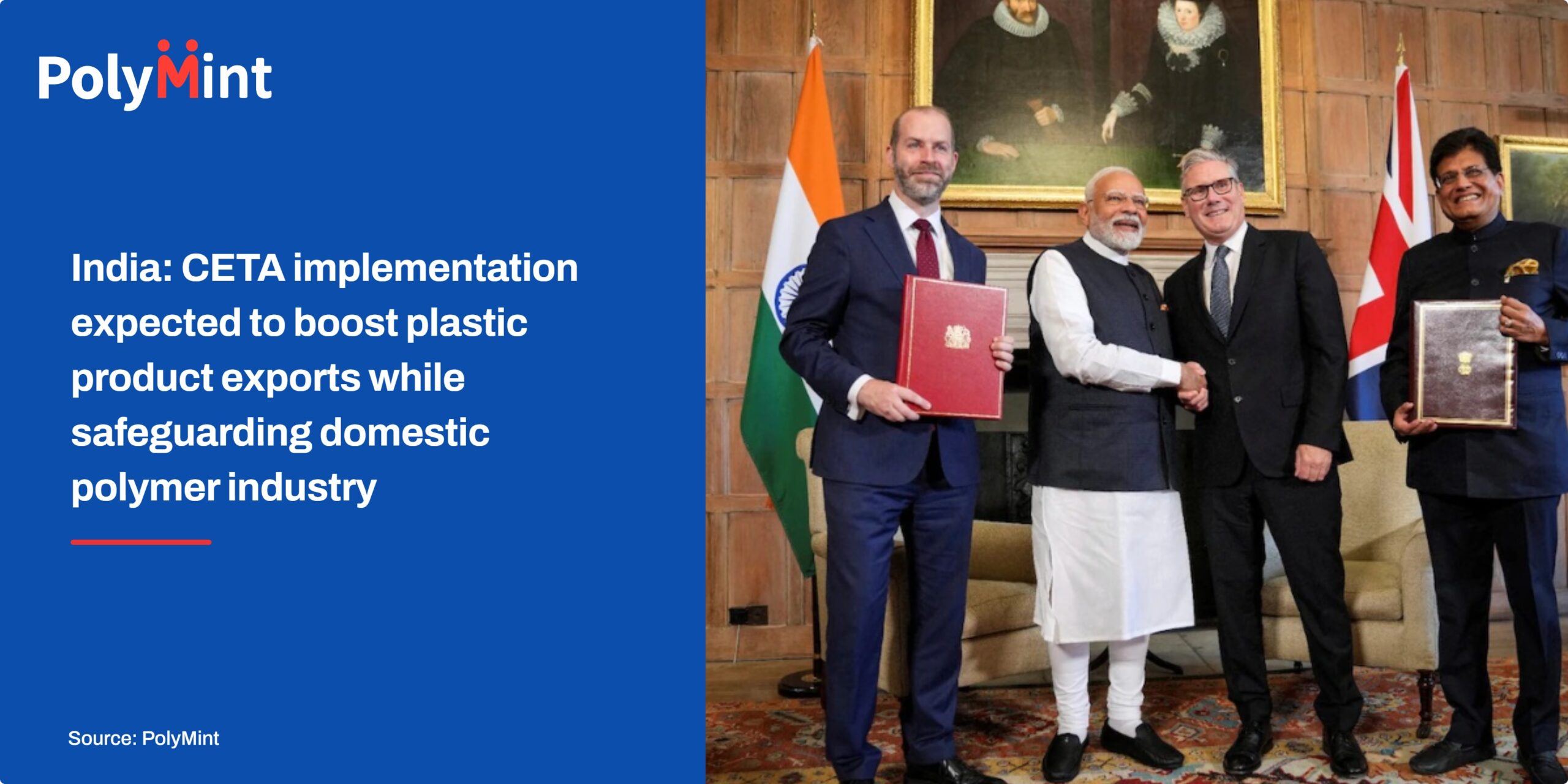
- India grants duty-free access to nearly 99% of exports to the UK
- Critical polymers excluded from tariff concessions, protecting domestic investments
The implementation of the India-UK Comprehensive Economic and Trade Agreement (CETA) on 15 July 2026 marks a significant milestone in bilateral economic relations, strengthening one of India’s largest trade partnerships with a developed economy.
Under the agreement, nearly 99% of Indian exports, covering almost 100% of trade value, receive duty-free access to the UK, while India has offered tariff concessions on 89.5% of its tariff lines, representing around 91% of UK exports.
The calibrated structure of the agreement aims to expand bilateral trade and investment while protecting strategically important domestic industries.
The timing of the agreement is significant. Bilateral merchandise trade reached $25.12 billion in FY2025-26, comprising $13.44 billion of Indian exports and $11.68 billion of imports. Services trade was even larger at $35.44 billion in 2024, underlining the depth of economic integration between the two countries. The UK is also India’s sixth-largest foreign investor, with cumulative FDI of around $35 billion, creating a strong platform for further industrial collaboration.
Critical polymers outside tariff concession list
For the polymer industry, however, CETA adopts a selective liberalisation strategy. While plastic products have been identified among the labour-intensive sectors expected to benefit from improved market access, critical polymers and their monofilaments have been kept outside India’s tariff concession list.
This distinction reflects the government’s effort to promote downstream manufacturing while protecting domestic investments in petrochemicals and polymer production under initiatives such as Make in India and the Production Linked Incentive (PLI) scheme.
The immediate beneficiaries are expected to be manufacturers of value-added plastic products rather than polymer resin producers. Lower UK import duties improve the competitiveness of Indian exporters supplying packaging materials, consumer products, industrial mouldings, automotive plastic components, household articles and engineering plastics. Export-oriented processors and converters are therefore better positioned to increase their presence in the UK market as tariff barriers are removed.
Conversely, the exclusion of critical polymers limits the possibility of lower-duty UK resin imports competing with domestic producers. India’s polymer market has witnessed significant capacity additions in recent years, and retaining tariff protection provides greater investment certainty for domestic manufacturers while allowing downstream industries to leverage export opportunities. The agreement therefore supports expansion across the polymer value chain without undermining upstream production.
Beyond tariff reductions, CETA also introduces trade facilitation measures including simplified customs procedures, digital documentation and electronic certification. These initiatives are expected to reduce compliance costs, particularly for MSMEs engaged in plastic processing and finished goods exports.
Increased investment cooperation may also encourage technology transfer in areas such as specialty polymers, advanced processing technologies and sustainable packaging solutions.
Nevertheless, the agreement does not fundamentally alter the key drivers of India’s polymer market. Resin prices will continue to depend on crude oil, naphtha and feedstock costs, regional supply-demand balances, freight rates and capacity additions across Asia. Export growth will also depend on Indian manufacturers’ ability to comply with UK product standards, sustainability requirements and Rules of Origin provisions governing preferential tariff access.
Market implications
For the polymer sector, CETA is less about increasing resin imports and more about strengthening India’s position as a global supplier of value-added plastic products. The agreement supports downstream manufacturing, encourages export diversification and preserves policy support for domestic petrochemical investments by excluding critical polymers from tariff concessions.
Outlook
The benefits for the polymer industry are expected to emerge gradually as exporters increase utilisation of the agreement. Manufacturers of finished plastic products are likely to gain the earliest advantage through improved market access, while domestic polymer producers continue to operate under a protected tariff framework.
Over the medium term, the combination of preferential market access, stronger trade facilitation and continued investment in petrochemical capacity could improve India’s competitiveness across the global polymer value chain.
Leave a Reply