- Petcoke price rally reshapes cement fuel economics
- US NAPP retail inventories continue to tighten
India’s cement industry is recalibrating its fuel procurement strategy as tightening global petroleum coke (petcoke) supplies and rising delivered prices narrow petcoke’s traditional cost advantage over coal. While petcoke remains an important kiln fuel because of its high calorific value and low ash content, escalating prices are encouraging producers to optimise their fuel mix by increasing the use of domestic coal and imported US North Appalachian (NAPP) coal.
At the same time, India’s US NAPP market continues to show resilience. Alongside steady demand from major cement producers, retail inventories have declined steadily over recent weeks despite the seasonal monsoon slowdown, indicating improving underlying market fundamentals ahead of the post-monsoon construction season.
Global petcoke prices continue to strengthen
Tighter refinery production in the Middle East has reduced the availability of fuel-grade petcoke in the international market, leaving US Gulf refiners to meet a larger share of global demand. Firm freight rates have further lifted delivered prices into Asia, keeping buyers under increasing cost pressure.
Global fuel-grade petcoke price snapshot

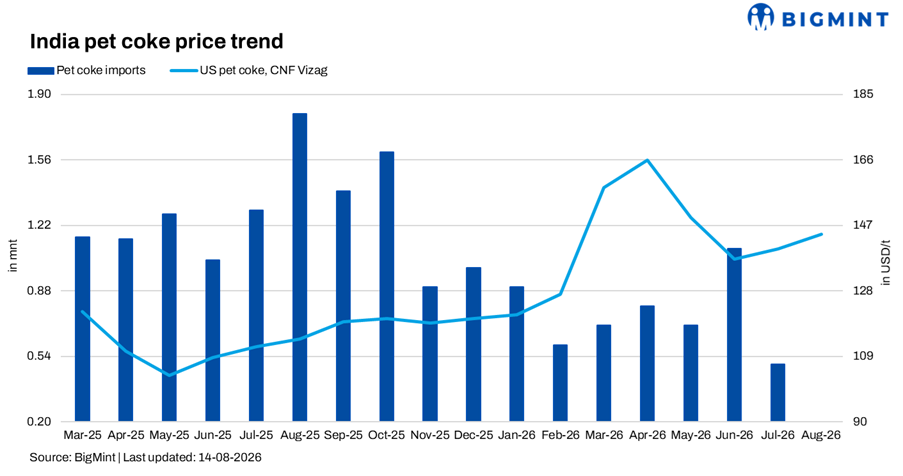
Indicative September offers into India’s west coast have largely moved into the $144-148/t CFR range. One cement producer reportedly sought cargoes through a reverse auction with a ceiling of $142/t CFR, yet the lowest offer received was $143/t CFR, illustrating the widening gap between buyer expectations and replacement costs.
Cement producers optimise rather than replace fuels
The current market does not suggest a wholesale shift away from petcoke. Instead, cement manufacturers are increasingly optimising their fuel basket.
Petcoke continues to offer significant operational advantages because of its high calorific value and low ash content. However, as its delivered premium has widened, domestic coal and imported US NAPP coal have become increasingly competitive alternatives.
US NAPP coal remains particularly attractive because of its relatively low sulphur, low ash and high calorific value, making it technically well suited for cement kiln operations. By contrast, Indonesian coal generally remains less suitable because of its higher inherent moisture, which lowers its effective energy value in cement applications.
Procurement decisions are therefore becoming increasingly driven by delivered fuel economics rather than reliance on any single fuel.
Import trends reflect changing procurement strategies
Petcoke imports during January-July 2026 declined sharply from the previous year as higher prices and tighter global supplies encouraged buyers to moderate purchases. Imports from Saudi Arabia fell significantly following reduced Middle Eastern refinery availability, while the United States further strengthened its position as India’s largest supplier.
However, petcoke imports should not be viewed solely through the lens of cement demand. Besides fuel-grade material consumed primarily by cement kilns, India also imports calcined petcoke for graphite electrode and carbon-product manufacturing, while Reliance Industries imports petcoke as feedstock for its gasification facilities. Fuel-grade petcoke is not permitted for use in captive power plants in India, making cement its principal industrial fuel application.
US NAPP market remains resilient
US NAPP coal continues to enjoy healthy demand from India’s large cement producers, supported by a steady pipeline of August and September cargoes arriving at both east and west coast ports. Beyond these industrial consumers, the retail market has also shown encouraging resilience.
India retail US NAPP market

Retail inventories have fallen by around 31 kt over the past month, while weekly despatches have steadily increased despite the seasonal slowdown. Most retail demand continues to originate from brick kilns, together with ceramics, food processing, commercial boilers and other small industrial consumers.
The steady drawdown in inventories suggests replacement cargoes have broadly matched ongoing despatches without creating excess stock. Importers have also shown little willingness to discount material as firmer US FOB prices and higher replacement costs continue to support market sentiment ahead of the expected post-monsoon recovery.
BigMint Insight
India’s cement fuel market is becoming increasingly dynamic. Rather than relying predominantly on petcoke, manufacturers are continuously optimising between petcoke, domestic coal and US NAPP coal as relative economics evolve. Tightening global petcoke supplies have reduced the fuel’s traditional cost advantage, strengthening the commercial case for coal without eliminating petcoke’s operational benefits.
At the same time, the resilience of India’s US NAPP market extends beyond bulk cement imports. Declining retail inventories and steadily rising despatches suggest underlying demand remains healthy despite the monsoon, providing additional support to prices. As construction activity accelerates after the monsoon, procurement decisions across both petcoke and coal markets are likely to be driven increasingly by delivered fuel economics, making fuel optimisation-rather than fuel substitution–the defining theme of India’s cement sector through the remainder of 2026.
Leave a Reply