- Global consumption reaches 6-year high, widening production deficit
- Falling stocks, lower US production strengthen market balance
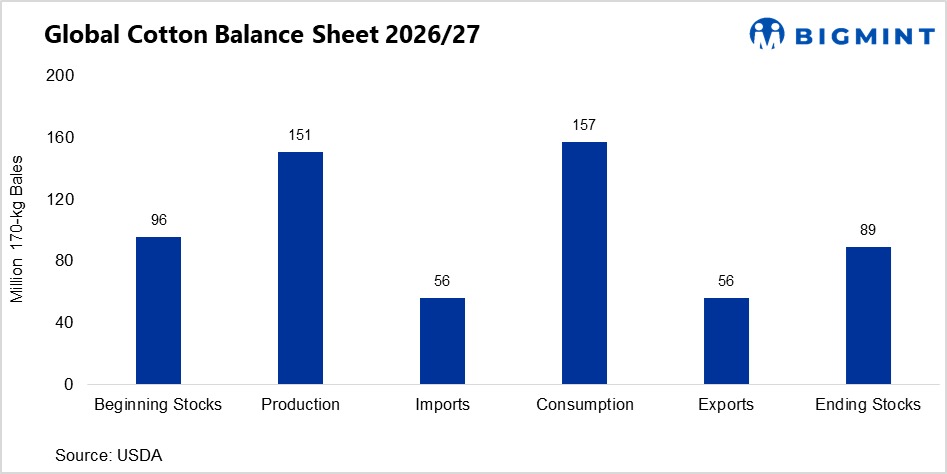
The global cotton market is moving into a tighter phase in 2026-27, with consumption growth outpacing production and drawing down inventories. The August 2026 USDA outlook forecasts global cotton production at 117.6 million bales, up just 0.4 million bales from July, while consumption is projected to increase by nearly 1 million bales to 122.9 million, the highest in six years. The widening production-consumption gap means the market will increasingly depend on existing stocks and uninterrupted trade flows to meet mill demand.
Global inventories fall
The clearest sign of tightening is the decline in global ending stocks. USDA has lowered the forecast by more than 1.5 million bales to 69.7 million, with inventories expected to fall in China, India, Brazil, and the US. The decline reduces the buffer available to absorb weather-related production losses, logistical disruptions or stronger-than-expected textile demand. The lower global stocks-to-use ratio reinforces the shift toward a less comfortable supply-demand balance.
US supply adds pressure
The US is emerging as a significant supply-side pressure point. USDA cut its 2026/27 production forecast to 13.61 million bales, down 0.67 million bales from July, primarily because of lower expected yields. At the same time, the US season-average farm price was raised to 75 cents/lb, indicating a firmer domestic pricing outlook as supplies tighten.
However, the global supply picture is not uniformly bullish. Brazil is rapidly expanding its exportable surplus, with production raised to 18.25 million bales and exports forecast at a record 15.3 million bales. Strong Brazilian shipments will increase competition in export markets, particularly against US cotton, and could prevent a sharper rise in international prices despite tightening fundamentals.
Asian demand drives trade
Demand remains the strongest pillar of the global outlook. China’s cotton consumption is forecast at 42 million bales, while mill use is expected to rise in India, Vietnam, and Indonesia. Import demand is projected at 3.0 million bales for India, 8.2 million for Vietnam, and 2.0 million for Indonesia, pointing to sustained buying interest from major textile manufacturing hubs.
Market prices are already reflecting the improved balance. Since the July WASDE, ICE cotton futures have risen around 3 cents/lb to about 84 cents/lb, while the A-Index increased from 87.3 cents/lb to 95 cents/lb by August 10.
Overall, the global cotton market has shifted toward a more supportive fundamental environment. Stronger consumption, declining stocks and lower U.S. production provide a foundation for prices, while Brazil’s record export availability remains the key counterweight. In the near term, the direction of prices will depend largely on whether Asian mill demand can absorb Brazil’s additional supply without a significant slowdown in global textile consumption.
Leave a Reply