- Soft China brass ingot demand keeps market under pressure
- Payment delays make sellers cautious
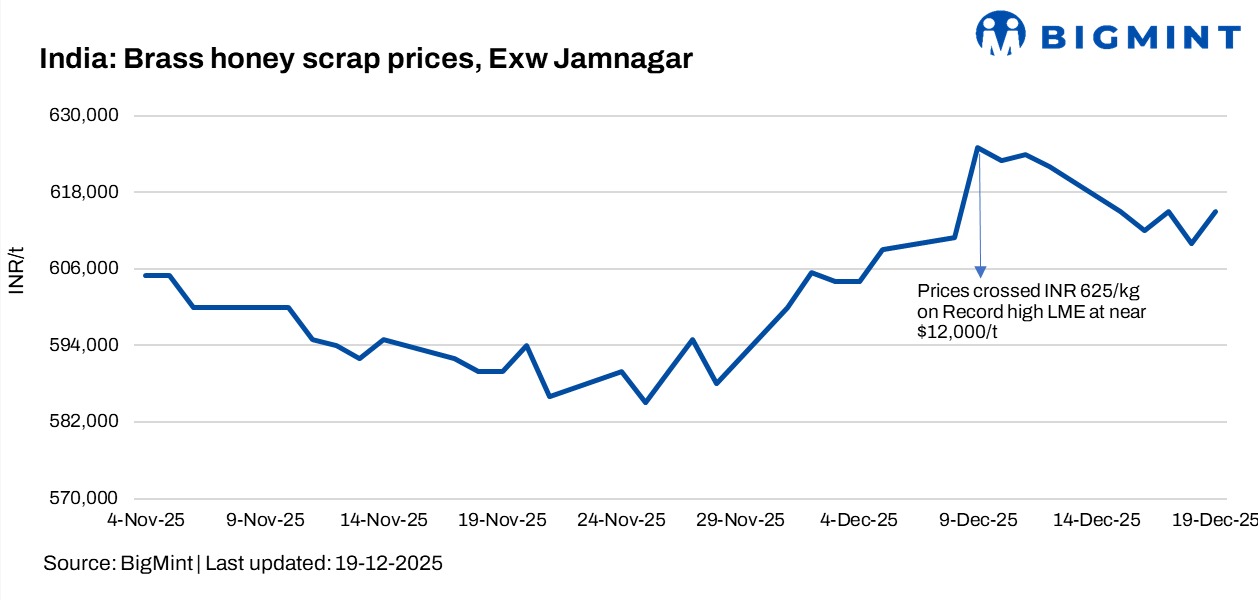
India’s domestic brass honey prices edged lower w-o-w on subdued market activity and multiple demand-side pressures. Market participants reported significantly reduced processing rates, particularly in north India, as ongoing pollution control measures in Delhi continued to disrupt operations across the value chain.
According to BigMint’s assessment, brass honey exw Jamnagar was assessed at INR 615,000/t, a decrease of INR 7,000/t w-o-w.
A seller stated that activity remains subdued, with several units running at low utilisation or temporarily shut. The impact has extended beyond Delhi, as many brass products rely on a split manufacturing process, where part of the production is carried out in Delhi and finishing is completed in Jamnagar. With stricter environmental norms forcing factory shutdowns in Delhi, processing activity in Jamnagar has also slowed, creating a cascading effect on the brass honey market.
Another key factor weighing on prices has been the slowdown in Chinese buying of brass ingots, a major downstream product linked to brass honey consumption in Jamnagar. Market sources indicated that Chinese demand has remained weak for nearly one-and-a-half months, keeping brass honey prices largely range-bound and limiting any upside momentum despite relatively stable copper prices.
Payment delays have further pressured the market. Sellers reported payment cycles stretching to 10-15 days, prompting some to offload material at discounted levels to maintain cash flow. Spot deals were reported at INR 606,000/t for brass honey supplied to regular buyers, while transactions with seven-day payment terms were concluded at relatively higher levels of INR 615,000-617,000/t. In some cases, discounts of up to INR 9,000-10,000/t were offered to secure faster payments.
On the import front, activity remained muted as western suppliers prepared for the Christmas and New Year holiday period beginning 22 December. European-origin brass honey offers were heard at 55-56% of 3M LME levels, while Middle Eastern material was offered at around 62% of LME.
Outlook
Unlike other copper-based scrap categories, brass honey pricing is currently being driven more by operational disruptions, cash flow constraints, and downstream ingot demand rather than LME movements. With both domestic processing and export-linked demand under pressure, brass honey prices are expected to remain soft in the near term, with any recovery likely dependent on easing environmental restrictions and a revival in Chinese buying interest.
Leave a Reply