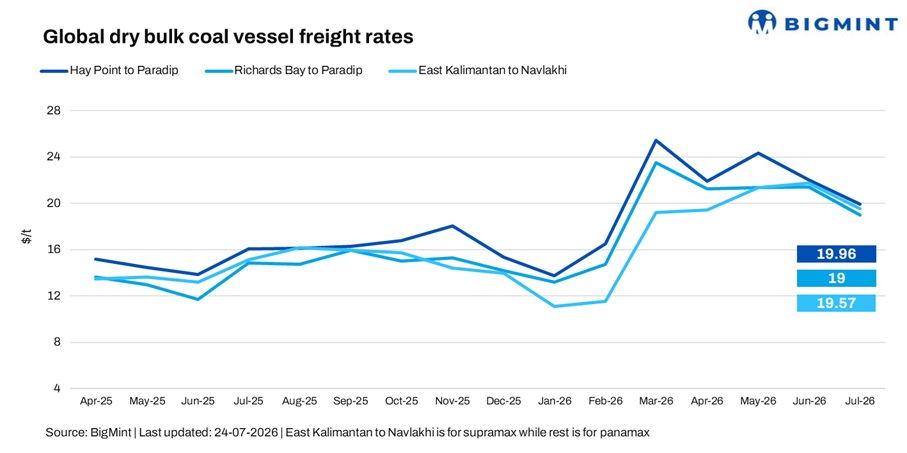
- Australia-India fixtures and higher voyage costs support Panamax routes
- Supramax holds firm despite subdued Indonesian coal enquiries
India’s dry bulk coal freight market remained firm in the week ended 24 Jul’26, with freight rates largely stable across the Panamax and Supramax segments. Higher bunker prices, active Australian met coal fixtures, healthy Queensland loadings, and steady South African coal programmes continued to support owners’ rate expectations despite limited fresh cargo enquiries and comfortable vessel supply.
The Panamax market faced headwinds from subdued demand across both the Atlantic and Pacific basins. However, sustained Australian met coal activity and stable South African cargo programmes helped keep India-bound freight largely resilient.
A shipbroker told BigMint, “Market sentiment remains bearish, with both Panamax and Supramax segments under pressure as limited fresh cargo enquiries and ample vessel availability continue to weigh on dry bulk earnings.”
At the same time, the sharp rise in Brent crude and bunker prices strengthened owners’ resistance to lower freight levels by increasing voyage costs. Another shipbroker said, “The sharp rise in Brent crude and bunker prices is increasing voyage costs, encouraging owners to seek higher freight rates. This is gradually improving market sentiment, with freight levels expected to find support despite mixed cargo demand.”
In the Supramax segment, balanced vessel availability and selective fixtures concluded at firmer levels helped offset softer Indonesian coal enquiries, allowing rates to hold steady.
However, market participants remained cautious. A shipbroker noted, “Freight rates continue to soften as weak cargo demand and an oversupply of prompt tonnage keep charterers in a stronger negotiating position. Unless cargo volumes improve, the market is likely to remain under pressure.”
Overall, while softer Baltic indices reflected subdued chartering activity, elevated bunker costs and supportive cargo programmes continued to underpin India-bound coal freight levels.
Route-wise update

Market highlights
- Baltic Dry Index (BDI) declines further w-o-w: The BDI fell 4.0% (115 points) w-o-w to 2,725 as of 23 Jul’26, from 2,840 a week earlier, as softer Capesize earnings continued to weigh on the broader dry bulk market. The Panamax Index dropped 8.5% (193 points) to 2,064, pressured by weaker Atlantic and Pacific demand amid limited fresh cargo enquiries. Meanwhile, the Supramax Index eased 1.6% (28 points) to 1,702, reflecting slower chartering activity despite relatively stable demand in South East Asia.
- Brent crude futures rise sharply w-o-w: Brent crude oil (September 2026 contract) climbed to $97.69/barrel (bbl) as of 24 Jul’26, up $11.71/bbl w-o-w from $85.98/bbl a week earlier. The rally was driven by escalating geopolitical tensions, heightened supply disruption concerns and stronger buying interest amid uncertainty over global crude availability.
- Bunker prices rise sharply w-o-w: Singapore’s Very Low Sulphur Fuel Oil (VLSFO) bunker prices increased by $118/tonne (t) w-o-w to $882/t as of 24 Jul’26, compared with $764/t a week earlier. The sharp rise tracked higher Brent crude prices, escalating geopolitical tensions and concerns over fuel supply, increasing voyage operating costs for shipowners.
- DCE coke futures decline w-o-w: Coke futures on the Dalian Commodity Exchange for the September 2026 contract fell to RMB 1,840.50/t ($271.85/t) as of 24 Jul’26, down from RMB 1,864/t ($275.20/t) a week earlier. The decline reflected cautious market sentiment amid subdued steel demand, ample coke supply and continued uncertainty surrounding China’s steel production outlook.

Outlook
India-bound coal freight is expected to remain firm to range-bound in the near term. Elevated bunker prices, active Australian met coal fixtures and steady South African coal programmes are likely to continue underpinning owners’ rate expectations, while limited cargo enquiries and comfortable vessel availability may cap stronger gains. Fresh chartering activity and developments in global energy markets will remain key factors influencing freight direction in the coming weeks.

Leave a Reply