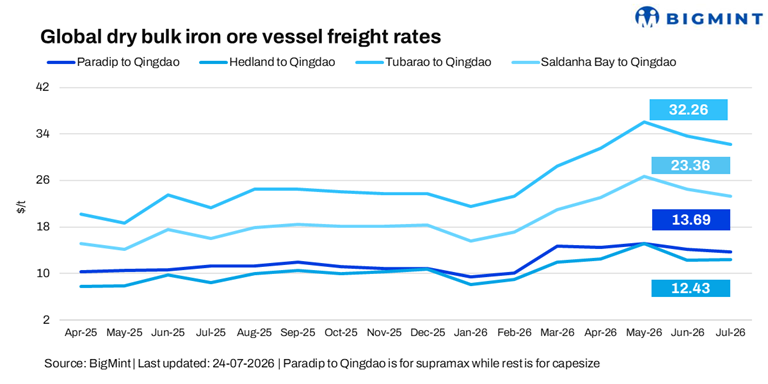
- Capesize under pressure amid rising bunker prices
- Supramax trades sideways on balanced supply-demand fundamentals
Dry bulk iron ore freight showed mixed trends in the week ended 24 July. Capesize rates came under pressure as softer fixture activity, improved vessel availability, and cautious chartering sentiment weighed on key iron ore routes, despite broadly stable export volumes and elevated bunker prices.
In contrast, the Supramax segment remained largely stable, supported by balanced vessel supply and steady minor bulk cargo demand, although limited fresh enquiries restricted further upside. Overall, market sentiment stayed cautious as participants monitored cargo demand and vessel fundamentals across both the Pacific and Atlantic basins.
A shipbroker said, “Market sentiment remained mixed, with the Capesize segment showing modest firmness, while Panamax softened and Supramax and Handysize remained largely stable. Fresh cargo orders were limited, resulting in subdued fixture activity.”
Route-wise update

Factors influencing freight rates
- Baltic Dry Index (BDI) drops w-o-w: The BDI declined by 4% (115 points) w-o-w to 2,725 on 23 July, reflecting softer overall dry bulk freight sentiment amid weakness across major vessel segments. The Capesize Index fell 3% (141 points) w-o-w to 4,198, as easing iron ore fixture activity and increased vessel availability weighed on earnings. Meanwhile, the Supramax Index dropped 2% (28 points) w-o-w to 1,702, with slower minor bulk cargo demand and balanced fleet supply continuing to pressure rates.
- Brent crude futures surge w-o-w: Brent crude oil (September 2026 contract) climbed to $97.69/barrel (bbl) as of 24 July, up $11.71/bbl w-o-w from $85.98/bbl a week earlier. The sharp increase was driven by heightened geopolitical tensions in the Middle East, escalating security risks to Red Sea shipping routes, and growing concerns over potential disruptions to global oil supplies, boosting bullish sentiment across energy markets.
- Bunker prices rise w-o-w: Singapore’s Very Low Sulphur Fuel Oil (VLSFO) bunker prices increased by $118/tonne (t) w-o-w to $882/t as of 24 July, compared with $764/t a week earlier. The rise mirrored the surge in crude oil prices, with higher feedstock costs and geopolitical risks surrounding key maritime trade routes continuing to support bunker fuel prices and increase operating costs for shipowners.
- DCE iron ore futures drop w-o-w: Iron ore futures on the Dalian Commodity Exchange (DCE) declined by RMB 16/t w-o-w to RMB 746/t ($110.2/t) as of 24 July, from RMB 762/t ($112.5/t) a week earlier. The decline reflected weaker market sentiment amid cautious steel demand, rising port inventories, and expectations of slower seasonal steel consumption, prompting traders to adopt a more conservative stance.

Outlook
The dry bulk iron ore freight market is expected to remain mixed in the near term. The Capesize segment may continue to face pressure from cautious chartering activity and ample vessel availability, although any pickup in iron ore exports from Australia and Brazil could provide support.
Meanwhile, the Supramax market is likely to remain stable, underpinned by steady minor bulk demand and balanced fleet supply, with limited upside unless cargo volumes improve.

Leave a Reply