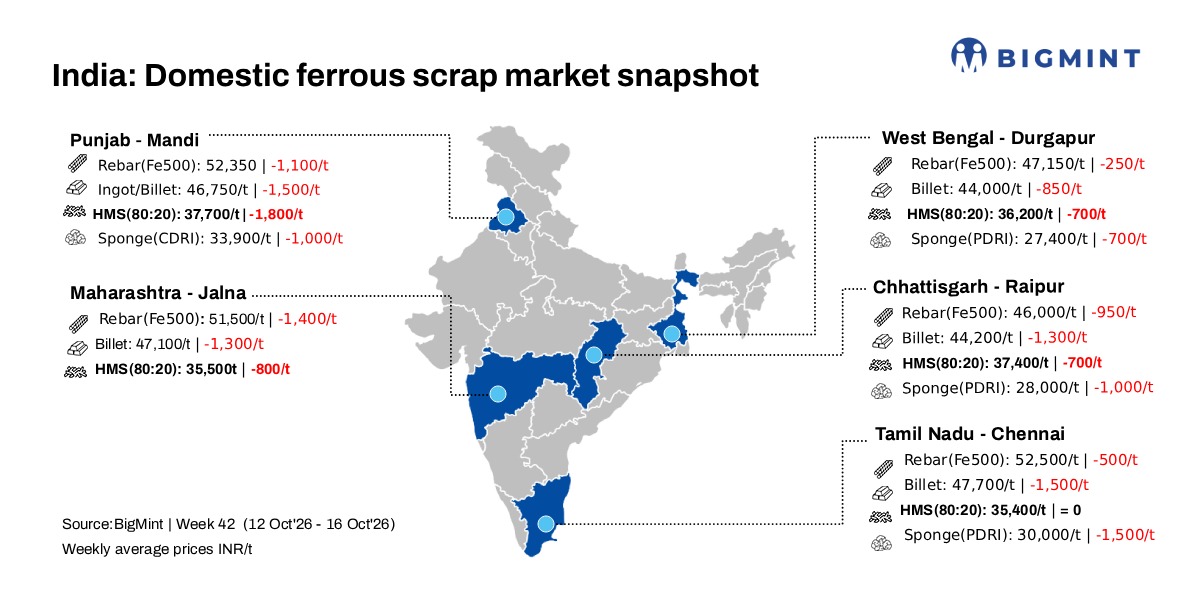
- Weak steel demand, inventory pressure weigh on scrap prices
- Higher domestic scrap arrivals prompt mills to limit procurement
BigMint’s domestic end-cutting scrap index, tracking the Mandi Gobindgarh market, decreased by INR 400/tonne (t) d-o-d to INR 40,300/t DAP on 16 October 2026. Scrap prices in the region fell by INR 1,750-2,000/t w-o-w, with the index declining by INR 2,000/t w-o-w.
Mandi Gobindgarh, a key secondary steel hub of north India, witnessed a broad-based softening in both raw material and finished steel prices during the week, as demand remained subdued and no major trade deals materialised. Scrap-to-finished steel prices declined by around INR 1,000-2,000/t w-o-w, reflecting a cautious stance among mills and traders amid weak downstream offtake.
The Mandi-Ludhiana scrap market faced additional pressure from higher-than-usual scrap arrivals from neighbouring regions. Improved domestic scrap generation and easier availability kept local suppliers competitive, but mills remained selective in procurement, buying mainly for immediate daily requirements rather than building inventories.
This supply-demand imbalance put local scrap suppliers under pressure to protect margins in deals, as mills negotiated aggressively and avoided bulk commitments. Market participants noted that suppliers were increasingly accepting lower offers to clear material, while buyers stayed on the sidelines unless prices were attractive.
On the finished steel side, mills in the region are also grappling with inventory build-up, as sluggish demand from construction and manufacturing segments failed to absorb output at the desired pace. Liquidity pressure has emerged as a key concern, with mills preferring to liquidate finished goods rather than accumulate more raw material.
A mill owner informed BigMint, “Imported scrap purchases have remained muted for an extended period, primarily due to price volatility in the international market and the comfortable availability of domestically generated scrap. With local scrap supply adequate and prices competitive, mills see limited incentive to commit to imported cargoes, especially given currency and freight uncertainties.”

Alternative raw material prices
Sponge iron (CDRI) prices in Mandi Gobindgarh moved down by INR 200/t d-o-d to INR 33,800/t (DAP). Prices declined by INR 1,030/t w-o-w.
Steel-grade pig iron prices in Ludhiana remained stable d-o-d at INR 43,500/t (DAP), while prices softened by INR 300/t w-o-w amid limited demand.
Steel market
Semi-finished steel (ingot) prices in Mandi Gobindgarh declined by INR 400/t d-o-d, settling at INR 46,200/t DAP. Other major production hubs also witnessed price drops in the range of INR 100-500/t in today’s trading session. W-o-w, ingot prices in the region decreased by INR 1,530/t.
Rebar (Fe500) prices decreased by INR 100/t d-o-d to INR 52,100/t ex-works, recording a w-o-w decline of INR 1,130/t. Hot-rolled (HR) strip prices fell by INR 200/t d-o-d to INR 50,300/t ex-works while falling INR 1,800/t w-o-w.
Price highlights
End-cutting to billet spread: In Mandi, the spread between end-cutting scrap and billets stood in the range of INR 5,800-6,200/t.
Domestic vs imported scrap: Imported melting scrap prices at Nhava Sheva Port were assessed at $368-$370/t, approximately INR 37,300/t (inclusive of freight). HMS (80:20) prices in Mumbai fell by INR 150/t to INR 36,550/t DAP. Indicative prices of shredded from Europe stood at $405-$410/t CFR Nhava Sheva.
Raipur sponge iron-billet spread: The conversion spread (margin) between pellet-based DRI (P-DRI) and steel billets in Raipur stood at INR 16,000/t.

To see BigMint’s melting scrap assessment, pricing methodology and specification documents, click here
To provide feedback on this index or if you would like to contribute by becoming a data partner, please contact – support@bigmint.co
Leave a Reply