- UltraTech leads as Ramco, Dalmia and Ambuja record lower rail receipts
- Hot metal production rises 2.5%, supporting higher BF slag generation
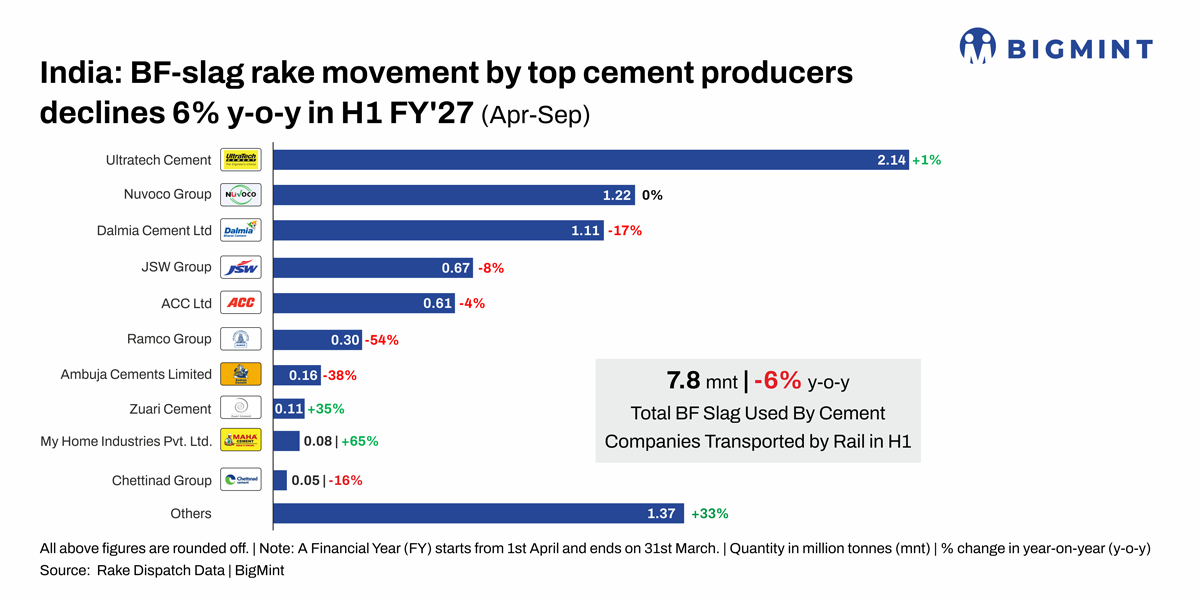
India’s blast furnace (BF) slag rake movements to cement companies declined 6% y-o-y to 7.80 million tonnes (mnt) in H1FY27, from 8.35 mnt in H1FY26, as per BigMint’s rake dispatch data. The decline came despite higher cement production and hot metal output.
UltraTech retains lead amid divergent procurement trends
UltraTech Cement remained the largest consignee, with tracked rake receipts increasing 1% y-o-y to 2.14 mnt. Nuvoco Group maintained volumes at 1.22 mnt, while Dalmia Cement’s receipts fell 17% to 1.11 mnt.
Ramco Group recorded a 54% decline to 0.30 mnt, followed by Ambuja Cements, down 38% to 0.16 mnt, and My Home Industries, down 65% to 0.08 mnt. JSW Group and ACC reported declines of 8% and 4%, respectively.
In contrast, Zuari Cement’s receipts rose 35% to 0.11 mnt, while movements under the ‘Others’ category increased 33% to 1.37 mnt. These divergent trends indicate that rail procurement changed unevenly across consumers.
Cement output growth points to a potential shift in logistics
India’s cement production volumes increased 10.3% y-o-y to 212 mnt in April-August 2026, with August output rising 12.5% to 39.7 mnt. Growth was supported by housing and infrastructure demand.
Against this backdrop, lower tracked BF slag rake movements do not necessarily indicate lower total slag consumption. A shift towards road transport could account for part of the decline, particularly where suppliers and cement grinding units use road-based deliveries.
Higher hot metal output supports slag availability
India’s hot metal production increased 2.5% y-o-y to 48.3 mnt in April-September 2026, compared with 47.2 mnt a year earlier, according to the Ministry of Steel.
One tonne of hot metal generates around 0.37-0.38 t of BF slag per tonne of hot metal, estimated generation reached around 18-18.5 mnt in H1FY27, up from around 17.5-17.9 mnt in H1FY26. This implies an estimated increase of about 0.5 mnt. Actual generation of usable granulated slag may differ according to plant operating conditions and processing practices.
Outlook
Higher hot metal output should support greater BF slag availability, while cement production growth underpins demand for slag-based products such as Portland slag cement (PSC) and ground granulated blast furnace slag. The decline in tracked rail movements may partly reflect a change in transport mode rather than a contraction in consumption. BF-slag rake movement is anticipated to rise in H2FY27 with higher slag generation from BF-mills and cement companies’ capacity expansion will support procurement volumes.
Leave a Reply