- August approvals moderate to 1.60 mnt after July’s 7.53 mnt peak
- BOF projects account for more than half of approved capacity during April-August
- Karnataka emerges as the largest destination for new integrated steel investments
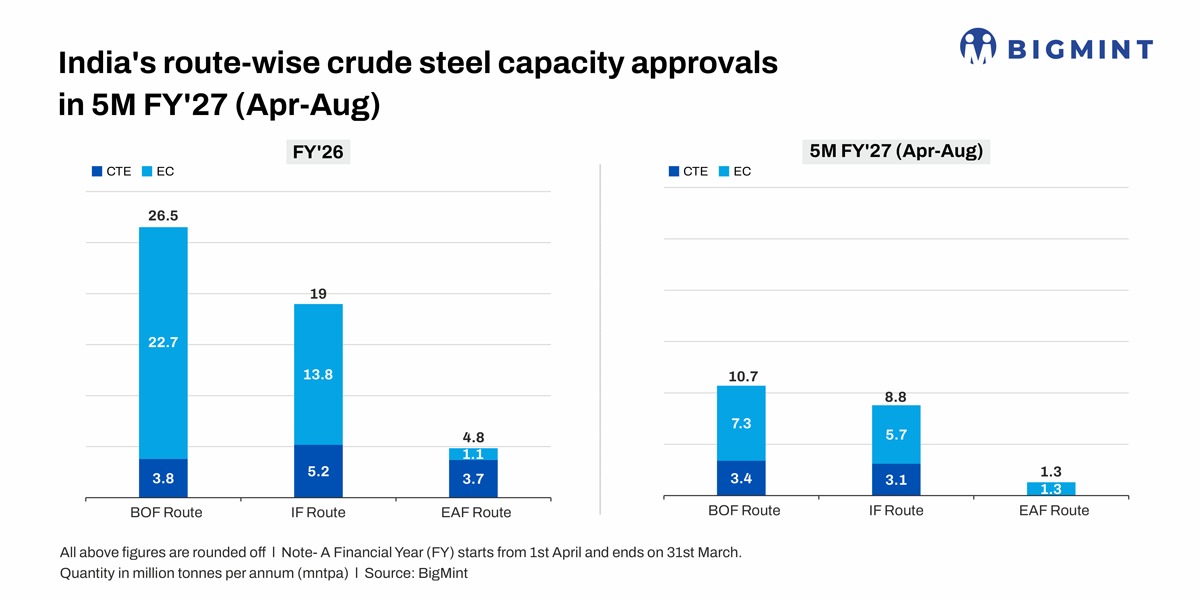
Morning Brief: India’s crude steel capacity approvals slowed to 1.60 million tonnes per annum (mntpa) in August after peaking at 7.53 million tonnes (mnt) in July, taking cumulative approvals during April-August FY’27 to 20.77 mnt across the environmental clearance (EC) and consent-to-establish (CTE) stages, according to BigMint data. While the monthly pace moderated following July’s large project approvals, the cumulative pipeline indicates that steelmakers continue advancing expansion plans despite subdued global steel market conditions.
Approvals remain a leading indicator of future capacity creation rather than immediate production additions, with projects progressing through environmental and statutory clearances before construction and commissioning.
Integrated steelmakers continue driving expansion
The composition of approvals suggests India’s latest investment cycle is increasingly being led by integrated steel producers. BOF-based projects accounted for 10.67 mnt, or just over half of all approved crude steel capacity during April-August, while induction furnace (IF) projects contributed 8.79 mnt and electric arc furnace (EAF) projects 1.30 mnt.
The approval mix differs from a pipeline dominated by secondary steelmaking alone. Large integrated projects require longer development timelines, higher capital investment and greater raw material integration, indicating that developers continue committing capital to large-scale capacity despite uncertain global steel demand.
Karnataka joins eastern India as a major investment destination
Karnataka accounted for the largest share of approved crude steel capacity at 6.0 mnt, entirely through the BOF route. Odisha followed with 3.84 mnt, comprising 3.37 mnt of BOF and 0.47 mnt of IF capacity, while Chhattisgarh received approvals for 3.51 mnt, including 1.30 mnt of BOF and 2.21 mnt through the IF route.
Jharkhand added 2.57 mnt, primarily through IF and EAF projects, while Maharashtra and West Bengal contributed 1.60 mnt and 1.56 mnt, respectively. Together, Karnataka, Odisha, Chhattisgarh and Jharkhand accounted for roughly three-quarters of all crude steel approvals during the period, reinforcing the concentration of new investments in established steelmaking clusters.

Developers continue integrating upstream and downstream facilities
The approval pipeline extends beyond crude steel capacity. Pellet projects totalled 23.5 mnt, exceeding approved crude steel capacity during the period, while sponge iron approvals reached 8.5 mnt and long rolling products 15.1 mnt.
The investment pattern indicates that developers are expanding raw material processing and downstream rolling capacity alongside steelmaking rather than treating them as standalone investments. Such integration reduces dependence on merchant raw materials, improves operating flexibility and allows producers to align future steelmaking capacity with captive pellet, DRI and rolling facilities.

Outlook
The moderation in August approvals follows an exceptionally strong July rather than indicating a slowdown in investment intentions. With 20.77 mnt of crude steel capacity already progressing through EC and CTE stages during the first five months of FY’27, the project pipeline remains broadly consistent with India’s long-term steel expansion strategy.
The route mix also suggests that future capacity additions will continue to be supported by integrated steelmaking investments alongside secondary steel producers. As projects move beyond regulatory approvals, demand for iron ore, pellets, beneficiation capacity, captive power and downstream rolling infrastructure is expected to strengthen, reinforcing the industry’s continued investment in integrated steel value chains rather than standalone crude steel capacity.
Leave a Reply