- Indian exporters to explore other markets overseas
- Manganese alloys prices in the EU on the rise
The European Union’s safeguard measures on steel and related alloy products are reshaping global ferro alloy trade flows, including that of India. As Europe tightens import controls to protect its domestic steelmakers, Indian producers of silico manganese, ferro manganese, ferro chrome, and ferro silicon face a complex web of challenges as well as unexpected opportunities.
To understand this impact, it is essential to note how crucial ferro alloys are in steelmaking. These alloys act as deoxidants, de-sulphurisers, alloying agents and strengthen steel in terms of corrosion resistance, hardness, and heat tolerance.
What are EU safeguard curbs all about?
The European Commission has officially imposed definitive safeguard measures on imports of certain ferro alloys, concluding an 11-month investigation and stepping up efforts to protect the EUs ferro alloy industry, which employs about 1,800 workers. Each ferro alloy type will have a tariff rate quota (TRQ) per exporting country. These measures will be valid for 3 years and apply until 17 November 2028.
Why does it matter for the Indian ferro alloys industry?
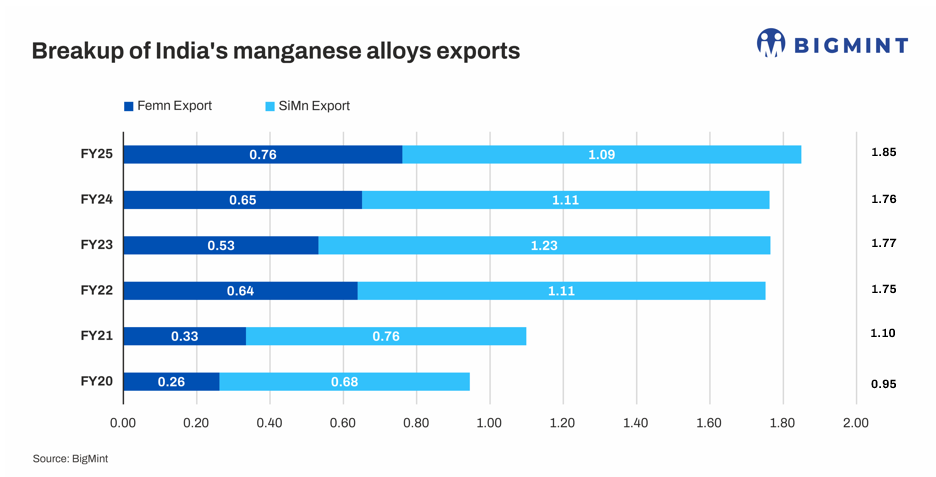
India’s manganese alloys production stood at 4.8 mnt in FY’25, as per data maintained with BigMint. Exports held a share of nearly 40% (1.8 mnt) of India’s manganese alloys production. Notably, India remained the top exporter globally of both silico and ferro manganese in CY’24. India’s exports of silico manganese stood at 1.1 mnt. Ferro manganese exports, however, witnessed an uptick, reaching 0.73 mnt in CY’24.

How will the safeguards impact Indian ferro alloys industry?
- Indian exporters may seek new overseas markets to offset potential impact – With the introduction of safeguard measures and growing trade barriers in traditional markets, Indian ferro alloy producers could face constraints on exports, particularly to the EU. As a result, producers may increasingly look to diversify their export portfolio by targeting higher volumes in alternative markets in Southeast Asia, Egypt and Turkey . However, heightened competition, varying quality specifications, and pricing pressures in these regions could limit immediate absorption, potentially keeping margins under strain in the near term.
- EU share in India’s manganese alloys exports likely to decline – The European Union currently accounts for around 15-20% of India’s total manganese alloys exports, but this share is expected to come under pressure following the implementation of safeguard measures. However, the scope of Indian manganese alloys exports which are not covered under the Tariff rate quota may be subject to threat. For instance, The EU has set the following TRQs for India for the first year: for ferro silico manganese the quota is ~126,800 t. For ferro manganese quota has been set at ~69,900 t.

- EU market prices may see upward impact – Domestic manganese alloys prices in EU are learnt to be witnessing an upward trend since the announcement of safeguards. Market participants in EU are now worried how the shortfall will be covered. Few market sources indicated that domestic silico manganese prices in EU have risen by around 15-20% since early Oct’25.
- Opportunity for value-added and specialty alloy exports: EU safeguards mainly target bulk steel; niche alloy segments remain less affected. This opens a window for Indian producers to shift focus to high-grade, low-carbon, or customized alloy compositions that serve higher-end European applications. Moving up the value chain can help Indian producers remain competitive despite trade restrictions.
Outlook
EU safeguard measures undoubtedly tighten export opportunities for Indian ferro alloy producers, especially in ferro chrome and manganese alloy segments. However, the impact may not be that severe and may be to the extent of 5%.
Leave a Reply