- Stamp charging gains ground as mills seek greater blending flexibility
- Mills shifting to long-term contracts to ensure raw material security
- PHCC to remain central to blends despite growing use of alternative grades
Morning Brief: India’s metallurgical coal demand is expected to rise sharply by FY’30 as steelmakers add blast furnace capacity, but mills are also working to reduce supply risks by diversifying coking coal sources, suppliers, and blend compositions, industry executives said at the BigMint India Ferrous Week 2026, in a panel discussion titled “India’s Coking Coal Landscape: Securing Supply for Steel Growth”.
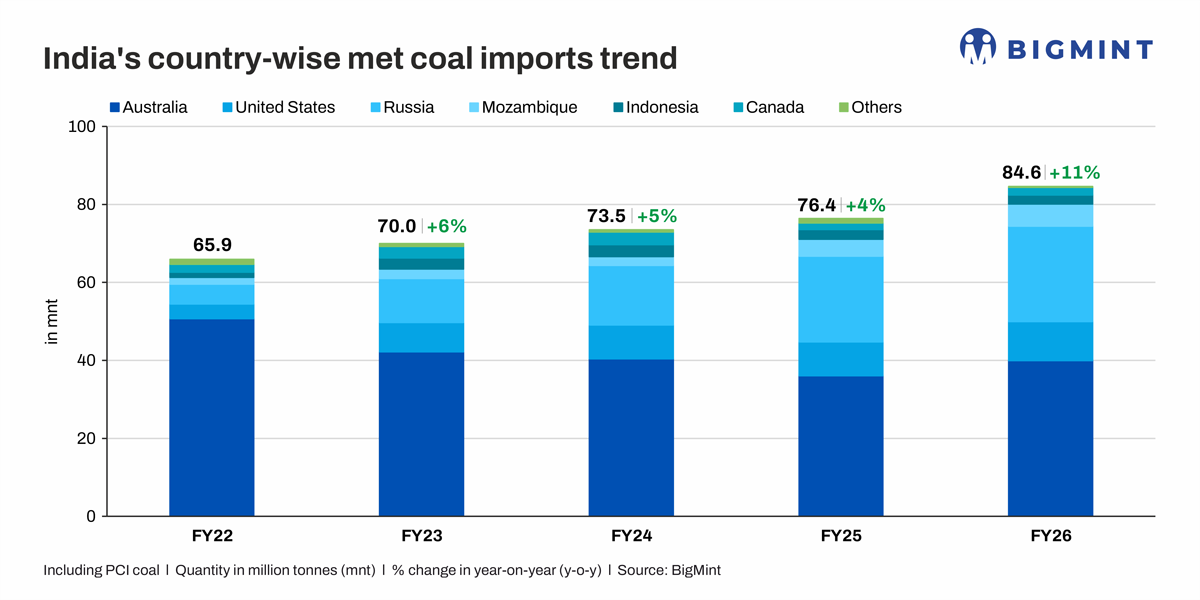
Metallurgical coal demand is projected to increase from around 73 million tonnes (mnt) in FY’26 to 118-120 mnt by FY’30, according to BigMint’s projections. Coking coal is expected to account for about 94 mnt of this demand, while pulverised coal injection (PCI) demand could reach around 24 mnt. The increase will be driven mainly by capacity additions on the blast furnace-basic oxygen furnace (BF-BOF) route, which will raise both coke and coking coal requirements.
Notably, although Australia remains the largest supplier of coking coal, its share of India’s imports has dropped from around 84% to about 75% in FY’26. Russia, Mozambique, the US, and Canada are gaining importance as Indian mills look for alternative sources.
Diversification becomes core procurement strategy
Sanjay Agrawal, Executive Director, SAIL, said Indian steelmakers currently meet more than 80% of their steel-grade coal requirements through imports, making supply diversification critical for managing disruptions. Expanding the geographic sourcing base can reduce exposure to weather, shipping, geopolitical, and other supply disruptions, while adding suppliers within an existing origin can reduce the impact of operational or financial problems at individual mines.
SAIL is also seeking to maximise output from its ICVL asset in Mozambique, which produces PHCC, further supporting its supply diversification strategy.
Rajesh Banwala, Associate Vice President of Raw Material Procurement (Coal and Fluxes), Jindal Steel, said that substitution is increasingly being treated as a technical problem rather than simply a procurement problem. Mills are testing different origins and grades in advance so they have replacement options when a particular coal becomes unavailable.
Notably, Banwala said trials at Jindal Steel have shown that more than 60-70% of the premium hard coking coal (PHCC) component in a blend could be replaced by a high-rank coal.
However, the scope for substitution remains constrained by coke quality and blast furnace requirements. As the effective volume of blast furnaces become bigger, coke quality becomes more important, limiting the ability of mills to make frequent or drastic changes to blends without technical validation.

Prime hard coking coal remains quality anchor
Debasis Panda, Head of Iron Ore & Coal (Steel Making & Energy) Trading at IRH Geo and Tech, said prime-grade coking coal acts as the quality anchor in a blend. Once that base quality is established, mills can add hard coking and semi-soft coals to reduce costs while maintaining the required coke properties.
The need for this quality anchor is particularly important as modern blast furnaces require coke with consistent mechanical and metallurgical properties, with mills closely monitoring parameters such as coke strength after reaction (CSR), coke reactivity index (CRI), M10 (for abrasion resistance), and M40 (measuring mechanical strength and shatter resistance).
Prime-grade coal also has a role beyond its conventional usage. Panda said it can enable the use of biomass and biochar in coke-making as steelmakers move towards lower-carbon blast furnace operations. A stable quality base gives mills more room to introduce alternative carbon-bearing materials and other coal origins without losing control over the final coke quality.

Stamp charging widens coal blending flexibility
The expansion of stamp charging technology is giving Indian coke makers greater flexibility in coal blending. Stamp charging densifies the coal blend before it enters the coke oven, allowing coke makers to use wider range of lower-rank domestic and imported coals.
The technology is also relevant to India’s efforts to increase domestic coking coal consumption. Agrawal said that SAIL is in the process of shifting more coke ovens towards stamp charging, while also increasing the use of domestic coal.
The development is important because the government is targeting higher domestic coking coal production and greater use of washed domestic coal. However, stamp charging does not mean that every type of coal can be added without limits. Each coal has a role within a defined blend, and high-rank coals, semi-soft coals, PCI coal, petroleum coke, and other materials affect oven pressure and coke quality differently.
Panda noted that reactive components in coal can increase oven wall and internal gas pressures, creating a need for inert materials. Petroleum coke, PCI coal, and semi-soft coal can therefore play specific roles in managing the blend.
At the same time, top-charging technology will also remain relevant. While stamp charging offers greater flexibility with lower-rank coals, top-charge batteries can handle higher-pressure coals and can produce coke with high CSR.

Domestic coal availability constraint
Indian steelmakers see significant potential for domestic coking coal, but supply consistency and beneficiation capacity remain key constraints.
Sanjay Agrawal said SAIL is ramping up output from its captive coking coal mines and is also working with more washeries to increase the availability of beneficiated coal. Rajesh Banwala also said trials of domestic coking coal have shown that it can replace imported material across different categories. However, the availability of suitable washed coal is not yet consistent enough to support a significant increase in consumption.
The issue therefore is increasingly shifting from whether Indian coal can technically be used to whether enough consistent-quality material can be supplied. If domestic mining and washing capacity expands as planned, the impact on imports could become more meaningful, particularly for grades that can be substituted without affecting coke quality.
Long-term contracts gain importance as steel capacity expands
The expansion of India’s steel industry is also changing procurement strategies, with mills increasingly favouring long-term supply arrangements over spot purchases for key coal grades.
Banwala said Jindal Steel has shifted a significant part of its procurement towards long-term contracts because consistent coal quality is essential for coke oven and blast furnace operations. Mills cannot easily change coal qualities without carrying out technical trials and adjusting their blends.
At the same time, steelmakers are conducting trials of alternative coals so that individual grades can be replaced when supplies are disrupted. This creates a two-layer procurement strategy: secure critical grades through longer-term relationships, while maintaining technical flexibility to substitute other coals when required.
US suppliers gain traction, Colombia remains niche option
Indian steelmakers are also deepening engagement with US coal suppliers as part of their diversification strategies.
Agrawal said SAIL has long-term relationships with several US suppliers and is seeking to increase purchases from their portfolios. It is also evaluating new US suppliers following government-facilitated discussions on specifications and commercial requirements.
Interest from Colombia is also increasing, although its potential remains limited compared with larger suppliers. Colombian coking coal exports to India are currently small because much of the country’s production is consumed by domestic coke makers.
PCI will provide another avenue for reducing coke consumption. The panel estimated typical PCI injection rates at around 180-220 kg per tonne of hot metal, with some advanced blast furnaces reaching around 225-230 kg/t, although actual rates depend on furnace design and operating conditions.
Higher PCI rates can reduce coke consumption and therefore lower the requirement for PHCC. However, PCI cannot replace coke completely because coke continues to provide the permeability and mechanical support required inside the blast furnace.
Outlook
India’s metallurgical coal demand is projected to rise by roughly 45-47 mnt, or more than 60%, from 73 mnt in FY’26 to 118-120 mnt by FY’30 as BF-BOF capacity expands. Imports will remain central, but the supplier mix is likely to broaden, with Russia, Mozambique, the US, Canada, and domestic coal gaining importance alongside Australia.
However, PHCC demand may not rise at the same pace as total consumption. Stamp charging, wider blending, domestic beneficiation, and higher PCI use could reduce PHCC intensity per tonne of coke, even as prime-grade coking coal remains the quality anchor needed to maintain coke performance and accommodate alternative grades.
Leave a Reply