- Grid stayed stable amid demand and hydro decline
- Coal sustained the system’s reliability
As the last vestiges of the monsoon gave way to the crisp air of approaching winter, India’s power grid began its annual, intricate dance. Over the four weeks from 20 October to 16 November, 2025, the nation’s electricity landscape underwent a silent but significant transformation. Data from the National Load Despatch Centre (NLDC) reveals a tale not of crisis, but of a system in managed transition: peak demand is softening, renewable sources are holding steady, and the mighty rivers are yielding less power. Through it all, one constant remains – the relentless, dependable hum of India’s coal-fired power plants.
Demand arc: From post-monsoon peak to winter plateau
The period began with a final, powerful surge. The week of October 20-26 saw the grid strain under a peak demand of 189,660 MW, one of the highest for the season. This was the culmination of the post-monsoon surge – a period where agricultural pumps ran relentlessly, factories ramped up production after the rains, and residual humidity kept air conditioners humming, particularly in the industrial heartlands of the West and North.
“The demand profile in late October is a complex interplay of multiple factors,” explains a grid operations manager who requested anonymity. “You have the tail-end of the Kharif season’s irrigation demand, a rebound in industrial activity, and the last gasp of cooling load. Managing this requires meticulous planning.”
By the first week of November, a subtle shift was detectable. While a mid-week peak of 188,355 MW on November 6 showed the system’s residual stress, the lowest daily demand that week – a 169,116 MW on a Sunday – revealed the emerging trend. The arc of decline became unmistakable in the week of November 10-16, with peak demand settling at 187,863 MW before dipping to 171,191 MW by week’s end. This represented a net decline of 1.9% over the four-week period.
“The softening is classic for this time of year,” says Dr. Anjali Mehta, an energy analyst. “Cooler temperatures across North and Western India dramatically reduce the cooling load. Furthermore, there’s often a temporary moderation in manufacturing activity following the Diwali festivities, which contributes to the easing of weekday peaks.”
Shifting generation mix: A story of substitution
Beneath the surface of this stable demand curve, a dramatic reshuffling of power sources was underway. The most striking change was the precipitous decline of hydropower.
- Hydro’s retreat: Hydroelectric generation, a vital and flexible resource, began the period at a robust 469-481 MU per day. By November 16, it had plummeted to just 299 MU—a staggering 36% decline. This was driven by the natural drawdown of reservoirs after the monsoon inflows receded, particularly in the northern states of Himachal Pradesh and Uttarakhand.
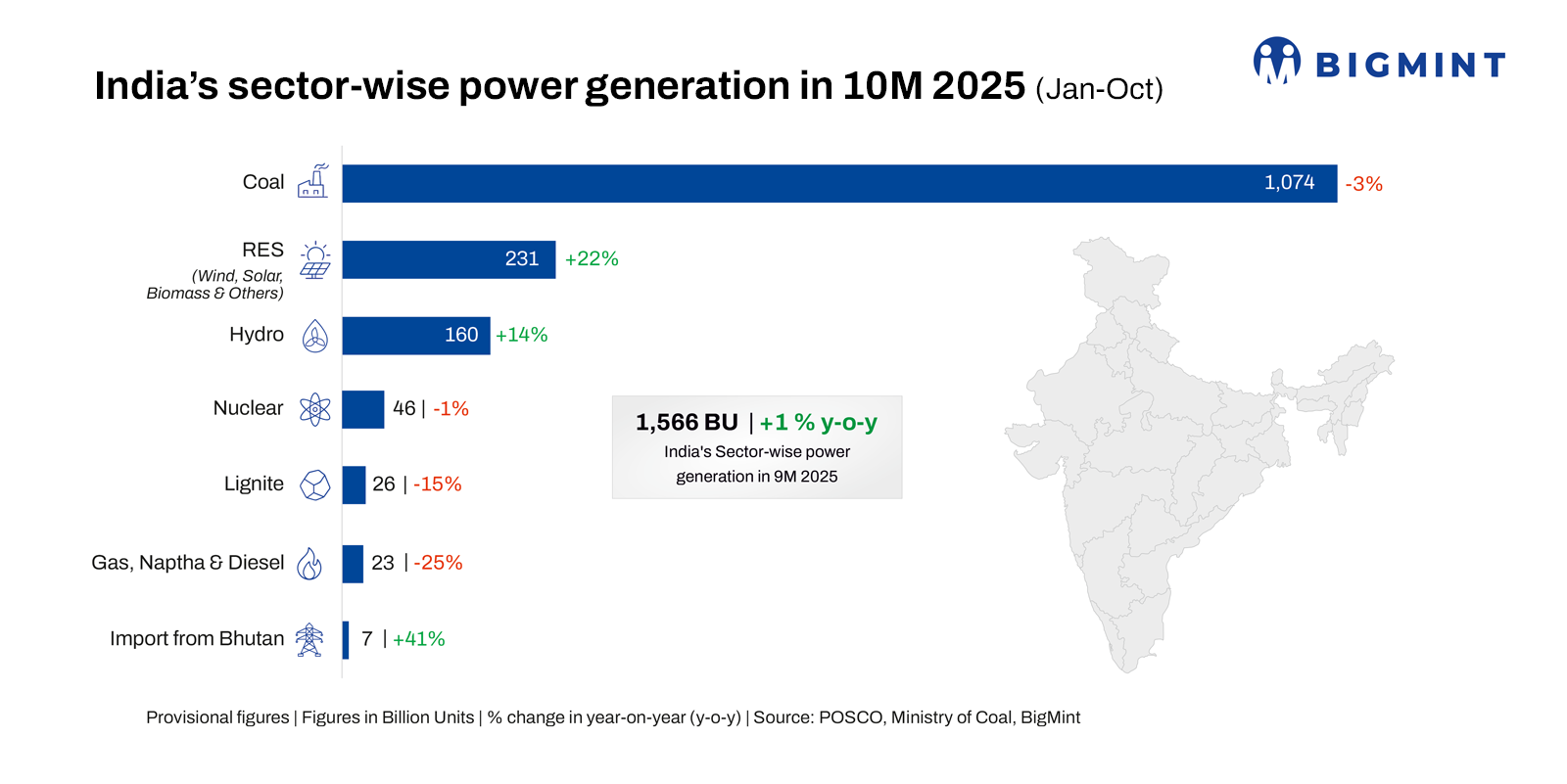
- Coal’s unflinching role: As hydro’s contribution waned, coal-fired generation stepped in to fill the void. Its share in the daily generation mix actually increased, from 73% in late October to 76% by mid-November. In absolute terms, coal output remained remarkably stable, churning out between 2,900 and 3,100 MU per day.
“This is the reality of our grid,” states a senior official from the Central Electricity Authority. “Hydro is our battery, but it’s a seasonal one. When it depletes, the entire baseload burden falls on coal. The stability of the frequency around 50 Hz tells you that the thermal fleet is performing this balancing role admirably.” - Renewables: A Steady, But Limited, Hand: Solar and wind generation held their ground, contributing a consistent 450-550 MU per day, or about 12-14% of the total mix. Solar peaks, particularly in the sun-drenched states of Gujarat and Rajasthan, provided crucial relief during midday hours, while wind generation in coastal Tamil Nadu and Karnataka, though weakening seasonally, offered a steadying influence.
Regional Dynamics: A Nation in balance
The national story is, in fact, a mosaic of regional narratives:
- The western anchor: The Western Region, led by the industrial powerhouses of Maharashtra and Gujarat, remained the nation’s economic engine, consistently accounting for nearly 40% of the national load. Their demand profile showed the least volatility, underpinned by a strong industrial base.
- The Cooling North: The Northern Region, including states like Uttar Pradesh and Rajasthan, exhibited the most pronounced demand softening as the sweltering heat gave way to pleasant autumn, sharply reducing household electricity consumption for cooling.
- The Inter-Dependent South: The Southern Region, particularly Tamil Nadu and Karnataka, navigated the decline in its own hydro output by leaning heavily on inter-regional power transfers. The robust transmission corridors from the coal-rich East and West ensured that the region’s own industrial demand, which remained resilient, was met without interruption.
Grid resilience: The unsung success
Perhaps the most telling metric of this period was the grid’s stability. Despite the significant shift in the generation mix and a 36% drop in a key flexible resource like hydro, the grid frequency remained within the ideal band of 49.9–50.05 Hz for over 80% of the time. This remarkable stability, with no reported shortages, underscores a system that has matured in its management.
“The real success story here is the seamless coordination of inter-regional power flows,” explains the grid operations manager. “When hydro in the South dips, we ramp up generation in the pithead plants of Odisha and Jharkhand and send the power thousands of kilometers. The system is behaving exactly as it was designed to.”
Outlook: A quiet winter of content for coal
As India looks ahead to the heart of winter, the trend is set to continue. Demand is expected to plateau or soften further, with northern states potentially seeing a slight uptick in heating load, though this is negligible compared to the summer cooling demand.
The data from this four-week transition paints a clear picture for the foreseeable future: renewables will provide a crucial, growing, but variable share; hydro will remain in its seasonal trough until next monsoon. In this equation, coal’s role as the bedrock of India’s energy security remains unchallenged. It is the shock absorber that allows the grid to navigate the ebb and flow of nature’s bounty, ensuring that even as the seasons turn, the lights stay on.
Leave a Reply