- Consumption remains broadly stable, scrap-based crude steel output rises 2% y-o-y
- Vietnam, Bangladesh, Pakistan, Thailand drive Asian import growth as India retreats
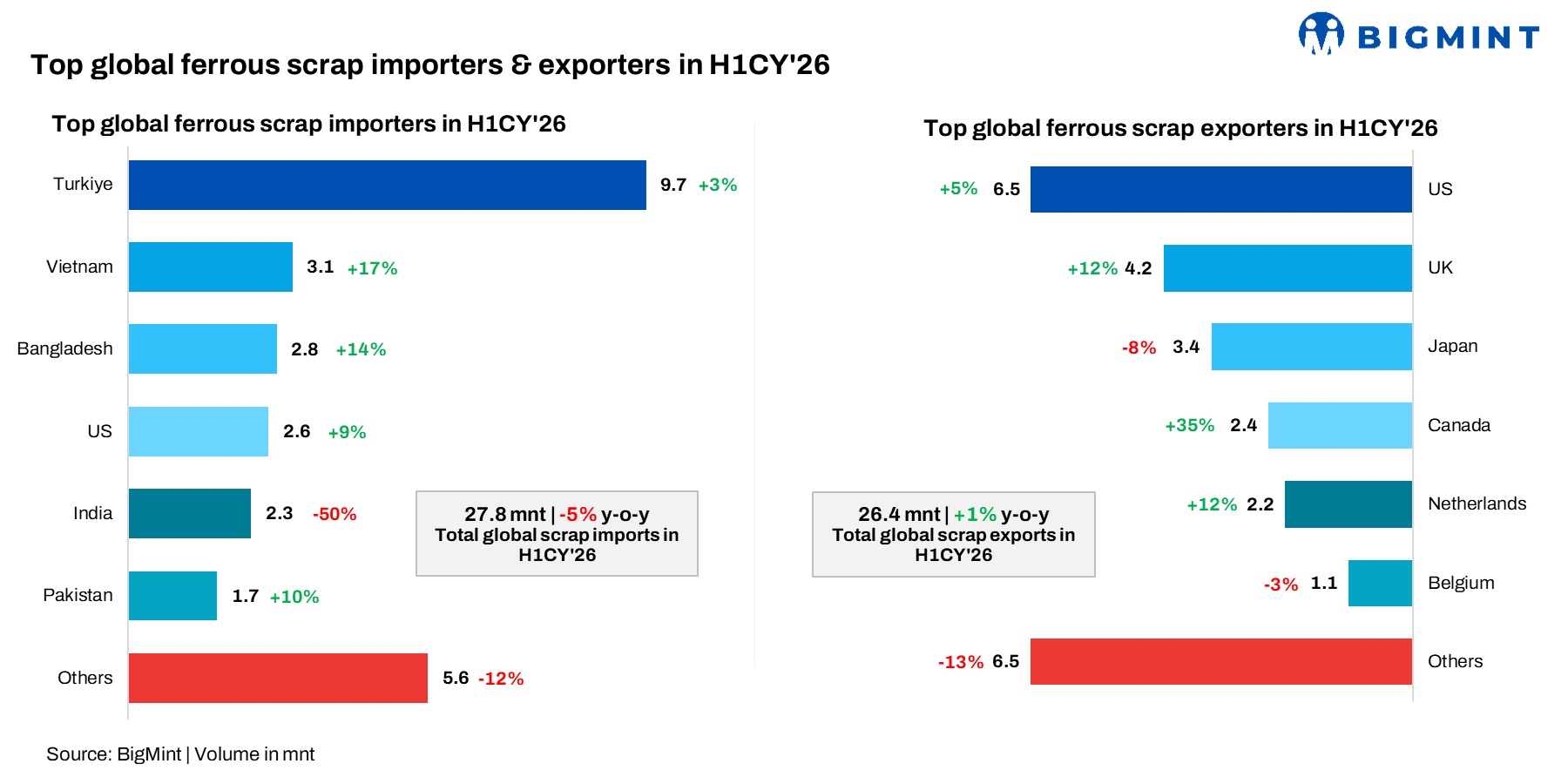
Data Deep Dive: Global ferrous scrap imports (excluding intra-EU trade) across major markets declined 5% y-o-y to 27.8 million tonnes (mnt) in H1CY’26 from 29.3 mnt in H1CY’25, according to BigMint data. The decline was largely driven by geopolitical disruptions, which led to a sharp 49% reduction in India’s imports, while higher purchases by Vietnam, Bangladesh, Pakistan, and Thailand partly offset the fall. India and Taiwan were the only major markets to record lower imports during the period.
The decline in seaborne trade, however, does not point to a broad-based fall in scrap demand. Consumption in major regions remained largely stable at 292 mnt in H1CY’26 compared to 294 mnt in H1CY’25, with declines in China, Russia, Brazil, and Taiwan balanced by robust growth in India, the US, and Vietnam. More importantly, scrap continued to gain share in the global steelmaking mix even as overall steel output declined.
Global steel metallic mix shifts towards scrap in H1CY’26
Global crude steel production declined marginally by 1% in H1CY’26, with output from the major producing countries and other markets totalling around 932 mnt compared with 938 mnt a year earlier. The global steelmaking mix, however, continued to shift towards scrap.
Crude steel production through scrap increased 2% y-o-y to 299 mnt from 293 mnt, driven by markets with expanding or higher-utilisation EAF capacity such as Southeast Asia. Meanwhile, hot metal production declined 1% to 580 mnt and DRI-based production fell 7% to 52 mnt. Scrap, therefore, accounted for around 32% of global crude steel production during H1CY’26.

Evidently, even as steelmakers consumed more scrap, a growing share of this demand was met through domestic supply and, in some markets, alternative metallics such as DRI rather than imports. Higher delivered costs for seaborne material during H1CY’26 further reinforced this shift, particularly in import-dependent markets.
Global scrap trade weakens as geopolitical disruptions lift delivered costs
Scrap trade flows were disrupted during H1CY’26 as the Middle East conflict pushed up freight and insurance costs. This raised replacement costs for buyers, particularly in import-dependent markets, and further reduced the competitiveness of seaborne material against domestic alternatives. For example, in benchmark Turkiye, prices of HMS (80:20) increased by 11% y-o-y to $391/tonne (t) CFR Iskenderun.
Currency movements also weakened the competitiveness of imported scrap against domestic metallics. In India, US-origin shredded scrap prices remained broadly stable y-o-y at $374/t, but the rupee’s depreciation increased the landed cost of imports, reducing the attractiveness of imports.
China’s continued steel export activity (despite a 6% drop) also remained an indirect pressure on global scrap demand, as lower-cost finished and semi-finished steel exports reduced the incentive for overseas mills to maximise scrap-based production.

Turkish imports rise 3% despite 8% growth in crude steel output
Even as Turkiye remained the world’s largest ferrous scrap importer during H1CY’26, a sharp rise in domestic scrap generation allowed Turkiye’s mills to contain import growth despite higher steel production.
Imports increased by only 3% y-o-y to 9.68 mnt from 9.38 mnt, far slower than the 8% uptick in the country’s crude steel production to 19.8 mnt from 18.3 mnt.
The slower growth in imports was largely due to stronger domestic scrap availability. Scrap consumption increased 4% to 15.4 mnt, while domestic scrap generation rose sharply by 32% to 7.3 mnt. This allowed mills to meet a larger share of their requirements locally, limiting import growth amid higher freight costs, elevated scrap prices, and narrow rebar margins.
Despite higher domestic generation, imported scrap remained essential for Turkiye’s EAF-based steel industry. Moreover, mills also continued to balance scrap purchases against billet and semi-finished steel economics, particularly when finished steel margins weakened.
India loses global import share as domestic scrap generation improves
India, the second-largest importer in H1CY’25, saw imports fall 49% to 2.32 mnt in H1CY’26 from 4.58 mnt, pushing it down to fifth place. The decline came despite a 7% increase in crude steel production to 87 mnt, highlighting the extent to which mills shifted away from imported material.
Mills turned to cheaper domestic alternatives amid unfavourable import economics, with domestic scrap generation increasing 38% to 20.1 mnt. Consequently, scrap consumption increased 17% to 22.4 mnt from 19.2 mnt even as imports declined sharply.

In H1CY’26, imported scrap accounted for only around 10% of India’s total scrap consumption, compared with nearly 24% in H1CY’25. Domestic generation covered almost 90% of consumption during H1CY’26.
Improved collection and processing of industrial scrap, fabrication waste, machinery replacement, infrastructure demolition and end-of-life vehicle scrap strengthened domestic availability.
DRI also provided mills with an alternative to imported scrap. Despite stronger domestic scrap availability, scrap prices increased y-o-y, tracking higher gas prices and a stronger steel market. DRI prices, however, rose relatively slowly, improving their competitiveness against scrap and encouraging secondary steelmakers to increase its share in the metallic mix to optimise costs.
Asian markets emerge as key growth centres
Unlike India, several Asian markets continued to face structural shortages of domestically generated obsolete scrap, keeping overseas procurement important for steel production. Asian markets collectively increased scrap purchases by around 1 mnt y-o-y, cushioning the impact of India’s decline on overall regional trade.
Vietnam’s imports increased 17% y-o-y to 3.07 mnt, driven by a strong 27% growth in crude steel production to 15.2 mnt. Domestic scrap generation also increased 36% to 3.9 mnt, but this was insufficient to meet domestic requirements. Vietnam’s scrap consumption rose 27% to 7.0 mnt in H1CY’26.
Bangladesh increased imports 14% to 2.78 mnt amid lower domestic scrap availability from ship recycling. Ship breaking tonnage declined 21% y-o-y to around 392,000 LDT from 498,000 LDT in H1CY’25. At the same time, Bangladesh’s crude steel production increased by around 10% y-o-y to an estimated 2.8-3 mnt in H1CY’26. However, the increase in imports remained moderate as steel mills continued operating at only around 50-55% capacity utilisation amid weak construction demand, high production costs, financing constraints, and power shortages.
Meanwhile, Pakistan’s imports rose 10% y-o-y to 1.67 mnt even as the country’s crude steel production fell a sharp 31% y-o-y to 1.3 mnt. The divergence reflects the industry’s continued dependence on imported metallics, even as weak downstream demand, high energy and financing costs, and low mill utilisation constrained steelmaking activity and limited the pace of procurement.
Thailand recorded the fastest growth among the major listed Asian importers, with purchases increasing 35% to 1.40 mnt. This was supported by robust domestic demand, government measures to stimulate consumption and capital investment, and stronger industrial raw-material requirements.
US scrap imports strengthen on higher domestic consumption
The US recorded increases across generation, imports, and consumption during H1CY’26.
Domestic scrap generation increased 9% y-o-y to 35.2 mnt, while scrap consumption increased 11% to 31.5 mnt. Imports also rose 8% to 2.62 mnt, while exports increased 2% to 6.3 mnt.
The stronger growth in imports alongside domestic consumption points to continued demand for imported material despite higher domestic scrap availability, particularly as EAF-based steelmaking remained firm. At the same time, the US continued to maintain a sizeable export flow, making it an important source of seaborne scrap for overseas markets.
Global export flows realign
Global non-EU ferrous scrap exports remained broadly stable at 26.4 mnt in H1CY’26 versus 26.1 mnt a year earlier.
Despite higher domestic demand, the US remained the world’s largest individual exporter in the supplied trade flow data, with exports increasing to 6.5 mnt from 6.2 mnt. The US was followed by the UK at 4.2 mnt (+11%), while Japan’s exports declined 8% to 3.4 mnt.
UK exports increased to Turkiye and Egypt, whereas Japan redirected part of its exports from Vietnam to Bangladesh, highlighting exporters’ growing focus on stronger netbacks and changing regional demand.
Europe remains key supplier but structural changes emerge
The European Union remained a major source of globally traded scrap. EU-27 scrap generation increased 1% y-o-y to 46.3 mnt, while consumption increased 2% to 40 mnt. The region’s crude steel production inched down by 0.3% to 65.4 mnt.
Nonetheless, the EU’s scrap imports rose 4% to 16.1 mnt, while exports increased 2% to 22.4 mnt.
Europe’s export surplus remains substantial, but the region’s transition towards EAF-based steelmaking is expected to gradually increase domestic scrap requirements. Higher domestic consumption, tighter environmental regulations, and potential export restrictions could reduce the volume available to overseas buyers over the medium term.
Global consumption may remain stable despite risks tilted to downside
BigMint expects global scrap consumption to remain stable y-o-y during H2CY’26, supported by expanding EAF-based steelmaking, although growth will remain uneven across regions.
We expect Turkiye to sustain strong demand due to its structural reliance on imported scrap, while Vietnam, Bangladesh, Pakistan and Thailand should remain the key growth markets as steel production expands and domestic scrap availability remains limited.
In contrast, China’s recovery is likely to depend on steel production and downstream demand, while the US and Europe should continue supporting consumption through stable EAF production.

A key trend in H2 will be the widening disconnect between scrap consumption and seaborne trade. Higher scrap utilisation will not necessarily translate into stronger imports, as improving domestic collection and greater use of alternative metallics enable mills to source more raw materials locally.
Weak finished steel demand remains the primary risk to global scrap consumption during H2CY’26. Other risks include continued Chinese steel exports, lower crude steel production, higher freight costs, geopolitical disruptions, currency volatility, and tighter environmental or export regulations.
For importing countries, a sharp increase in landed prices and domestic scrap availability could further reduce overseas procurement. India provides the clearest example, with imports falling 49% even as crude steel production increased 7%.
On the supply side, any sudden export restrictions or shipping disruptions could tighten availability and generate regional price spikes.
Outlook
BigMint expects global ferrous scrap trade to remain broadly stable during H2CY’26, with the y-o-y decline narrowing as global trade recovers following a de-escalation in the Middle East.
However, trade will remain uneven across regions. Turkiye is likely to remain the largest importer, while Vietnam, Bangladesh, Pakistan and Thailand are set to account for much of the incremental import demand.
India is expected to remain the biggest constraint on global seaborne trade as higher domestic scrap generation and metallic optimisation reduce import requirements despite rising steel production.
On the supply side, we expect the US, UK and Europe to remain the dominant exporters, although stronger domestic EAF demand and evolving regulations could gradually tighten export availability.
Leave a Reply