- Japan Kanto tender rises; Tokyo Steel hikes bids amid tighter supply
- India sees selective imports; prices firm despite cautious mill buying
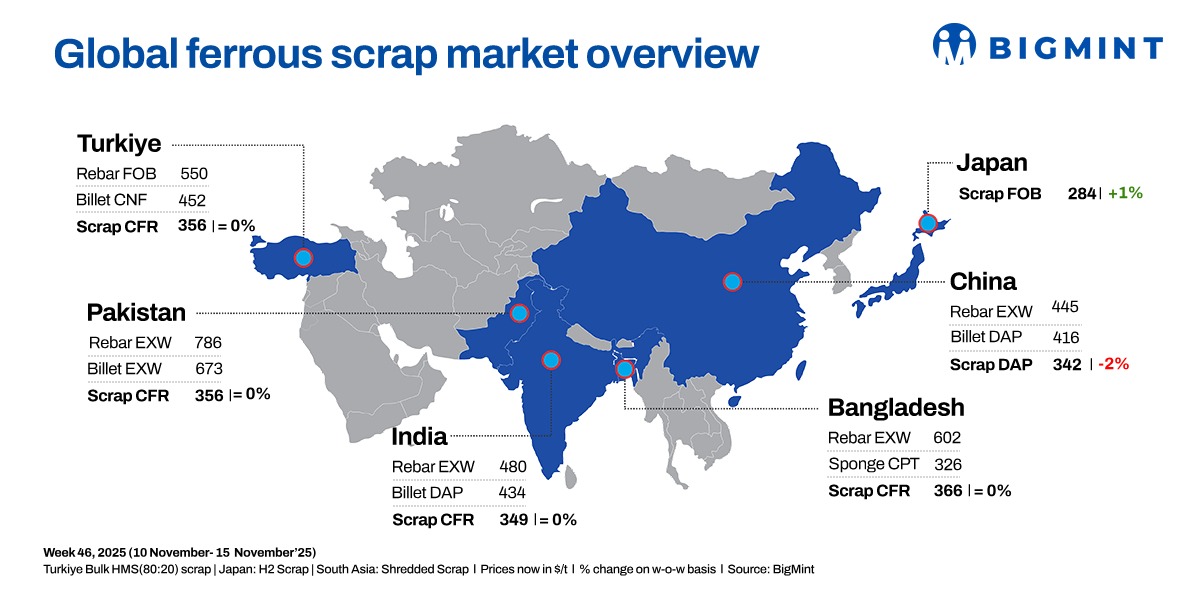
Global ferrous scrap markets showed a mixed tone this week, with Turkiye posting mild gains on tighter winter collection, while South Asian markets saw mostly range-bound pricing amid fragile steel demand. Japan strengthened on the back of a firmer Kanto tender and higher Tokyo Steel bids, whereas the UAE softened due to oversupply. India remained active with selective buying, but Pakistan and Bangladesh continued to face weak fundamentals and cautious mill procurement.
Turkiye: Deep-sea imported scrap prices firmed up w-o-w, with US-origin HMS 80:20 trading at $355-358/t CFR and shredded near $376/t CFR. European sellers targeted $355/t, while US exporters aimed closer to $360/t amid tightening winter collection. Despite firmer scrap activity, mills remained cautious as both domestic and export rebar demand remained weak. Rebar offers inched up to $555-560/t FOB, but softer bids led to uncertainty regarding the sustainability of the current momentum.
India: The Indian imported scrap market saw moderate activity, driven mainly by selective buying from east and west coast mills. Two major bookings emerged — an Australian lot at $347-348/t CFR and a UK-origin parcel at $315/t CFR.
Shredded scrap offers were held at $350-354/t CFR, while HMS 80:20 was quoted at $320-325/t, though workable bids were $5-8/t lower. Mozambique HMS 1% was offered at $330/t against $325 bids, Poland HMS at $325/t, and Ireland-origin turning (3% impurities) at $310/t against $295 bids. Shredded remained unappealing, with buyers targeting sub-$350 levels. Domestic finished steel prices remained range-bound, keeping mills cautious.
Roughly 26,000 t were booked in total, comprising about 15,000 t of HMS 80:20 at $315-353/t and 10,000 t of shredded at $347-353/t, with the remainder in HMS 60:40, PNS, and NTP, all on a CFR Chennai, Mundra, Pipavav, and Vizag basis.
Pakistan: Imported shredded scrap edged up to $355-356/t CFR Qasim, with European/UK cargoes at $355-358/t and some trades at $356/t. UAE offers stayed higher at $370/t. Buying improved slightly, but steel markets remained weak, keeping mills cautious despite quick-delivery bookings from the Middle East.
Rebar traded near PKR 220,000/t ($783/t), billet around PKR 190,000/t ($677/t), and local scrap at PKR 135,000-140,000/t ($481-499/t), while mills operated at 35-40% utilisation with no clear recovery yet.
Bangladesh: Imported scrap prices were largely range-bound, with a recent Australian HMS bulk sold at $340-345/t CFR Chattogram, setting $345/t as the workable level. About 3,000 t of Malaysian busheling was traded at $370/t. US HMS 80:20 was heard at $348-352/t and Japanese H2 at $340-342/t. Market sentiment remained weak amid liquidity constraints and slow construction activity, while mills cut rebar prices by BDT 1,200/t ($10/t) due to soft demand and delayed bulk arrivals.
Japan: The Japanese scrap market strengthened this week, with the November Kanto tender rising JPY 644/t to JPY 44,960/t ($291/t) FAS, the highest since January, amid tight supply and a weaker JPY. Tokyo Steel lifted H2 purchase prices by JPY 500/t to JPY 43,000-44,000/t ($279-285/t), supporting firmer sentiment. Export offers held at $330-335/t, against Vietnamese bids of $320-324/t, with selective buying from South Korea and Bangladesh keeping activity steady.
UAE: The UAE scrap market softened this week, with BigMint’s processed HMS index slipping AED 10/t ($3/t) to AED 1,150/t ($313/t) amid oversupply and paused mill buying. Abu Dhabi suppliers trimmed offers, while export prices held slightly firmer on higher collection costs. Need-based bookings by Pakistani mills offered limited support, but overall sentiment remained weak as domestic demand stayed muted.
China’s Shagang Steel cut scrap purchase prices by RMB 30/t ($4/t) on 12 November, its second reduction this month, bringing HMS (6-10 mm) to RMB 2,430/t ($341/t).
Speaking at an industry conference, a senior CISRI official outlined China’s shift toward scrap-based steelmaking, with EAFs — now accounting for under 10% of output — projected to reach 28% by 2035 and 56% by 2045. Crude steel output is expected to fall to 922-948 mnt by 2030 and 6160-731 mnt by 2060.
Leave a Reply