- Consumption projected to rise on higher Nigerian demand
- Trade volumes may grow as US, Myanmar exports increase
Global rice production for 2025-26 is projected at a record 541.46 million tonnes (mnt) (milled basis), virtually unchanged from last month’s forecast by the United States Department of Agriculture (USDA). Meanwhile, consumption edged higher to 541.97 mnt, driven primarily by upward revisions for Nigeria. Ending stocks are now forecast at 186.70 mnt, a reduction from July estimates, with the largest cuts occurring in Nigeria, the Philippines, and Myanmar.
Production estimates for 2024-25 revised lower
For 2024-25, global production was revised lower to 523.84 mnt due mainly to a smaller Indonesian crop. Consumption and stocks were also adjusted downward, reflecting tighter supplies in key markets.
Trade volumes expected to rise in 2025-26
World rice trade in 2025-26 is forecast to rise to 62.04 mnt, with Myanmar’s exports increasing by 200,000 tonnes (t) to 1.8 mnt on strong demand from core markets and competitive prices.
US exports are also expected to climb by 100,000 t to 3.1 mnt, supported by a larger crop and firm sales to medium-grain destinations.
On the import side, changes are relatively limited, though Kenya, the European Union (EU), and Indonesia are expected to see modest gains. The Philippines, by contrast, has temporarily reduced imports following a 60-day ban.
Higher Southeast Asian exports to boost 2024-25 trade volumes
Trade is expected to witness an uptick in 2024-25 too, with Myanmar’s shipments up 300,000 t, Vietnam’s up 300,000 t, and Thailand’s up 200,000 t robust sales to Africa, China, Iraq, and the United States. Import increases were noted for Bangladesh, Kenya, the EU, and Indonesia, while declines were recorded for Benin, Côte d’Ivoire, and the Philippines.
Rice prices fluctuate worldwide
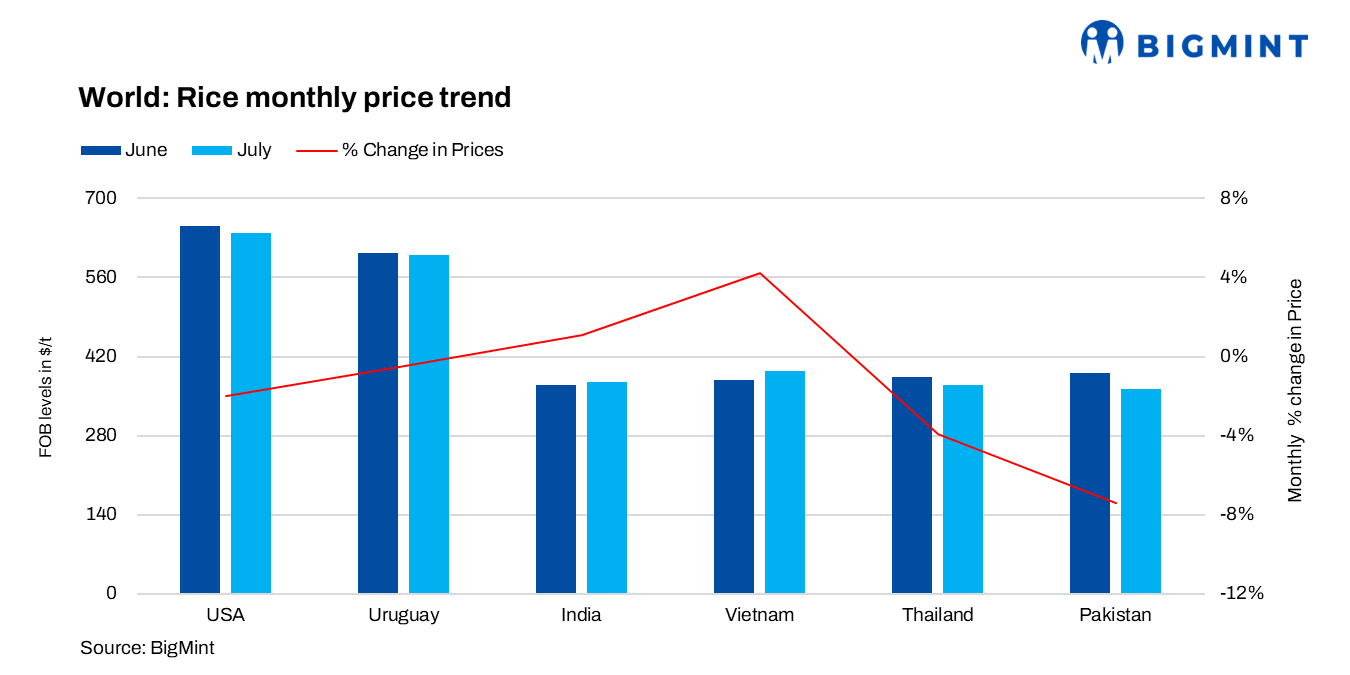
International rice prices have shown mixed trends since the July report from the World Agricultural Supply and Demand Estimates (WASDE). US 4% broken white rice fell $13/t to $639/t amid slowing sales to Latin America, while Uruguay’s tags eased $3/t to $500/t on sluggish demand.
In Asia, Indian quotes rose $4/t to $374/t on strong interest from Bangladesh, and Vietnamese prices jumped $16/t to $394/t following large sales to the Philippines and Africa. Thailand cut prices by $15/t to $369/t to stimulate demand, while Pakistan’s tags tumbled $29/t to $362 on weak African interest.
Iraq’s rice imports pick up on supply-demand gap
A key market development this year is Iraq’s accelerating import demand. Iraq is now the sixth-largest rice importer in the world, sourcing primarily from Thailand, India, and the US.
For 2024-25, Iraq’s rice imports are on track to reach a record 2.225 mnt, 10% higher than last year’s January-June shipments. This growth reflects a combination of a rapid population increase, expanded government distribution programmes, and limited domestic production due to water scarcity. Domestic production in Iraq is forecast at just 225,000 t in 2025-26, less than 10% of the country’s growing consumption needs.
Thailand has become Iraq’s second-largest supplier overall and is its top source for regular white rice, while India remains a dominant basmati supplier. The US has strengthened its position as Iraq’s second-largest long-grain milled supplier, with exports through June reaching their highest level in five years, supported by a memorandum of understanding for annual purchases of 200,000 t.
Leave a Reply