- Indonesia plans major cuts to 2026 mining quotas
- PT Vale mine disruptions add short-term supply uncertainty
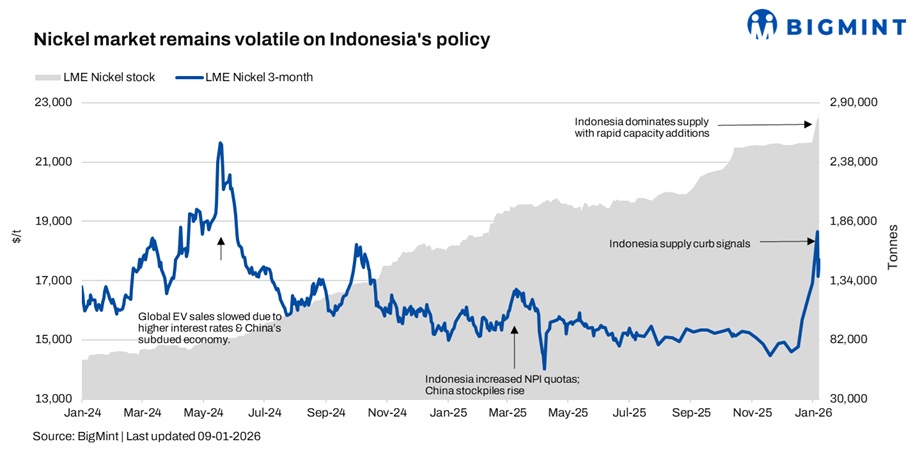
LME nickel prices averaged $17,800/t in the week ended 9 January, rising 5.2% w-o-w from $16,915/t, supported by supply-side uncertainty. Meanwhile, LME-monitored inventories rose 11.5% to 284,790 t, limiting upside momentum as ample stocks continue to cap sustained rallies.
Market updates
Indonesia policy adds supply risk
Indonesia’s annual RKAB mining quota regime remains the key market driver. The government plans to cut nickel ore mining quotas by around 34% in 2026, shifting from three-year approvals to annual permits to better manage oversupply and protect state revenues. Temporary output curbs at PT Vale Indonesia’s Pomalaa and Bahodopi mines, due to delayed 2026 approvals, have added near-term supply risk, although growing global inventories continue to soften the impact.
EU scrutiny clouds global supply outlook
Adding to uncertainty, the European Commission has launched a Phase-II investigation into Anglo American’s proposed $500 million sale of its nickel business to China-backed MMG, citing risks to Europe’s ferronickel supply security for the stainless steel industry. The final ruling, due by 20 March 2026, could influence future trade flows and investment sentiment.
Structural demand outlook remains supportive
Despite short-term volatility, the global nickel market remains on a firm long-term footing. The market is expected to grow from $33.6 billion in 2022 to $47.2 billion by 2031, at a 5.5% CAGR, driven by electric vehicles, energy storage, and stainless steel. Major producers including Glencore, Vale, Anglo American, BHP, Norilsk Nickel and Jinchuan are expanding mining, refining and recycling capacity, while the US and Japan are ramping up investments to secure domestic and long-term nickel supply chains for battery manufacturing.
Outlook
Nickel fundamentals remain supported by structural energy-transition demand, but near-term prices will continue to be driven by Indonesia’s quota policies, regulatory risks in Europe, and inventory trends, keeping the market volatile through 2026.
Leave a Reply