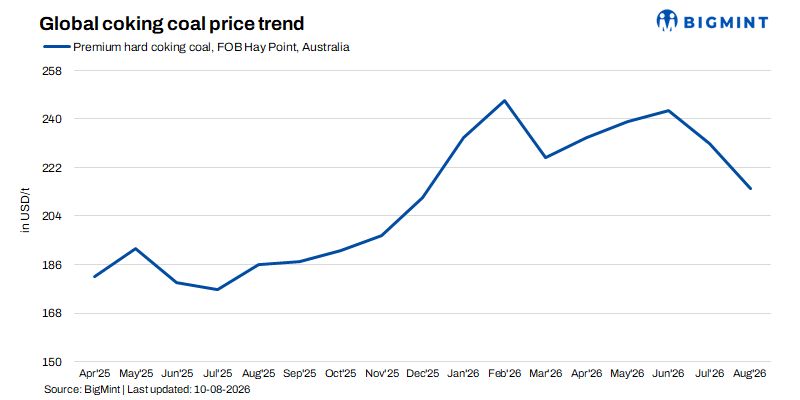
- Premium coal supported by temporary supply disruptions
- Weak steel margins continue to cap upside
The global metallurgical coal market remained balanced between tightening supply of premium raw materials and subdued downstream steel demand during the week ended 8 August. Weather-related disruptions in China’s key coking coal producing region, improving Chinese buying interest for premium Australian hard coking coal and firmer futures sentiment provided support to seaborne coking coal prices. However, weak steel profitability, lower pig iron production and further coke price cuts in China continued to restrain the broader metallurgical complex.
Heavy rainfall disrupts premium coking coal supply in China
The most significant supply-side development came from China’s Shanxi province, where heavy rainfall caused power outages that temporarily halted operations at seven coking coal mines in Liulin county.
The affected mines represent approximately 10.35 Mtpa of production capacity, or roughly one-quarter of Liulin’s raw coal production capacity. Although the disruption is expected to last only a few days, Liulin occupies a strategically important position within China’s metallurgical coal industry as one of the country’s largest production centres for premium low-ash, low-sulphur primary coking coal.
Based on the expected duration of the outage, the production loss is estimated at around 100,000 tonnes, relatively modest in the context of China’s overall coal industry but significant enough to tighten availability of premium-quality material. The market currently expects operations to resume once power supply is restored, limiting the likelihood of any lasting impact on overall supply-demand fundamentals.
Chinese demand supports premium Australian coking coal
Australian premium hard coking coal received modest support during the week as Chinese buyers returned selectively to the market.
Higher-priced transactions for premium low-volatility cargoes highlighted continued demand for higher-CSR coals used by blast furnace operators seeking improved coke quality and furnace productivity. Premium brands widened their price premium over benchmark hard coking coal grades, reinforcing the market’s preference for higher-quality material.
In contrast, premium mid-volatility coals remained relatively well supplied, with traders continuing to report abundant availability of several Australian brands. The result has been increasing quality differentiation rather than a broad-based recovery across the metallurgical coal market.

Chinese coke market remains under pressure
While premium coking coal sentiment improved, downstream coke markets continued to face headwinds.
Major Chinese steel mills initiated a third round of coke price reductions, reflecting continued pressure from weak steel profitability, lower pig iron production and maintenance-related output cuts. Although mine safety inspections and temporary supply disruptions have tightened coking coal availability in certain regions, steelmakers have remained cautious in procuring additional raw materials.
Coke producers continue to face squeezed margins. Some have reduced operating rates, yet elevated inventories and subdued downstream demand continue to limit pricing power across the Chinese coke market.
Indian met coke market remains comparatively resilient
India continued to display stronger fundamentals than China.
Domestic blast furnace-grade coke prices remained broadly stable during the week, supported by firm production costs, restricted spot availability and the recently implemented anti-dumping duties on imports from selected countries. Eastern Indian prices increased marginally, while western Indian prices remained unchanged.
Imported Indonesian blast furnace-grade metallurgical coke also held steady at $308/t CFR India, despite softer upstream coking coal prices, reflecting limited export availability and stable offer levels.
Nevertheless, steelmakers remained cautious amid the seasonal slowdown in steel demand during the monsoon. Market participants indicated that buyers are increasingly evaluating alternative import origins not covered by the anti-dumping duties, suggesting that trade flows could gradually diversify rather than decline materially.
PCI demand remains subdued
The PCI market remained comparatively quiet.
Weak blast furnace operating rates across several Asian markets continued to limit incremental PCI demand, leaving procurement largely requirement-based. Unlike premium hard coking coal, PCI has not benefited materially from the recent improvement in Chinese buying sentiment and continues to track conservative steel production schedules.
Without a sustained recovery in blast furnace utilisation, PCI demand is likely to remain secondary to developments in the premium hard coking coal market.
Market increasingly rewards quality
A clear theme emerging across the metallurgical raw materials complex is the growing premium attached to quality.
Premium hard coking coals continue to outperform lower-quality products as steelmakers prioritise blends capable of delivering higher coke strength and blast furnace productivity. Temporary supply disruptions in China’s premium coal regions have reinforced this trend, while abundant availability of several mid-volatility brands continues to weigh on lower-quality segments.
Similarly, in the coke market, higher-quality products remain supported by production costs and constrained spot availability despite weaker downstream steel demand.
BigMint Insight
The global metallurgical coal market remains driven by two competing forces.
On one hand, temporary supply disruptions in China’s premium coking coal regions and selective Chinese buying have provided renewed support for premium Australian hard coking coal, reinforcing the widening premium commanded by higher-quality products. On the other, weak steel profitability, lower pig iron production and continued coke price reductions are preventing a broader recovery across the metallurgical raw materials complex.
India continues to offer relatively stronger fundamentals. Domestic met coke prices remain stable on the back of firm production costs, restricted spot availability and anti-dumping protection, while imported coke prices have remained resilient despite softer upstream raw material prices.
For now, the market is rewarding quality rather than volume. Premium hard coking coal remains the strongest-performing segment of the metallurgical complex, while mid-volatility coals, PCI and Chinese coke continue to face headwinds from subdued steel sector fundamentals.
Leave a Reply