- China raises imports sharply; Mongolia, Russia key beneficiaries
- Indian imports decline despite higher crude steel production
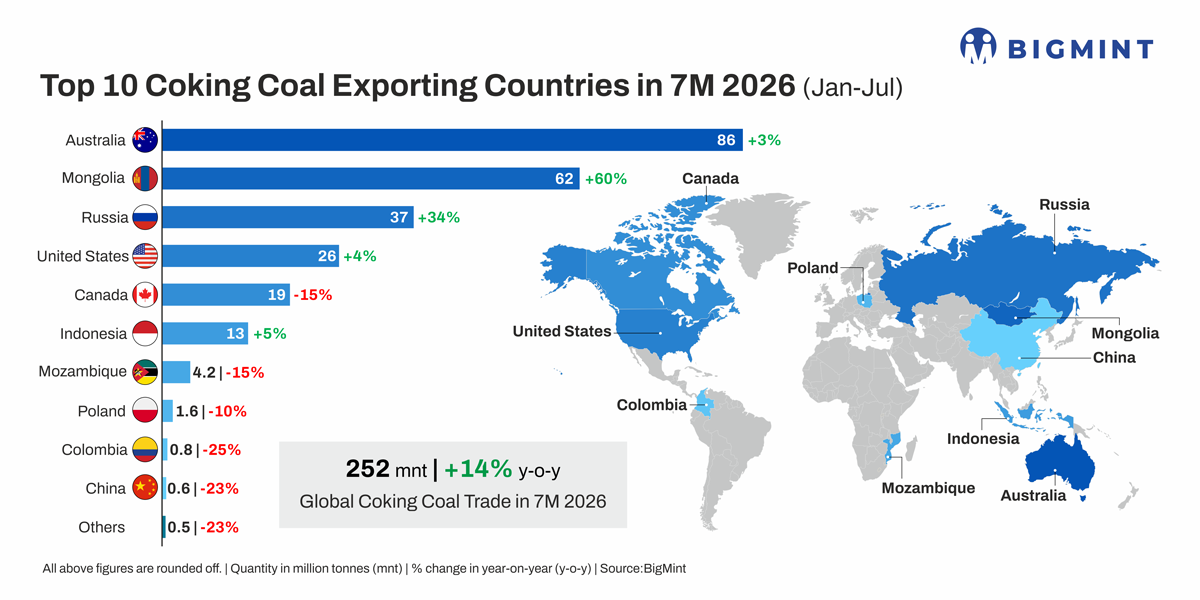
Data Deep Dive: Global coking coal trade increased by 14% y-o-y to 251.9 mnt during January-July 2026, compared with 220.1 mnt in the corresponding period of 2025, according to BigMint data.
However, the expansion was highly concentrated. Mongolia and Russia recorded the largest increases, while Australia and the US posted modest growth. Canada, Mozambique, Poland and Colombia lost volumes.
The structure of trade is also changing. China is drawing substantially more landborne coal from Mongolia and Russia, while India is reducing its dependence on Australia and expanding purchases from alternative suppliers.
Export growth concentrated in Mongolia and Russia
Australia remained the largest seaborne supplier, but Mongolia and Russia dominated incremental growth. Their expansion highlights the increasing importance of overland supply, shorter trading routes and price-sensitive procurement in Asia.
China becomes Mongolia’s biggest beneficiary
Mongolian coking coal exports increased by 23.2 mnt to 62.1 mnt. China was the destination for the entire Mongolian volume captured in the dataset.
Mongolia supplied approximately 63% of China’s identified imports, up from around 55% a year earlier. China benefits through shorter delivery times, lower freight exposure and greater flexibility during domestic supply interruptions. Higher Mongolian availability also strengthens China’s negotiating position with seaborne suppliers and provides coke producers with additional blending options.
This became particularly important after mine safety inspections disrupted production in China’s principal coking coal regions. Mongolian and Russian grades cannot entirely replace premium Australian and Canadian coals, but they can satisfy a substantial portion of China’s baseload blending requirements.
Mongolia is expanding railway and border infrastructure to support higher exports. The Gashuunsukhait-Gantsmod cross-border railway is designed to handle approximately 30 mnt annually and forms part of plans to increase the country’s overall coal export capacity.
This infrastructure effectively extends China’s supply base across the border. Mongolia gains export revenue, but China captures the wider strategic benefits through improved supply security, reduced maritime exposure and greater influence over regional pricing.

Russia expands across Asian markets
Russian exports increased by 9.5 mnt, or 34%, to 37.4 mnt. Unlike Mongolia, whose recorded trade was concentrated entirely on China, Russia expanded across several destinations.
Competitive pricing and the redirection of Russian exports towards Asia supported the increase. Further growth may nevertheless face constraints from rail availability, financing, insurance, sanctions and longer voyage distances to some markets.
Australia grows but loses Indian share
Australian exports increased by a modest 3% to 86.4 mnt, but its destination mix changed sharply. Higher shipments to Japan, China and Vietnam offset the steep reduction in India.
Australia nevertheless remains difficult to replace in the premium hard coking coal segment. Its high coke strength, fluidity and consistency are necessary for large blast furnaces. Mills can reduce Australian coal in their blends, but complete substitution could affect coke quality and furnace productivity.
India diversifies despite rising steel output
India’s identified imports declined by approximately 4% to 32 mnt, even as crude steel production increased by 6.1% to 101.1 mnt during January-July.
Australia’s share of identified supplies fell from approximately 54% to 40%, while Russia’s increased from 16% to 29%.
The divergence between higher steel production and lower imports may reflect inventory drawdowns, shipment timing, greater PCI use, improvements in coke rates and increased domestic coal utilisation. Indian mills may also have deferred purchases during periods of elevated premium coal prices.
Despite diversification, India will remain structurally import-dependent because domestic coal cannot fully provide the low-ash, high-quality feed required by large blast furnaces.
US stable; Canada loses ground
US exports increased 4% to 26.3 mnt. Higher shipments to India, Indonesia and the Netherlands offset lower deliveries to Japan and Brazil.
Canada’s exports declined 15% to 19 mnt, led by weaker purchases from China, South Korea and India. The 2.3 mnt reduction in Canada-China trade was its largest route-level decline. Indonesia’s exports rose 5% to 12.8 mnt, supported by Japan and China. Mozambique fell 15% to 4.2 mnt, while smaller Atlantic and European flows from Colombia and Poland also contracted.

CY26 trade could reach around 400 mnt
Full year global coking coal trade stood at 374.5 mnt in CY25. The 220.1 mnt traded during January-July represented just over half the annual total, leaving 154 mnt for August-December.
Applying the 11.7% year-to-date growth rate mechanically to the remainder of 2026 would produce full year trade of approximately 4180-420 mnt. However, this appears optimistic because China’s domestic production is recovering and its steel output remains below last year.
A more realistic base case is 395-405 mnt, representing growth of approximately 5-8% from CY2025.

Chinese production recovery could moderate imports
China will determine whether full year trade finishes closer to 390 mnt or 420 mnt.
Mine safety inspections following disruptions in Shanxi reduced domestic coking coal availability. By mid-June, approximately 64% of the affected capacity had resumed, although utilisation remained below pre-disruption levels. Domestic production was expected to stabilise from August as mines resumed operations. China’s broader import surge was consequently expected to taper after July.
A faster production recovery would reduce China’s requirement for discretionary seaborne cargoes. Canadian and some Australian coals could face the greatest volume risk, especially where imported material carries a significant premium.
Mongolian supply should prove more resilient because of its lower logistical cost, shorter delivery cycle and suitability for Chinese blends. However, its 60% growth rate is unlikely to be sustained indefinitely once domestic production normalises.
Premium coal demand will not disappear. Domestic Chinese, Mongolian and Russian coal cannot fully replace high-quality Australian and Canadian material required to produce coke with stronger mechanical properties.
Outlook
Global trade is likely to approach over 400 mnt in CY26, compared with 374.5 mnt in CY25. China’s domestic recovery could reduce the total by 10-20 mnt compared with a straight line application of the January-July growth rate. China’s procurement will become increasingly landborne and regional, centred on Mongolia and Russia. The seaborne market will depend more heavily on India, Japan and emerging Asian steel producers.
India’s blast furnace expansion provides the strongest source of structural demand, while Australia will remain the principal supplier of premium hard coking coal. Australia’s government expects metallurgical coal exports to grow by approximately 1.1% annually through 2030-31.
The market is therefore expanding and fragmenting simultaneously: China is building a lower-cost landborne supply system, while India is becoming the pivotal buyer determining competition across the seaborne market.
Leave a Reply