- Indonesian logistics constraints support Indian coke, PCI markets
- Indian mills stay away from coking coal market amid adequate stocks
Global metallurgical coal, metallurgical coke, and pulverised coal injection (PCI) markets diverged in the week ending 1 October 2026. Australian coking coal prices softened marginally, while recovering Chinese mine output and weak steel margins triggered the first material correction in domestic and export coke prices.
However, supply constraints in Indonesia kept prompt coke availability tight and supported delivered prices into India. Indian mills remained cautious on fresh coking coal purchases but continued to show interest in PCI as an alternative to expensive metallurgical coke.

Shanxi pushes mine restarts while retaining safety controls
China’s domestic coking coal market weakened as Shanxi accelerated mine restarts following four consecutive months of falling production. The province produced 74.6 mnt of raw coal in August, down 30.9% y-o-y, while January-August output declined 12.5% to 755.68 mnt.
Authorities have instructed mines that have completed safety rectification to resume operations and operating mines to raise utilisation. However, mines with unresolved safety deficiencies must pass inspections before restarting.
Standardised Shanxi premium low-vol coking coal values fell from RMB 2,400/t ($ 358/t) ex-washplant on 23 September to RMB 2,340/t ($ 349/t) on 30 September. High-sulphur premium low-vol coal declined by RMB 40/t ($ 6/t) to RMB 2,190/t ($ 327/t), while PCI remained unchanged at RMB 1,700/t ($ 254/t).
The production recovery is therefore easing immediate scarcity, but continued safety scrutiny and capacity controls limit the speed at which supply can return.
Australian PHCC softens as Indian buying slows
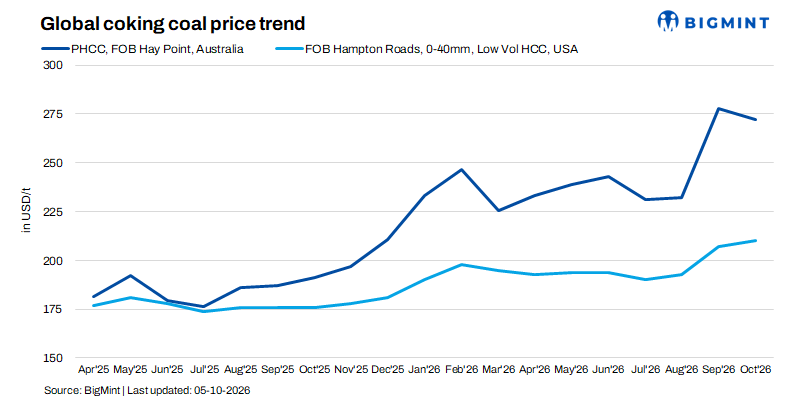
Australian premium hard coking coal (PHCC) declined marginally to $272.10/t FOB on 1 October, while the delivered China assessment eased to $294/t. No fresh confirmed premium-coal transaction was identified around the assessment date, with tradable FOB indications centred around $270.10-273/t.
Indian mills remained adequately covered and largely outside the prompt market. Buyers avoided building expensive forward positions as subdued finished-steel demand and elevated coke costs continued to pressure margins.
Australian semi-soft coal recorded a larger decline of $2/t to $159/t FOB. Low-vol HCC remained stable, indicating that the correction was concentrated in selected grades rather than across the entire coking coal complex.
Atlantic high-vol coal trades below assessed market
Atlantic-origin coal remained an important diversification option for Indian buyers, although high freights continued to restrict competitiveness.
US high-vol A coal was assessed at $190/t FOB US East Coast (USEC), down $5/t from 29 September. However, two reported second-hand transactions for October and November loading were heard at approximately $180/t FOB. These transactions indicate that selected cargoes were available below the broader assessed level.
A separate bid indication of $210/t was not corroborated. US low-vol hard coking coal (HCC) remained assessed at $210/t, with no fresh confirmed bid, offer or transaction.
Chinese coke correction gathers momentum
The weakening in Chinese coking coal costs moved into the coke market. Domestic 62/60 CSR coke declined RMB 100/t to RMB 2,020/t DDP North China, confirming the first substantive downward adjustment after the earlier price rally. Chinese export assessments fell by $10/t across the principal grades. BF coke with 66/65 CSR declined to $334/t FOB, 65/63 CSR to $324/t and 62/60 CSR to $312/t.
Higher coke-plant operating rates, improving raw-material availability and weak steel-mill profitability drove the correction. Expectations of lower coal replacement costs also encouraged mills to delay coke purchases.
Indonesian logistics prevent broader coke decline
Indian CFR coke prices did not follow the Chinese correction. Indonesian coke availability remained restricted by low river levels, disrupted barge movements and reduced feedstock deliveries.
At least one producer was unable to ship a September-loading vessel, while operating rates at some Indonesian coke plants were reported at around 50%. Producers prioritised contractual commitments, leaving limited material for prompt spot sales.
This created a regional divergence: Chinese coke prices weakened as production recovered, while Indonesian supply constraints kept delivered Indian values elevated. BF-grade 65/63 CSR coke remained assessed at $364/t CFR India.
Indian coke stays elevated; buyers resist
Indian BF-grade coke remained at INR 42,000/t ex-Jajpur, while ex-Gandhidham prices eased to INR 37,800/t. Foundry-grade coke declined marginally to INR 39,400/t ex-Rajkot.
Trading remained limited as consumers restricted purchases to immediate requirements. Softer coking coal and Chinese coke prices encouraged buyers to seek reductions, but restricted domestic and imported availability prevented a sharper correction.
The government’s clarification of actual-user conditions for selected exclusions from anti-dumping duty may assist eligible ferro alloy and small pig-iron producers. The exclusions apply only to specified coke grades imported for the declared end use, supported by legally enforceable undertakings and, where applicable, blast-furnace capacity certification.
PCI demand provides underlying support
PCI prices were broadly stable. Australian low-vol PCI held at $190.20/t FOB, while mid-vol PCI remained at $184.20/t FOB and $205/t CFR India.
Indian mills continued to examine PCI as a means of reducing coke consumption. However, the economic benefit depends on coal quality, injection rates and the relative cost of coke. Stable PCI values alongside elevated Indian coke prices preserved its substitution advantage during the week.
Outlook
The near-term market is divided between improving Chinese supply and continuing Indonesian constraints. Shanxi mine restarts, weaker Australian coking coal and falling Chinese coke prices create further downside pressure.
However, Indonesian river-logistics disruptions, limited prompt coke availability and stable PCI demand are providing a floor to Indian replacement costs. Indian buyers are expected to remain need-based, with the direction of coke prices depending on whether lower Chinese export values overcome the continuing scarcity of Indonesian material.
Leave a Reply