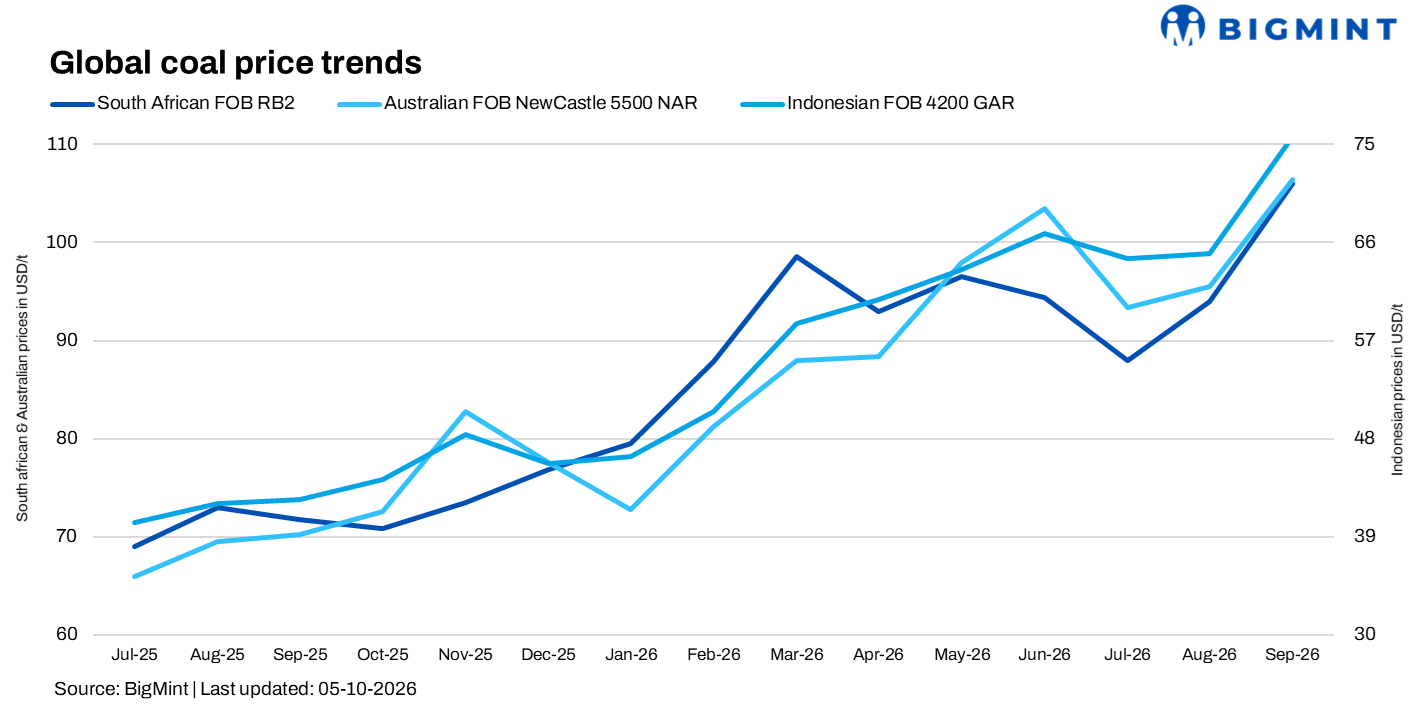
- Loading constraints sustain premiums for Indonesian coal
- Indian domestic coal prices increase as supply tightens
Asian thermal coal markets remained mixed in the week ended 3 October 2026. China’s Golden Week holiday slowed import buying, while declining Indian power-plant inventories sustained enquiries for seaborne coal. Indonesian loading constraints supported sellers, although elevated premiums and cautious procurement limited concluded business.
The regional market showed distinct movements across grades and destinations. Chinese domestic prices eased marginally after September’s rally, Australian 5,500 NAR indications remained resilient, and Indian portside South African coal prices strengthened sharply. Indonesian portside coal in India softened slightly despite concerns over utility stocks.
Weekly price comparison

International observations: weeks ended 25 September and 2 October 2026. Indonesian portside assessments: 26 September and 3 October; South African portside assessments: 24 September and 1 October; washed coal: 23 and 30 September. Australian figures are bids rather than transactions. Indian prices retain their reported GAR, NAR or FC specifications.
China’s holiday pause tempers regional demand
Chinese buyers reduced activity ahead of the 1-7 October holiday, leaving the market awaiting clearer procurement signals after their return. Reports of a domestic supply-stabilisation initiative also reduced the urgency that had characterised earlier buying.
Stocks at major northern Chinese ports stood at approximately 24.24 mnt on 28 September, against 24.50 mnt a week earlier. This modest drawdown accompanied slower enquiries rather than renewed aggressive purchasing.
QHD 5,500 NAR declined from RMB 996/t on 25 September to RMB 992/t on 2 October, while 6,000 NAR eased from RMB 1,091/t to RMB 1,086/t. All reported grades softened in domestic-currency terms. Prices nevertheless remained well above late-August levels: the 5,500 NAR marker was RMB 886/t on 28 August.
Import tender offers were firmer in selected grades. Chinese 5,500 NAR DDP tender offers reached RMB 993-1,008/t in the latest week, compared with RMB 989/t previously. These were offers, however, and do not establish stronger transaction prices or buying volumes.
Indonesia: loading constraints sustain premiums
Dry weather disrupted loading along the Barito River, restricting cargo availability despite the slowdown in Chinese buying. October availability was particularly difficult for some ultra-low-CV supplies, encouraging sellers to maintain premiums.
November-loading 3,400 GAR Supramax material was offered at a premium of around $6/t to market values, while selected branded supplies attracted double-digit premium demands. Indian buyers resisted elevated offers, keeping the gap between enquiries and executable business wide.
Physical transactions also highlighted the importance of separating grades. A November 3,400 NAR cargo traded at $68/t in the latest week, following an unconfirmed October transaction at $66/t previously. Separately, October 3,800 NAR traded at $77.50/t.
Uncertainty over Indonesia’s domestic-sales arrangements and 2027 production approvals complicated longer-term contracting. Participants were reluctant to commit before obtaining greater clarity on supply and pricing. Enquiries from Bangladesh and Vietnam for 5,000 GAR material provided additional demand outside China.
India: utility stocks tighten, but portside buying stays selective
Indian power-plant coal stocks declined from around 21.80 mnt on 27 September to 21.25 mnt on 30 September and 21.06 mnt on 1 October. Stock cover was approximately one week, with around 85 plants reportedly at critical levels.
This supported import enquiries ahead of festive demand. However, industrial spot buying remained cautious, and non-coking coal stocks at monitored Indian ports had increased 3% to 13.05 mnt on 26 September. Adequate aggregate port availability helped explain why Indonesian portside prices remained stable to slightly weaker.
Domestic procurement became more expensive. CIL’s September auction offerings fell 38% m-o-m to 13.02 mnt, while allocations increased 13% to 9.36 mnt. Average premiums rose to 94%, from 59% in August. Competition for suitable grades increased replacement costs for industrial consumers, particularly washeries.
South African coal strengthens; Australian mid-grade holds
South African coal at Indian ports gained on limited prompt availability, higher replacement costs and enquiries from sponge iron producers. RB2 ex-Paradip increased INR 600/t to INR 14,100/t. Improving sponge iron prices supported sentiment, although consumers remained selective.
Australian November 5,500 NAR bids increased to $109-110/t FOB, with an unconfirmed transaction at $109/t. High-grade Newcastle trading was less conclusive: no outright 6,000 NAR transactions were reported in the final two weekly snapshots, and December-January bids and offers remained widely separated.
BigMint assessment
The immediate outlook favours selective firmness rather than a uniform regional rally. Indian utility replenishment and Indonesian loading constraints provide support, while adequate Indian port stocks and buyer resistance restrain gains.
China’s post-holiday purchases will be the principal regional trigger. A sustained return to import buying could tighten available cargoes, particularly where loading remains constrained. Conversely, stronger domestic supply and continued procurement caution would limit seaborne upside. For Indian buyers, the decisive factors remain prompt availability, coal quality and delivered replacement cost.
Leave a Reply