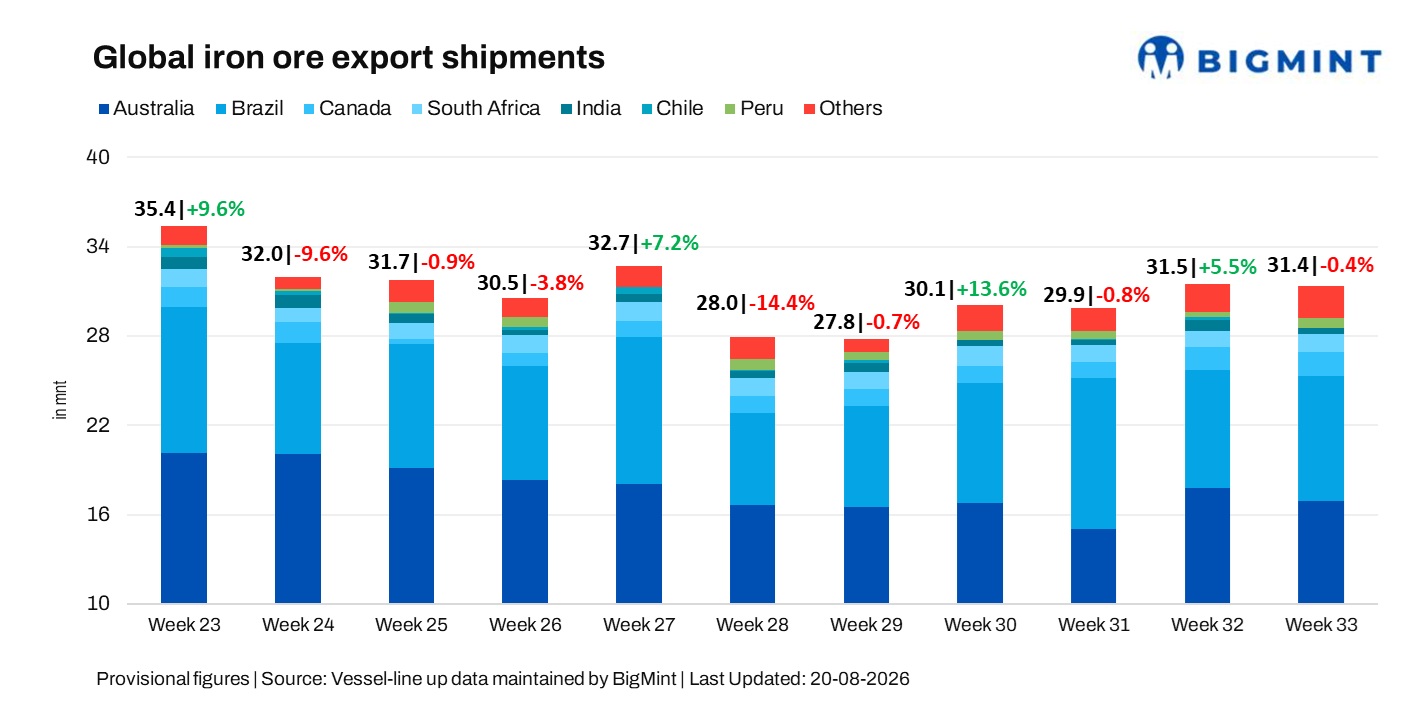
- Brazil and Peru drive stronger Atlantic shipments, while South Africa adds support
- Australia and India weigh on weekly flows as Capesize freight sentiment softens
Global seaborne iron ore shipments were largely unchanged w-o-w at 31.4 million tonnes (mnt) in the week ended 14 August, as stronger Atlantic flows balanced softer Pacific shipments. Brazil and Peru were the key contributors, while South Africa and Canada also provided support.
The week’s trade pattern was mixed across major exporters. Brazilian loadings strengthened on firmer terminal activity, while Peru posted a sharp recovery. Australia recorded softer shipments amid labour action at Port Hedland, with ongoing wage talks keeping the port in focus. India faced pressure from subdued seaborne demand and tighter scrutiny of iron ore grades in Odisha.
Country-wise exports

Port & shipper-wise trends
- Australia: Port Hedland handled 11.3 mnt, followed by Port Walcott (3.5 mnt) and Dampier (2.2 mnt). BHP led at 5.8 mnt, followed by Rio Tinto (5.7 mnt) and Fortescue Metals (4.1 mnt). China remained the top destination at 12.5 mnt.
- Brazil: Ponta da Madeira handled 4.3 mnt, followed by Tubarao (1.7 mnt) and Itaguai (1.2 mnt). Vale led shipments at 4.7 mnt, while China received 3.7 mnt.
- Canada: Port Cartier and Sept-Iles each handled 0.6 mnt. ArcelorMittal led shipments at 0.6 mnt, while China received 0.4 mnt.
- South Africa: Saldanha handled 1.1 mnt, followed by Richards Bay (0.1 mnt), with China receiving 0.7 mnt.
- India: Paradip handled 0.2 mnt, followed by Dhamra, Kakinada and Mangalore at 0.1 mnt each. Rungta Mines led at 0.2 mnt, followed by Rungta Sons and Lloyds Metals & Energy at 0.1 mnt each. China received 0.2 mnt.
- Peru: San Nicolas handled 0.5 mnt, followed by Matarani (0.1 mnt). Shougang Hierro led at 0.5 mnt, while China received 0.6 mnt.
- Guinea: Morebaya handled 0.6 mnt, with China receiving 0.4 mnt.
- Liberia: Buchanan handled 0.3 mnt, with China receiving 0.2 mnt.
- Mauritania: Nouadhibou handled 0.4 mnt, remaining the country’s sole export terminal.
- Sierra Leone: Freetown handled 0.4 mnt.
- Sweden: Narvik handled 0.6 mnt, with the Netherlands receiving 0.2 mnt and Germany 0.1 mnt.
Capesize freights soften as cargo activity cools; Supramax stays relatively firm
Iron ore freight markets softened during the week, with Capesize rates pressured by weaker cargo activity and ample tonnage availability. Cautious chartering, particularly in the Atlantic, kept rate ideas subdued, while Supramax markets remained comparatively resilient.
Softer Chinese steel demand added to the cautious tone, with July steel output at its lowest level of 2026. However, iron ore imports remained firm, with January-July volumes up 6% y-o-y, keeping the demand picture mixed.
Outlook
Global shipments are expected to remain broadly steady in the near term, with Australia and Brazil remaining key supply-side markets. Port Hedland wage negotiations will remain a watchpoint for Australian flows, with talks scheduled to resume on 25 August.
Freight sentiment is likely to remain mixed, with Capesize rates facing pressure from vessel availability and cautious chartering. Stronger Brazil-China cargo activity could provide support, while Supramax rates may remain comparatively resilient on steady regional enquiries.
Leave a Reply