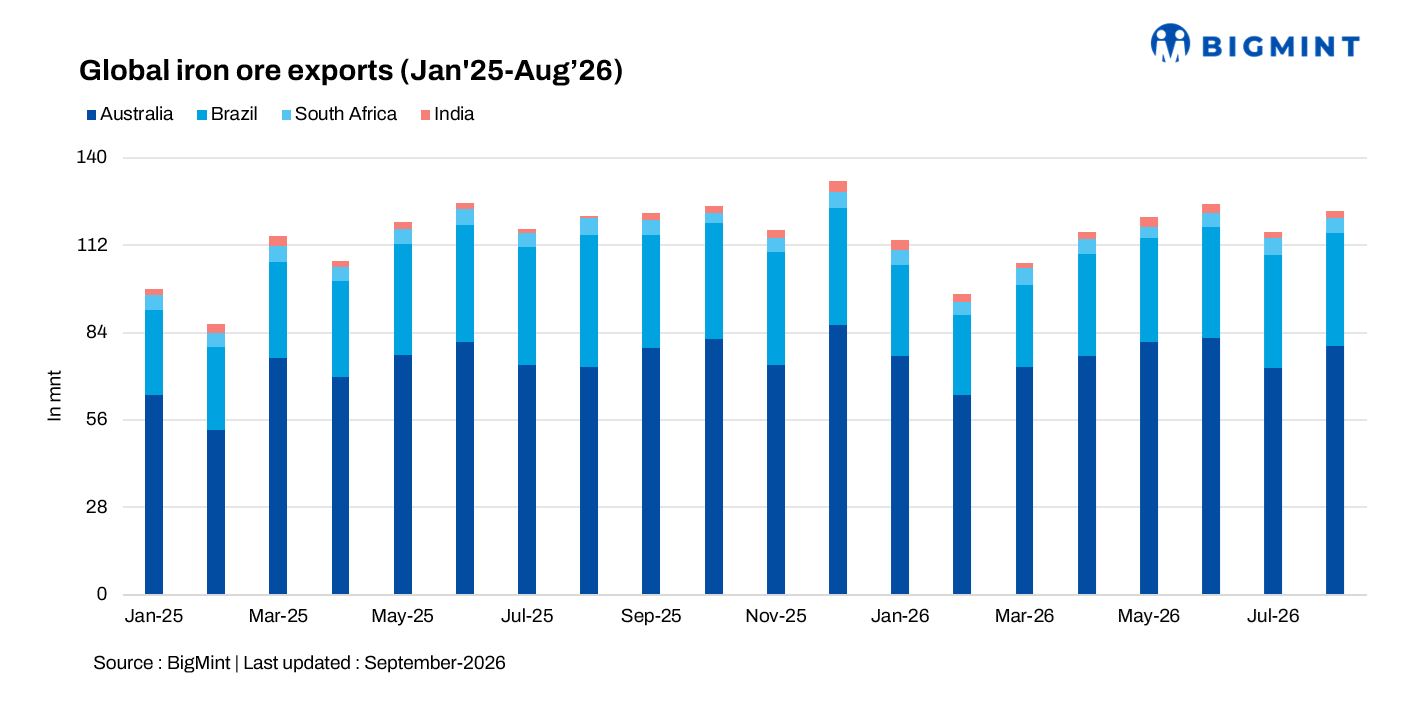
- Global iron ore exports show mixed trend in August
- Rising coking coal costs support demand for lower-grade alternatives
Iron ore (including pellets) exports from key global producers, Australia, India and Brazil remained firm to steady while those from South Africa declined m-o-m in August 2026. The sentiment remained largely on slower tone weighed by slower intake from China amid multiple lower-grade restrictions and scheduled mill maintenance for a brief period.
Additionally, higher raw material costs, particularly the coking coal weighed over pricing of iron ore fines making iron ore exporters less aggressive in the market to push cargoes further on any immediate basis.
Australian exports rise by 10% m-o-m
Australia’s iron ore and pellet export shipments stood at 79.6 million tonnes (mnt) in August, gained by 9.5% against 72.5 mnt in July, according to vessel line-up data by BigMint. Meanwhile, shipments edged down by 2% y-o-y against 72.9 mnt in August 2025.
China remained the top importer, receiving 65.3 mnt, followed by South Korea at 5.1 mnt and Japan at 4.7 mnt. Rio Tinto was the leading exporter at 29.5 mnt, trailed by BHP at 26.7 mnt and FMG at 16 mnt.
Australian exports recovered slightly from the ongoing miner-CMRG related disputes, though negotiations remain still unsettled. Sellers remained selective over trade windows to push volumes further, as slight optimism was observed for portside buying.
Exports from Brazil steady m-o-m
Brazil’s iron ore exports remained firm m-o-m at 36.3 mnt in August against 36.33 mnt in July. However, exports lowered by 13% y-o-y from 41.73 mnt in August 2025.
China remained the largest importer, taking in 25.96 mnt (down 16% y-o-y), followed by India at 1.58 mnt and Malaysia at 1.5 mnt.
Brazil’s iron ore exports held broadly steady, aided by smoother cargo scheduling and consistent shipments from key mining complexes, while producers largely maintained operating rates.
Medium and high-grade fines continued to find favour among Asian buyers, as higher coking coal costs improved the relative cost advantage of these grades, keeping them competitive against alternative origins amid cautious procurement.
South African exports soften by 10% m-o-m
South Africa’s iron ore exports stood at 4.94 mnt in August, a decline of 9.9% m-o-m against 5.48 mnt in July, as per vessel line-up data. Moreover, export volumes dropped by 5% against 5.22 mnt in August 2025.
China remained the leading importer with 2.64 mnt, followed by The Netherland and South Korea at 0.37 mnt each.
Subdued Chinese buying interest, amid ample availability of Australian and Brazilian cargoes in the seaborne market, further limited export volumes. Lower global iron ore prices and weaker price competitiveness of South African material also weighed on shipments during the month.
Weaker vessel loading activity and persistent rail logistics constraints, weighed on overall dispatches which disrupted the movement of material to export terminals.
India’s exports increase 8% m-o-m
India’s iron ore and pellet exports inch up 7.5% m-o-m to 2.15 mnt in August from 2 mnt in July. Interestingly, iron ore exports plunged by 22.8% m-o-m to 0.95 mnt against 1.23 mnt in July’26.
China remained the largest importer with 1.63 mnt, followed by Malaysia with 0.31 mnt.
Indian iron ore exports declined during the month, as ongoing monsoon conditions disrupted mining kept ore availability tight. Exporters also remained cautious on fresh offers, with weak global prices weighing on export realisations and limiting their interest in overseas sales.
Availability of lower-grade ore in the domestic market was also reportedly affected, as dispatches remained constrained by tighter grade-linked dispatch norms implemented by the state entity.
Outlook
In context to Australian exports, slight disruptions at port operations due to recent port-strike by workers called at Hedland port, the volumes will remain very measured.
Coming to India, the sellers reportedly held cargoes for the monsoon period which are expected to be concluded as weather related challenges make operations feasible and will likely reflect next month. Also, the recent mishappening at eastern waterfront will slow pace the loading operations from eastern coast due to tighter regulations.
Brazilian ore is expected to gain traction as continued rally in coke price increment had kept mills’ margin low and thus lower-grade alternatives are expected to be in good demand for cost-reduction and margin-prevention.
South African ore is expected to remain on same steady tone subjected to similar logistic constraints posing sluggishness in operating pace.
Leave a Reply