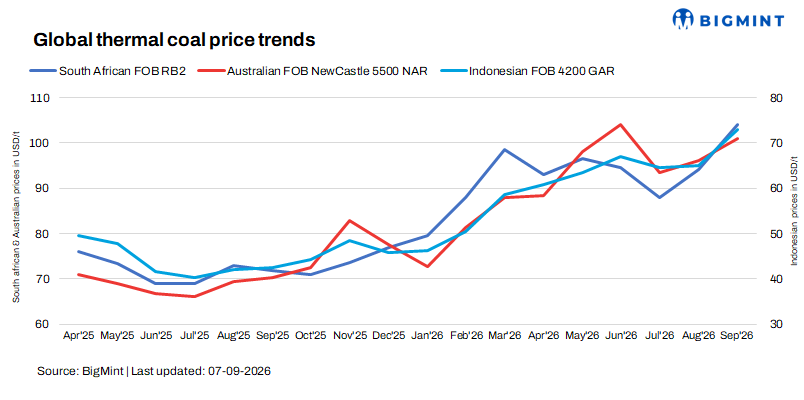
- Chinese import prices gain $8-9/t w-o-w
- Indonesian constraints raise regional replacement costs
Asian thermal coal markets strengthened sharply in the week ending 4 September 2026, as Indonesian supply constraints coincided with firmer Chinese buying, rising domestic Chinese prices, and higher India-bound freight.
Prices increased across Indonesian, Australian and South African coal. However, the rapid escalation also widened the gap between seller expectations and buyer acceptance, leaving non-urgent consumers cautious about fresh bookings.

Chinese prices accelerate across CV curve
Chinese seaborne import prices registered broad-based weekly gains. Delivered prices for 3,800 NAR coal increased $8/t to $90/t, while 4,700 NAR and 5,500 NAR rose $9/t to $111/t and $131/t, respectively.
FOB-equivalent values followed the same direction, with 3,800 NAR rising to $78.50/t and 4,700 NAR to $101/t.
Domestic coal prices also strengthened. The Qinhuangdao 5,500 NAR marker increased $8.59/t w-o-w to $139.22/t, while 6,000 NAR gained $8.56/t to $153.19/t. In domestic currency terms, 6,000 NAR crossed the RMB1,000/t threshold to reach RMB1,039/t.
The rise in domestic prices improved the competitiveness of imported cargoes, encouraging Chinese buyers to consider seaborne material. However, buying remained selective, with stronger interest concentrated in grades offering favourable delivered economics.
Indonesian supply constraints lift prompt prices
Indonesia remained the principal source of supply-side pressure. Low water levels along the Barito and Mahakam rivers disrupted barge operations, forcing some producers to reduce loads, revise schedules or delay movements to export terminals.
Availability was further constrained by delays and uncertainty surrounding production quotas, with some miners reportedly exhausting existing allocations. The impact was particularly visible in mid-CV coal, where regional requirements remained firm but prompt cargo availability was limited.
Confirmed trades for Indonesian 3,800 NAR coal increased from around $70/t FOB in the previous week to $80-83/t for September and October delivery. Unconfirmed business was reported at $74-76/t.
Index-linked transactions also attracted firm premiums. A 4,200 GAR trade was reported at index plus $4/t, while higher-CV 5,600 GAR coal attracted business close to index plus $10/t.
The market nevertheless remained uneven. Consumers without immediate requirements generally resisted higher fixed-price offers, contributing to wider bid-offer gaps and greater use of index-linked pricing.
Australian prices rise as buyers seek alternatives
Australian Newcastle coal strengthened alongside the wider Asian market.
For 6,000 NAR material, confirmed trades had increased from $125/t FOB in mid-August to $135.50/t by 28 August. No fixed-price trade was reported in the latest week, but bids reached $145/t for December and offers rose as high as $150/t for October-December cargoes.
The increase was more pronounced for 5,500 NAR coal. Confirmed trades rose from $100-102.50/t in the week ending 28 August to $113/t by 4 September. This represented a weekly increase of approximately $10.50-13/t, although the comparison included different delivery periods.
The absence of confirmed 6,000 NAR business in the latest week suggests that the market had not fully established a clearing price at the higher offer levels.
Indian replacement costs climb sharply
The regional rally fed directly into Indian portside prices. Indonesian 5,000 GAR coal increased INR800/t w-o-w to INR11,600/t at Kandla and INR11,500/t at Vizag. The 4,200 GAR grade rose INR700/t to INR9,600/t and INR9,500/t, respectively, while 3,400 GAR coal at Navlakhi gained INR600/t to INR7,750/t.
India-bound freight added to replacement costs. Hay Point-Paradip Panamax freight rose $1.50/t w-o-w to $23.20/t, while RBCT-Paradip increased $0.60/t to $20.40/t. East Kalimantan-Navlakhi and South Kalimantan-Navlakhi Supramax freight gained $1.20/t each to $21.90/t and $20.90/t, respectively.
Indian thermal coal inventories at major ports declined 2% w-o-w to 13.40 mnt. Power-plant stocks were reported at around 27.6 mnt on 3 September, equivalent to approximately nine days of consumption. Low inventories provide a potential basis for stronger import demand as monsoon-related disruptions recede, although elevated delivered prices could restrict discretionary purchases.
South African coal offers limited relief
South African thermal coal also strengthened, leaving Indian consumers with few lower-cost alternatives. The 5,500 NAR FOB market moved above $100/t, while India-bound offers were reported around $127-128/t CFR.
Indian portside RB2 prices increased to around INR12,900-13,000/t at Vizag and Paradip. Demand from sponge iron producers remained present, but buyers were hesitant to commit to fresh imports because of elevated replacement costs.
Outlook
The near-term Asian thermal coal market is expected to remain firm but volatile. Indonesian river constraints, limited prompt cargoes and restricted production flexibility are likely to preserve seller leverage, particularly across the 4,200-5,000 GAR segment.
Chinese buying and domestic price movements will remain central to the direction of seaborne prices. In India, low power-plant inventories and the approaching end of the monsoon could support restocking, although higher freight and CFR costs may delay purchases.
Buyer resistance remains the principal downside risk. Further gains will depend on whether Chinese and Indian consumers convert higher buying indications into physical bookings or continue waiting for supply conditions and prices to stabilise.
Leave a Reply