- China reduces imports by 1.3% m-o-m in Jul’25
- Lower premiums discourage Indian exporters
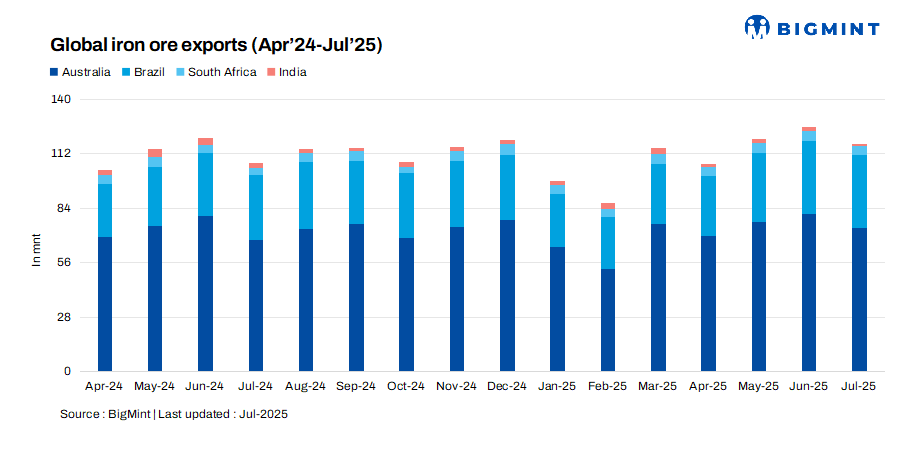
Iron ore exports from all major producing regions worldwide, except for Brazil, declined in July 2025. Australian shipments were down by 9% m-o-m, while India recorded the sharpest decrease of 32%.
The largest iron ore consumer, China, imported 104.62 million tonnes (mnt) in July, reflecting a modest 1.3% decline m-o-m against 105.95 mnt in June this year.
Australia’s exports drop 9% as Chinese importers pull back
Australia’s iron ore and pellet export shipments fell by 8.9% to 73.60 million tonnes (mnt) in July from 80.82 mnt in June, according to vessel line-up data compiled by BigMint.
China remained the top importer, receiving 60.4 mnt (a drop of 13% m-o-m), followed by Japan and South Korea with 4.6 mnt each. The significant decline in exports to China brought down Australian volumes.
Rio Tinto was the leading exporter with 25.9 mnt (falling by 7.5% m-o-m), closely trailed by BHP at 24.4 mnt (12% decline m-o-m).
Export shipments from Brazil remain stable m-o-m
Brazil’s iron ore exports remain unchanged m-o-m at 37.72 mnt in July. Additionally, exports rose by 13.5% from 33.23 mnt in July 2024.
China remained the largest importer, taking in 22.53 mnt, followed by Malaysia at 2.75 mnt and Bahrain at 1.36 mnt.
Brazil’s iron ore exports surged y-o-y due to improved operational efficiency, strategic market positioning, and rising global demand. In July 2025, favourable dry weather in major mining regions allowed for uninterrupted mining and logistics, significantly boosting export volumes.
South African exports fall m-o-m, shoot up y-o-y
South Africa’s iron ore exports fell by 9.3% to 4.46 mnt in July compared to 4.92 mnt in June, as per vessel line-up data maintained by BigMint. Despite the m-o-m drop, export volumes surged by 29% y-o-y from 3.47 mnt in July 2024.
China remained the leading importer with 1.83 mnt (45% drop m-o-m), followed by South Korea at 0.56 mnt.
Last month, Transnet faced challenges in providing reliable freight rail and port services, affected by equipment shortages and maintenance backlogs due to years of underinvestment. Its capacity was also limited by cable theft and vandalism, which further impacted exports.
India’s exports fall by 32% m-o-m
India’s iron ore and pellet exports recorded a fall of 31.5% m-o-m to 1.37 mnt in July from 2 mnt in June. Moreover, shipments saw a decline of 46.3% against 2.55 mnt in the year-ago period.
China remained the largest importer with 0.78 mnt, followed by Malaysia with 0.14 mnt.
The slowdown in demand for Indian iron ore was largely driven by hesitation from Chinese steel mills, which avoided restocking, as domestic demand weakened. On top of that, export prices for iron ore were not attractive enough for Indian suppliers, making it less viable for them to proceed with shipments. This combination of weaker buying interest and unappealing prices created a lull in trade activity.

Leave a Reply