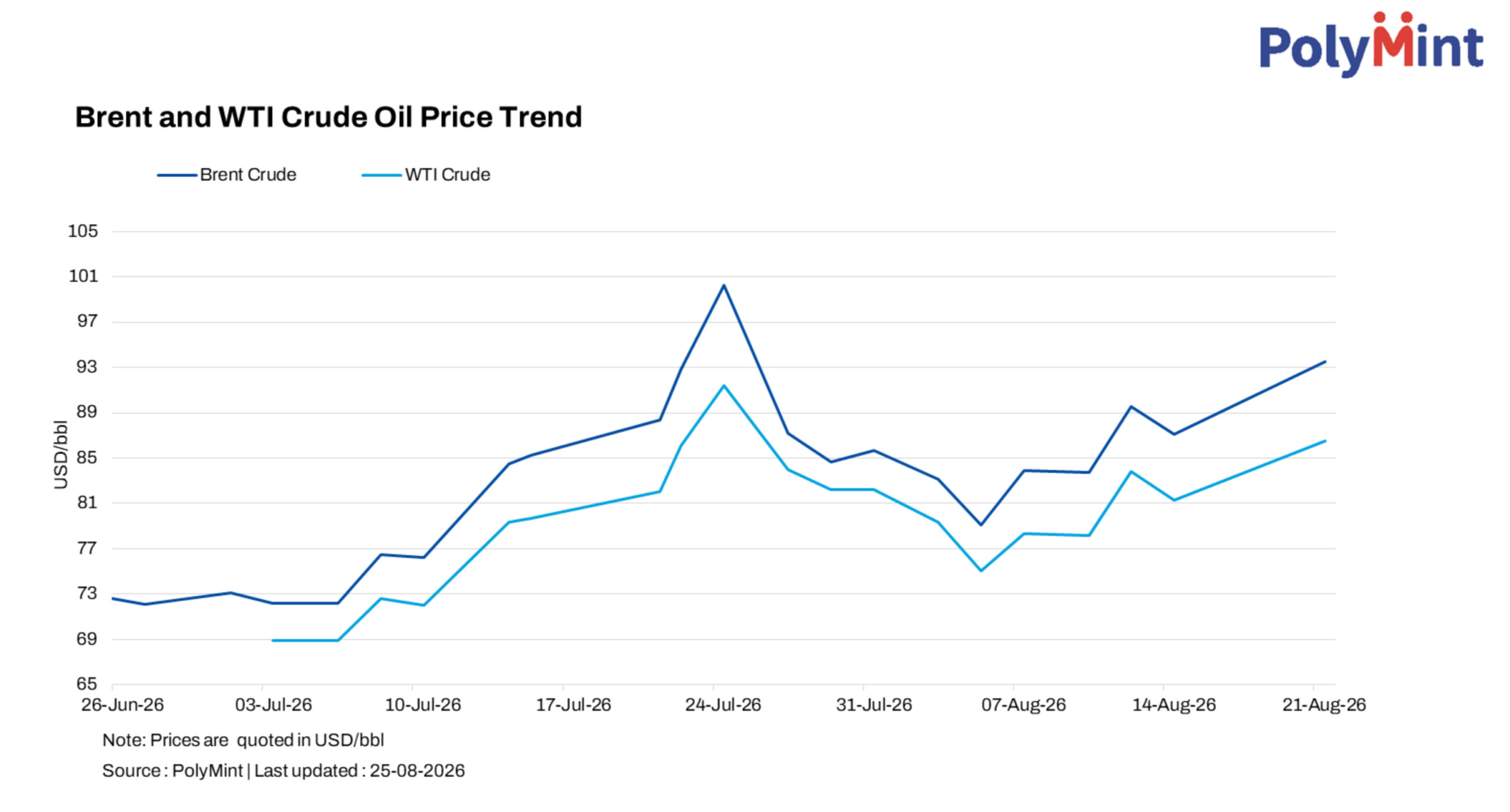
- Brent gains 6.63% in week ended 21 August
- WTI rises 5.66% as Hormuz disruption persists
Crude oil prices retreated in early Asian trading on 24 August after two consecutive weeks of gains, as markets turned cautious ahead of US sanctions on Iran and its trading partners. However, supply concerns remained elevated amid continued disruption to oil flows through the Strait of Hormuz.
ICE Brent crude futures fell 1.29%, or $1.22/bbl, to $93.17/bbl, while NYMEX WTI declined 1.38%, or $1.20/bbl, to $85.86/bbl. Brent had gained 6.63% during the week ended 21 August, while WTI rose 5.66%.
Geopolitical risks drive rally
Brent climbed from $88.52/bbl on 14 August to $94.39/bbl on 21 August, marking its second consecutive weekly gain after rising 5.95% in the previous week. WTI increased from $82.40/bbl to $87.06/bbl over the same period.
The rally was driven primarily by uncertainty over Middle East oil supplies and restricted traffic through the Strait of Hormuz. Only seven commodity vessels crossed the waterway on 20 August, highlighting the extent of the disruption.
The lack of progress in US-Iran diplomatic talks and continued uncertainty over the agreement further tightened supply expectations. Iranian crude shipments to Chinese buyers also declined as the US blockade disrupted flows.
Refined products support crude
Strong refining margins, particularly for diesel, provided additional support as Middle Eastern supply disruptions tightened fuel availability across Asia.
A 4.4 million-barrel increase in US crude inventories had limited impact on sentiment, with traders focusing more on geopolitical risks and tighter refined-product supplies. A weaker US dollar also supported dollar-denominated crude prices.
Sanctions become key catalyst
The US administration’s sanctions campaign against Iran and its trading partners has added another layer of uncertainty for oil markets. The measures are expected to increase pressure on Iranian oil exports, shipping networks and financial channels.
Iran has warned that further US pressure could trigger a stronger response. Market direction will therefore depend on the extent to which sanctions affect Iranian exports and whether Tehran takes further action around the Strait of Hormuz.
Outlook
Crude prices are likely to remain volatile through the week ending 28 August as markets assess US sanctions and Iran’s response. The 24 August decline reflects profit-taking after the strong two-week rally, but continued Hormuz disruption may keep supply risks elevated.
A sustained recovery in shipping activity could ease the supply premium, while further restrictions on Iranian exports or regional shipping may provide additional upward pressure on crude prices.
Leave a Reply