- China remains largest buyer, but imports fall amid unfavourable economics
- Indian scrap imports inch up by 3% y-o-y even as supply disruptions emerge
- US imports rise 37% amid stronger manufacturing activity; exports surge 21%
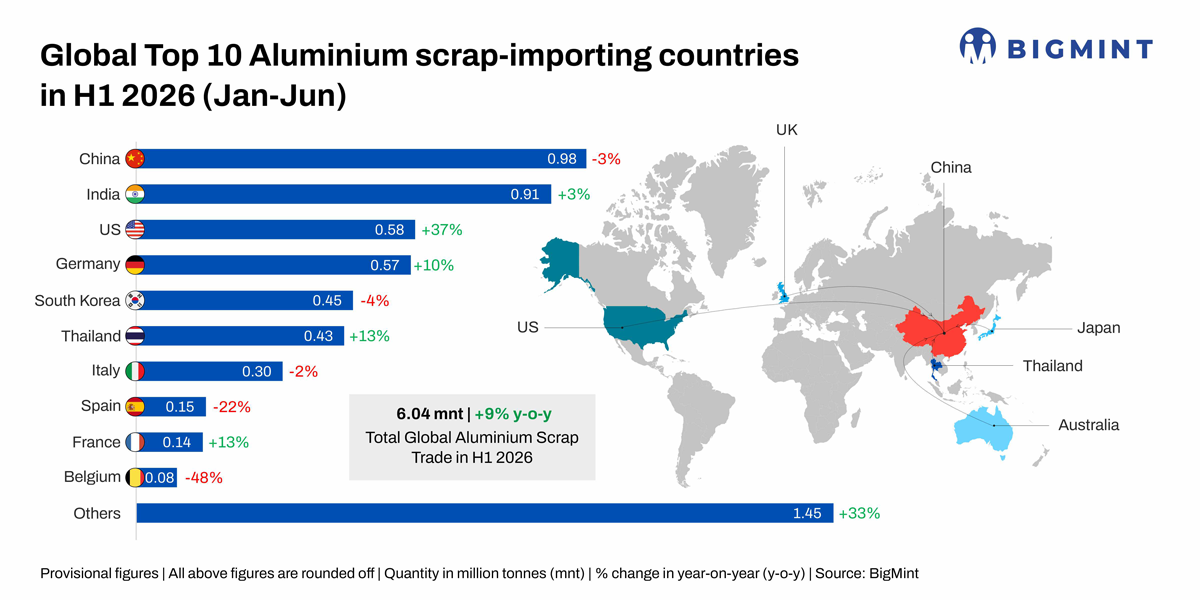
Morning Brief: Global aluminium scrap imports across the major markets tracked by BigMint rose 9% y-o-y in H1CY’26 to 6.04 million tonnes (mnt) from 5.55 mnt in H1CY’25.
China remained the largest importer, but volumes fell 3% y-o-y, while India, Thailand, Germany, and the US increased purchases. US imports rose 37%, even as US scrap exports climbed 21%, pointing to increasingly two-way trade flows rather than a broad increase in US domestic dependence on overseas scrap.
US-origin material gained ground in Asia, with shipments to Thailand rising about 66% and those to India increasing 25%. This shift could become more important as UAE supply restrictions and prospective EU export controls tighten competition for alternative sources.
Chinese imports fall amid unfavourable economics

China continued to be the largest individual importer, although volumes declined 3% to 0.98 mnt from 1.01 mnt.
The decline was not necessarily a sign of a structural reduction in secondary aluminium demand. Rather, the economics of importing became less attractive as downstream demand remained subdued, overseas scrap prices stayed elevated, and the overseas-domestic price spread widened.
China’s sourcing pattern also changed. Imports from Thailand, its largest supplier, fell from 0.26 mnt to 0.20 mnt, while imports from the UK increased from 0.12 mnt to 0.13 mnt. Supplies from Japan and the US also declined.

India increases imports despite supply disruptions
India remained a key growth market, with aluminium scrap imports increasing 3% to 0.91 mnt in H1CY’26 from 0.88 mnt. India’s aluminium demand continued to grow in H1CY’26 due to electrification needs and expanding automotive production.
Nonetheless, the increase in the country’s scrap imports is notable because Indian recyclers faced several supply-side disruptions during the period. India imports around 85-87% of its aluminium scrap requirement, leaving secondary aluminium producers highly exposed to changes in international availability, freight and supplier-country policies.

The UAE was one such disruption. Temporary restrictions on ferrous and non-ferrous scrap exports from the UAE added pressure on Indian buyers and encouraged them to look for alternative origins. At the same time, geopolitical disruptions in the Middle East affected cargo movement and freight and insurance costs.
Consequently, imports from India’s major alternative source, the US, increased. US-origin aluminium scrap shipments to India rose 25% from 0.16 mnt to 0.21 mnt in H1CY’26.
European demand diverges; Germany stands out with 10% rise
Germany recorded one of the strongest increases among the major European markets, with aluminium scrap imports rising 10% to 0.57 mnt from 0.52 mnt. The increase contrasts sharply with several other large European markets. Italy’s imports slipped 2% to 0.30 mnt, Spain declined 22% to 0.15 mnt, while Belgium recorded a much sharper 48% fall to 0.08 mnt. France, in contrast, increased imports 13% to 0.14 mnt.
The divergence suggests that European demand for imported scrap is being shaped increasingly by individual industrial conditions, domestic scrap availability, and the sourcing requirements of recyclers rather than by a single regional tamid manufacturing crend.
US lifts imports as manufacturing activity strengthens
US aluminium scrap imports rose 37% to 0.58 mnt from 0.42 mnt, reflecting stronger demand for recycled feedstock rather than a simple shortage of domestic scrap.
US manufacturing activity remained strong in H1CY’26, with the purchasing managers’ index hitting a four-year high amid robust order growth and data centre expansion. This likely lifted demand for aluminium as well as other metals.
With around 85% of aluminium production coming from secondary sources, US recyclers need a steady flow of suitable scrap to maintain production. This has supported higher purchases from nearby markets, particularly Canada and Mexico, where proximity and established trade routes make cross-border sourcing relatively efficient.

Thailand absorbs more US-origin material
Thailand’s aluminium scrap imports increased 13% to 0.43 mnt in H1CY’26 from 0.38 mnt a year earlier. The most notable shift was in US-origin material, with imports rising from 0.11 mnt to 0.18 mnt, an increase of around 66% y-o-y.
The increase points to a redistribution of trade flows in H1CY’26. While China’s aluminium scrap imports from Thailand declined, Thailand itself emerged as a stronger buyer of US-origin material, indicating a shift in sourcing patterns across the Asian recycling market.
The shift also underlines the growing role of Southeast Asia as an outlet for US-origin scrap. Thailand’s established recycling and manufacturing base allows it to absorb additional imported material and feed it into regional supply chains, particularly when demand from other major Asian markets remains subdued.
Pricing competitiveness is another factor that supported the flow. With prices in South Asian and Southeast Asian markets remaining viable for US suppliers, shipments to these destinations can offer attractive netbacks, encouraging suppliers to redirect material towards markets where demand and pricing remain relatively favourable.
US scrap exports rise 21% on strong Asian demand
In H1CY’26, US aluminium scrap exports reached around 1.25 mnt, up 21% y-o-y. Thailand received about 268,000 t, followed by India at 233,000 t, Malaysia at 161,000 t, and South Korea at 140,000 t.
The increase in exports was supported by stronger buying interest across Asia. For US suppliers, Asian markets offered a viable outlet for material that could be sold competitively after freight, particularly as recyclers in Thailand, India and Malaysia looked for additional feedstock. Higher aluminium prices and tighter primary metal availability also improved the economics of using recycled material, making imported scrap more attractive to secondary producers.
This created a favourable trade dynamic: ample US scrap availability on one side and commercially viable Asian demand on the other. Southeast Asia’s growing role as a recycling and processing hub further widened the pool of potential buyers, allowing US material to move into markets beyond traditional destinations.
This implies that the US is importing substantially less while exporting substantially more. This points to a broader shift in the country’s position in the global scrap trade, with less material being pulled into the US from overseas and more material flowing outward towards Asian recycling markets.
EU exports rise 4% but stricter regulations cause supply concerns
The EU’s aluminium scrap exports to non-EU destinations increased 3.8% y-o-y to 0.56 mnt during January-May 2026, with India remaining the largest destination at 0.17 mnt, up from 0.15 mnt a year earlier. However, Europe is becoming a more complicated sourcing market for buyers outside the region.
From 21 May 2027, the EU’s revised Waste Shipment Regulation will introduce stricter rules for exports of non-hazardous waste to non-OECD countries. Countries such as India will need to be authorised to continue receiving relevant EU waste streams.
Outlook
India is likely to remain a strong importer in H2CY’26, but competition for overseas scrap is expected to increase. With the UAE supply route disrupted and European exports facing a longer-term regulatory risk, Indian recyclers are likely to rely more heavily on the US and other alternative origins. This could put Indian buyers into closer competition with Thailand and other Southeast Asian markets for US cargoes.
China is likely to remain selective rather than chase additional volumes. A sustained improvement in secondary aluminium demand would be needed to pull China more firmly back into the international market.
The US should remain a major source of globally traded aluminium scrap, although domestic retention is becoming a policy issue. Industry efforts to increase domestic scrap collection and secure feedstock for new recycling and aluminium capacity could eventually limit export availability, even if the effect is unlikely to be immediate.
Europe presents the clearest medium-term supply risk. With the revised Waste Shipment Regulation due to tighten access from May 2027, overseas buyers are likely to start diversifying before the rules take effect.
Leave a Reply