- European mills’ high unsold steel inventories reduce expectations for scrap restocking
- US export prices fall despite firm domestic mill demand, below-normal scrap inventories
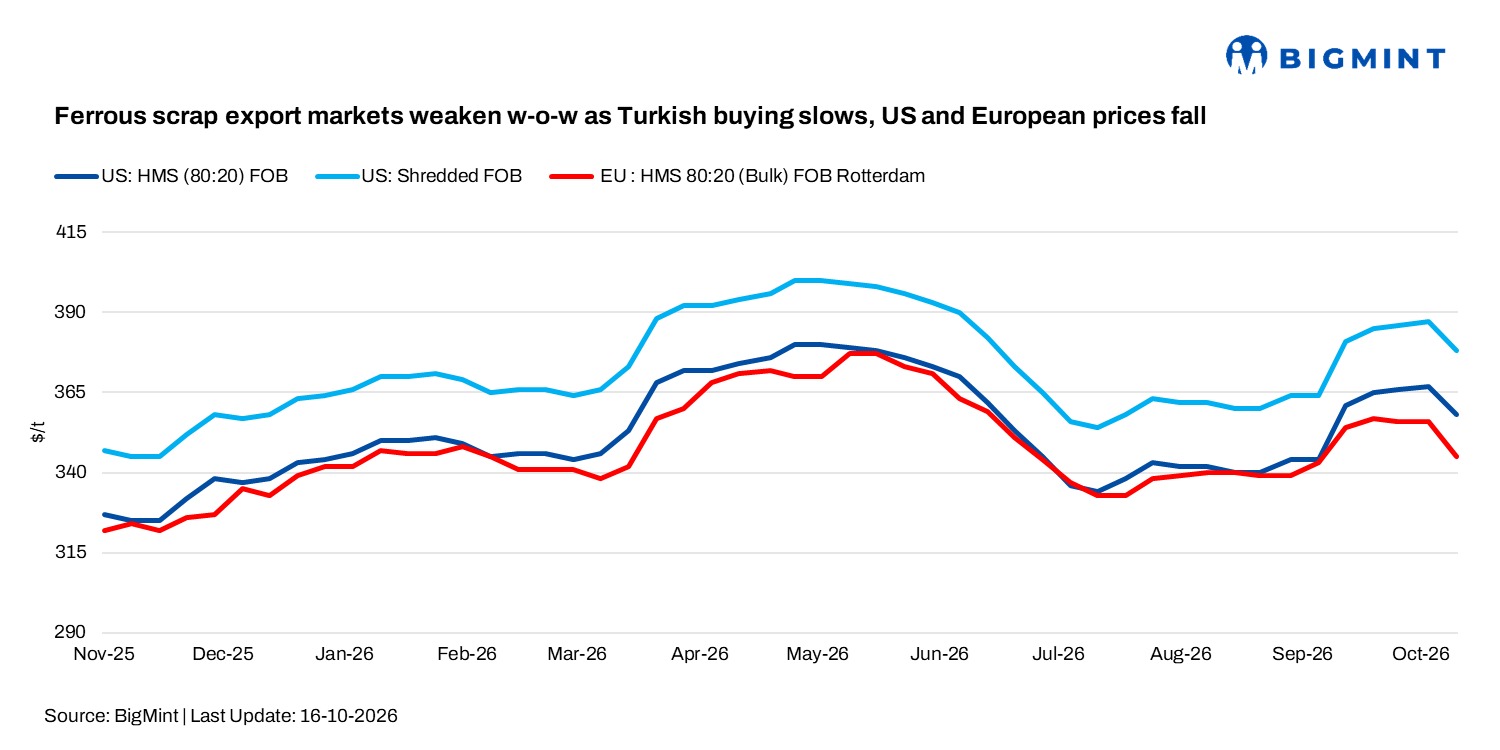
Global ferrous scrap export markets weakened in the second week of October 2026 ended 17 October 2026. Turkish mills stayed reluctant to buy, European mills held large stocks of unsold steel, and rising freight costs limited exporters’ room to cut prices. BigMint’s assessments for US HMS 80:20 and shredded scrap both fell by $9/t w-o-w, while Benelux and Rotterdam prices also declined. Brazil’s market was broadly stable.
US
US ferrous scrap export prices declined this week as Turkish demand stayed weak. BigMint’s assessment for HMS 80:20 fell to $358/t FOB from $367/t a week earlier. The assessment for shredded scrap dropped to $378/t FOB from $387/t. US-origin HMS 80:20 was assessed at $395/t CFR Iskenderun, down 1% w-o-w.
Domestic US conditions remained relatively firm. Mill order books are healthy, scrap inventories are below normal, and raw steel output rose. However, softer export demand and planned mill maintenance towards year-end are expected to limit any price recovery.
Europe
European ferrous scrap markets weakened in the second week of October as Benelux exporters met growing resistance to higher prices from major importers, particularly Turkiye. Turkish mills stayed reluctant to book imported scrap in early October. Falling finished steel prices and weak domestic demand reduced their urgency to restock raw materials.
Turkish import activity remained thin, with two deals reported during the week. The Netherlands-based seller sold HMS 80:20 to Iskenderun-region mill at $385/t CFR, $5/t below the same supplier’s previous deal in early October. In a separate deal, a UK-based seller sold HMS 80:20 to Izmir-region mill at $388/t CFR. Benelux HMS 80:20 was assessed at $388-390/t CFR Turkiye, down $5/t w-o-w.
The weaker euro (Euro 1 = $1.12, from $1.13 a week earlier) gave European suppliers some room on price. However, higher shipping costs offset much of this advantage, and many exporters were reluctant to make further concessions. A Turkish scrap agent said the favourable Euro/$ rate was being wiped out by freight costs. Reflecting these costs, HMS 80:20 fell by $11/t w-o-w to $344/t FOB Rotterdam.
In the Benelux region, dockside prices for HMS 80:20 fell to EUR 280-285/t ($315-320/t), from EUR 288-290/t ($324-326/t) a week earlier. Scrap arrivals at yards improved while key export outlets pushed prices down.
A Baltic exporter said supply was improving and European mills were unlikely to buy as much scrap as traders had expected, as they hold large unsold stocks of finished steel and Turkish demand is slow.
Brazil
Brazil’s ferrous scrap market remained broadly stable during the week ended 16 October, as rising operating costs continued to squeeze recyclers’ margins. Market conditions varied regionally, with some mills in Sao Paulo seeking additional volumes, while activity in the Northeast remained unchanged.
Some steel mills reportedly increased scrap purchase prices by BRL 60-80/t ($12-16/t) after equipment returned from maintenance, boosting demand. However, the increases varied by transaction and were not applied uniformly. Domestic scrap prices remained unchanged, with HMS 80:20 at BRL 830-850/t ($164-168/t) FOT, premium steel scrap at BRL 940-950/t ($186-188/t) FOT and turnings scrap at BRL 720-750/t ($142-148/t) FOT.
In the export market, Brazil-origin HMS 80:20 remained at $305-310/t FOB, while shredded scrap held at $330-335/t FOB. Rising costs and uneven regional demand continued to limit broader market momentum.
Leave a Reply