- EU bans plastic waste exports to non-OECD countries from 21 November
- India did not seek authorisation for plastic waste
The European Commission has published a draft list of non-Organisation for Economic Co-operation and Development (OECD) countries that could be authorised to import selected non-hazardous waste from the European Union (EU) after May 2027. Under the revised Waste Shipment Regulation (WSR), the EU will generally prohibit waste exports to non-OECD countries from 21 May 2027. Exceptions will apply to countries that request continued access and demonstrate sustainable management of the relevant waste streams.
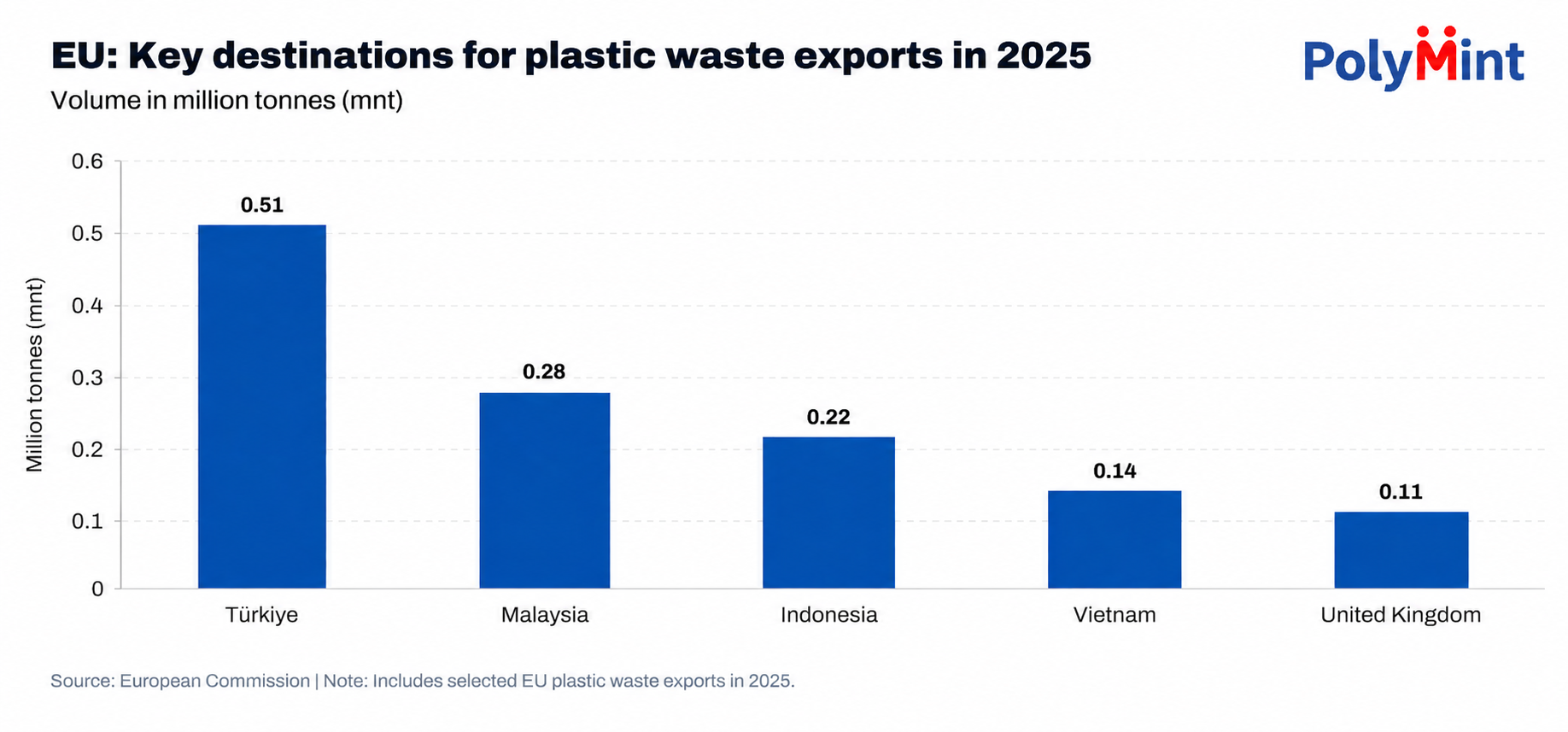
In 2025, exports were split roughly equally between OECD and non-OECD countries. Key destinations included Turkiye (510,000 t), Malaysia (276,000 t), Indonesia (215,000 t), Vietnam (137,000 t) and the UK (108,000 t).
The Commission assessed applications from 32 countries and opened a consultation until 16 October 2026. The first authorised-country list is expected by 21 November 2026, with updates at least every two years.
Plastic waste exports to Turkiye face closer scrutiny
Turkiye remains the main OECD destination for EU plastic waste. In 2025, the EU exported 510,000 t of plastic waste to Türkiye, out of total plastic waste exports of 1.4 million tonnes.
The Commission recognised Türkiye’s strengthened legislation, import controls and enforcement measures. However, it identified gaps in transparency around plastic waste generation and treatment, information on legislative implementation, and governance arrangements.
The Commission will continue discussions with Turkish authorities, monitor exports, and strengthen bilateral cooperation.
Implications for polymer recycling
The policy increases regulatory scrutiny of cross-border plastic waste flows. The EU generates around 40 million tonnes (mnt) of plastic waste annually and exports approximately 1-1.5 mnt. In 2025, roughly half of EU plastic waste exports went to OECD countries and half to non-OECD destinations.
Although the immediate ban targets non-OECD countries, continued monitoring of OECD destinations could also increase compliance expectations. Recyclers and traders may need stronger documentation covering collection systems, treatment capacity, traceability, and environmentally sound processing.
The Commission’s assessment does not establish an immediate reduction in Turkiye’s authorised imports or quantify its impact on global polymer scrap prices.
India did not seek authorisation for plastic waste
The Commission assessed India’s request covering paper, wood, rubber, textile, organic and agri-food, mineral, acidic, glass, ceramic, paint, dye and ink, and metal waste. Plastic waste was not included in India’s application and was therefore not part of the Commission’s assessment.
The Commission concluded that India met the requirements for all the requested categories except metal waste. While exports of the other requested waste categories would be authorised under the draft, the Commission found that India had not demonstrated all necessary measures to ensure the environmentally sound management of metal waste. Consequently, metal waste would not be authorised for export to India under the current draft.
India is among the countries that have requested continued access to selected EU waste streams. However, authorisation depends on specific waste categories and demonstrated waste-management capabilities, rather than providing automatic access to all recyclable materials.
For Indian polymer recyclers and importers, the framework highlights the importance of regulatory compliance, shipment documentation and verifiable treatment standards. The available information does not establish India’s current EU-origin plastic waste imports by polymer type or support a quantified impact on domestic prices.
Leave a Reply