- Europe’s green transition may reduce exportable scrap surplus
- New EU rules like WSR could reshape global ferrous scrap trade
- Overseas buyers may face tighter competition for European scrap
Data Deep Dive: For decades, Europe has been the backbone of global ferrous scrap trade. The region has consistently generated the world’s largest exportable scrap surplus, supplying millions of tonnes annually to Turkiye, India, Bangladesh, Pakistan and several Mediterranean markets.
However, Europe’s role in global scrap trade is beginning to change.
Rather than treating ferrous scrap simply as a recyclable commodity, policymakers increasingly view it as a strategic raw material essential for decarbonisation, electric arc furnace (EAF) steelmaking and Europe’s circular economy.
The question is no longer whether Europe will continue exporting scrap but whether it will export as much as it does today.
Europe’s dominance remains intact, for now
Europe remains the world’s largest ferrous scrap generating region. According to BigMint estimates, the EU-28 generated around 94.5 mnt of ferrous scrap during CY25 while consuming 74.1 mnt, leaving a sizeable exportable surplus that supported exports of around 22.5 mnt.
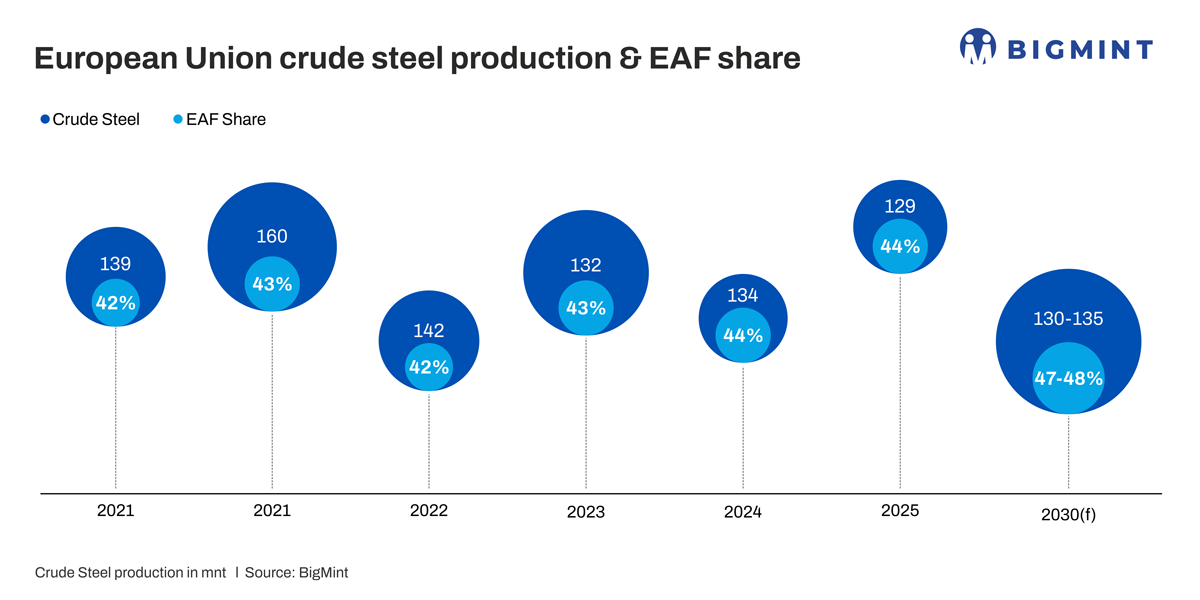
Lower crude steel production since 2022 has reduced domestic scrap consumption, allowing larger export volumes despite weaker steel output.
Over 1/5th of Europe’s scrap reaches export markets
As steel production gradually stabilises and green steel investments gather pace, domestic scrap consumption is expected to increase, reducing the amount available for export.

Green transition impact scrap market dynamics
Europe’s decarbonisation strategy is gradually changing the way scrap is consumed.
Unlike blast furnaces, EAFs rely primarily on ferrous scrap, while direct reduced iron (DRI) is increasingly expected to complement metallic requirements for low-carbon steelmaking.
Although EU crude steel production is projected to remain broadly stable at 130-135 mnt by 2030, the production mix is expected to shift further towards EAFs.
Even without major capacity additions, replacing blast furnace production with EAF steelmaking increases domestic scrap requirements.
Meanwhile, DRI consumption is expected to rise from 3.1 mnt in CY25 to around 4-5 mnt by CY30, supporting Europe’s transition towards lower-carbon steel production.

Scrap generation growing, but not dramatically
One common misconception is that Europe will simply generate enough additional scrap to offset rising demand. BigMint estimates scrap generation at around 86 mnt during CY’25.
By 2030, generation could increase modestly to around 90-95 mnt.
Consumption, meanwhile, is expected to reach approximately 75-85 mnt depending on EAF utilisation and steel production.
This implies Europe should remain structurally long in scrap. However, the exportable surplus could gradually narrow compared with today’s levels.
In other words, Europe is unlikely to run out of scrap but it may have less available for overseas buyers.
WSR changes the equation
Policy may prove just as important as steel production.
The EU’s revised Waste Shipment Regulation (WSR) is expected to tighten export conditions for ferrous scrap shipments to non-OECD countries from 2027.
Rather than banning exports outright, the regulation seeks to ensure recyclable materials are processed under environmental standards comparable to those within Europe.
Combined with CBAM and Europe’s broader decarbonisation agenda, the regulation reinforces the region’s strategy of retaining more recyclable materials to support domestic green steel production and strengthen the circular economy.
Although CBAM does not directly regulate ferrous scrap exports, it could indirectly support higher domestic scrap consumption by encouraging low-carbon steel production within Europe. As steelmakers increase electric arc furnace capacity to reduce emissions, scrap demand is expected to rise, potentially reducing exportable surplus over time.
Europe is not alone
Europe’s policy direction reflects a broader structural shift across the global scrap market.
The UAE has introduced temporary restrictions on exports of ferrous, aluminium and copper scrap. The United States continues investing in domestic EAF steelmaking while encouraging local manufacturing through trade measures. China also plans to increase the share of EAF steelmaking from around 10% to 15%, potentially creating an additional 45 mnt of annual scrap demand over the medium term.
Collectively, these developments suggest that more scrap-producing countries are prioritising domestic consumption over exports.
How may EU scrap demand evolve by 2030?
The future of European scrap exports will largely depend on crude steel production and EAF utilisation rather than scrap generation alone.

Who benefits if Europe’s scrap exports decline?
A reduction in Europe’s exportable surplus would create opportunities for alternative suppliers to expand their presence in global scrap markets. The United States is likely to be the biggest beneficiary given its abundant obsolete scrap availability and established export infrastructure. The UK, despite being outside the EU, could strengthen its position as a regional supplier depending on domestic scrap consumption and EAF expansion.
Japan may benefit from a weaker yen and competitive bulk scrap exports, while Australia and Brazil could gain market share in Asia through increased bulk shipments.
In the Middle East, growing scrap processing capacity and rising metallics trade could also support higher regional exports, although volumes are expected to remain smaller than those of Europe and the US.
What does this mean for global buyers?
The implications extend well beyond Europe.
Turkiye, India, Bangladesh and Pakistan have traditionally relied heavily on European scrap. If Europe’s exportable surplus gradually declines, competition for premium HMS and shredded scrap is likely to intensify.
Alternative suppliers-including the US, UK, Brazil and Australia-may only partially offset tighter European availability as many of these regions are also expected to increase domestic scrap consumption.
Key takeaway
Europe’s scrap outlook will be driven more by utilisation than production. Higher EAF usage, stricter regulations and circular economy policies are expected to gradually reduce exportable surplus, making long-term access to European scrap increasingly competitive for global buyers.

Leave a Reply