- Gulf aluminium output drops 35% amid regional conflict
- Brent tops $91 amid 11th consecutive night of US strikes
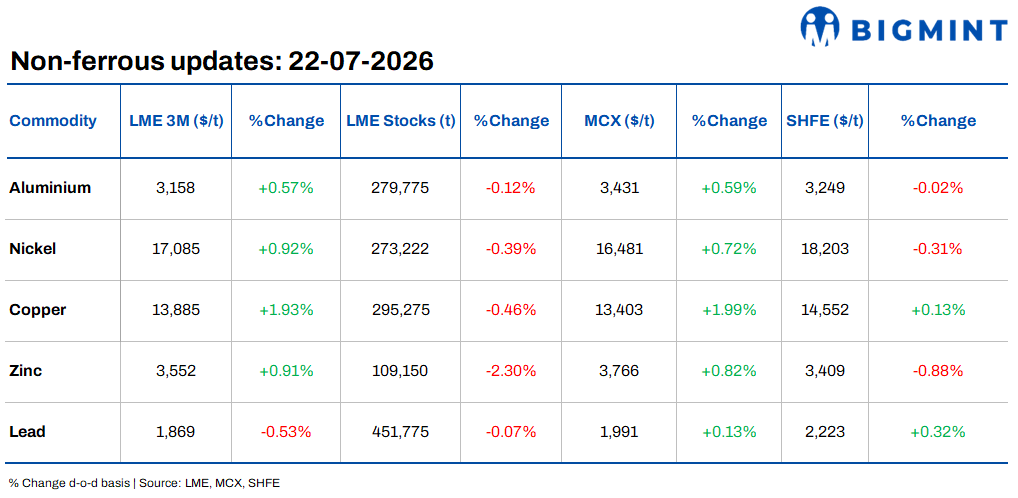
LME base metals traded mostly higher on 21 July, supported by tightening exchange inventories and improving market sentiment. Copper led the gains, rising 1.93% d-o-d to $13,885/t, followed by nickel, up 0.92% to $17,085/t, zinc, which gained 0.91% to $3,552/t, and aluminium, which increased 0.57% to $3,158/t. Lead was the only major loser, slipping 0.53% to $1,869/t.
LME inventories continued to decline across all major base metals, indicating persistent supply tightness. Copper stocks fell 0.46% d-o-d to 295,275 t, extending their recent downtrend. Zinc inventories recorded the sharpest decline, dropping 2.30% to 109,150 t, while nickel inventories decreased 0.39% to 273,222 t. Aluminium stocks eased 0.12% to 279,775 t, and lead inventories edged down 0.07% to 451,775 t, reinforcing expectations of tighter physical availability.
Domestic market overview
India’s non-ferrous scrap market remained largely steady on 21 July. Aluminium tense scrap (loose), ex-Delhi, was unchanged at INR 265,000/t, while ex-Chennai prices also remained stable at INR 255,000/t.
Meanwhile, copper armature scrap (Cu 99%), ex-Delhi, rose by INR 20,000/t, or 1.61% d-o-d, to INR 1,260,000/t, tracking the sharp rally in LME copper prices and improved buying sentiment.

Oil surges on escalating Middle East conflict
Global crude oil prices extended their rally on 22 July, with Brent crude climbing 4.28% d-o-d to $92.28/bbl, while WTI crude advanced 3.99% to $85.42/bbl. Natural gas edged up 0.67% to $2.87/MMBtu.
Oil prices surged to their highest level in nearly five weeks as geopolitical tensions in the Middle East intensified. The United States launched its 11th consecutive night of strikes on Iranian military targets, while Iran reportedly targeted US facilities in Bahrain, Kuwait and Jordan and launched drones intercepted by Kuwaiti air defences.
Supply concerns escalated further after Yemen’s Iran-backed Houthis threatened to target vessels carrying Saudi crude through the Bab el-Mandeb Strait and announced a naval blockade of Saudi Arabia. The growing security risks have prompted shipowners to demand higher premiums for vessels transiting the region.
Analysts warned that any prolonged disruption across these key shipping corridors could tighten global crude supplies and sustain upward pressure on energy prices. Meanwhile, the US Defence Department estimated that military operations against Iran have cost approximately US$37.5 billion, underscoring the escalating scale of the conflict and its implications for global energy markets.
Other updates
Global aluminium output declines 1.5% in June
Global primary aluminium production declined 1.5% y-o-y to 6 mnt in June’26, according to the International Aluminium Institute (IAI), largely due to sharp output losses in the Gulf following the Middle East conflict.
Gulf aluminium production fell to 0.33 mnt from 0.51 mnt a year earlier after Iranian attacks on two regional smelters disrupted operations and export logistics. On a daily basis, Gulf production remained steady at 11,000 t, well below the pre-conflict level of 17,800 t/day. Meanwhile, global average daily aluminium production edged up 0.3% m-o-m to 199,300 t/day, reflecting gradual recovery in production outside the conflict-affected region.
BHP pilots lower-carbon copper cable value chain
BHP has partnered with Mitsubishi Materials, NTT DATA Japan, Amazon Japan and other industry participants to launch a demonstration project for producing lower-GHG copper cables using a mass balance credit model across the supply chain.
The project will use copper concentrate from BHP-operated Escondida in Chile, where 100% of purchased electricity comes from renewable sources, before processing it into wire rods and cables for installation at an Amazon Japan logistics facility. The initiative aims to improve the traceability and transparency of low-carbon copper products while validating a chain-of-custody system that transfers environmental attributes from mine to end user.

Leave a Reply