- LME base metals trade lower due to concerns over AI-related spending
- Crude oil prices retreat despite sharp US crude inventory draw
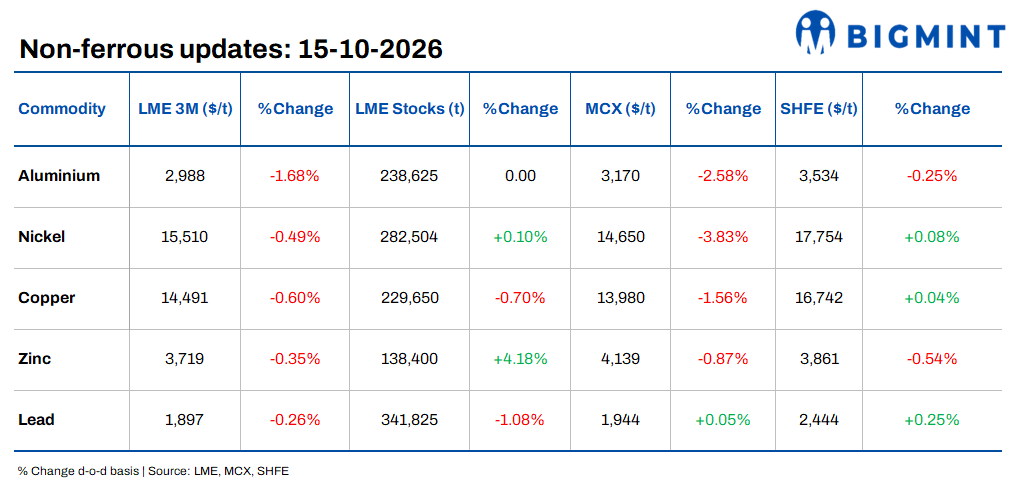
LME base metals traded lower on 14 October. Aluminium recorded the steepest decline of 1.68% d-o-d to $2,988/t, followed by copper, down 0.60% to $14,491/t. Nickel slipped 0.49% to $15,510/t, while zinc eased 0.35% to $3,719/t. Lead registered the smallest decline, losing 0.26% to $1,897/t.
The decline reflected weaker investor risk appetite, concerns over AI-related capital spending, and expectations of rising metal supply. A technology-stock sell-off raised doubts over future demand from data centres and power infrastructure, while expanding Indonesian aluminium capacity, Gulf smelter restarts, and projected copper and nickel surpluses added to bearish sentiment. However, low aluminium inventories and tight regional copper and zinc supplies could limit further downside.
LME inventories recorded mixed movements. Zinc stocks rose 4.18% to 138,400 t, while lead inventories fell 1.08% to 341,825 t. Copper stocks declined 0.70% to 229,650 t, followed by nickel inventories, up 0.10% to 282,504 t. Aluminium stocks remained unchanged at 238,625 t.
Domestic market overview
India’s non-ferrous market showed mixed movement d-o-d, with aluminium tense scrap prices unchanged across tracked locations, while aluminium ingot and copper scrap prices declined.
Aluminium tense scrap (loose) remained unchanged at INR 242,000/t ex-Delhi and INR 245,000/t ex-Chennai. P1020 aluminium ingot fell by INR 3,000/t, or 0.89%, to INR 334,000/t from INR 337,000/t. MCX aluminium declined 2.58% to $3,170/t.
Meanwhile, copper armature scrap (Cu 99%), ex-Delhi, slipped by INR 1,000/t, or 0.07%, to INR 1,347,000/t from INR 1,348,000/t. MCX copper fell 1.56% to $13,980/t.

Other updates
Oil prices retreat despite sharp US crude inventory draw
Brent crude fell by more than 1% in early trading on 15 October, reaching approximately $104.68/bbl. The decline followed heightened shipping risks around the Strait of Hormuz and renewed Middle East tensions. The American Petroleum Institute estimated that US crude inventories fell by 11.12 million barrels in the week ended 9 October, following a 2-million-barrel decline the previous week. Official US Energy Information Administration data remained pending, leaving traders to weigh tightening inventories against uncertainty over future supply flows.
BHP averts strike at Escondida
BHP and the supervisors’ union at Chile’s Escondida copper mine reached an agreement on 14 October, averting a potential strike. About 64% of union members approved the proposal, which establishes a 36-month contract covering compensation, benefits and additional bonuses. Escondida produced approximately 1.26 mnt of copper in FY2026 (July 2025–June 2026), down 3% year-on-year. The agreement removes an immediate operational risk for the world’s largest copper mine, although broader supply constraints and low exchange inventories remain relevant to market availability.
Aurubis sets record 2027 copper premium at $347/t
German copper producer Aurubis has reportedly set its 2027 annual contractual copper premium for European customers at $347/t, up 10.2% from $315/t in 2026. The $32/t increase applies to the premium paid above the LME benchmark, not the underlying copper price. Market participants have linked the higher offer to metal flows towards the United States ahead of potential tariffs and constrained concentrate availability. The premium signals elevated physical procurement costs, although subdued spot buying may limit acceptance among some consumers.
Russian Aluminium Accounts for Nearly All Available LME Stocks
Data released on 14 October showed that Russian-origin aluminium accounted for 99.98% of available LME aluminium inventories in September, as total available stocks fell 6.5% m-o-m to 226,675 tonnes, the lowest since March 2025. Limited acceptance of Russian metal among traders may constrain the effective availability of exchange stocks.
Leave a Reply