- MCL, SECL lead m-o-m production recovery in Sep’26
- CIL continues to draw down stocks to meet demand
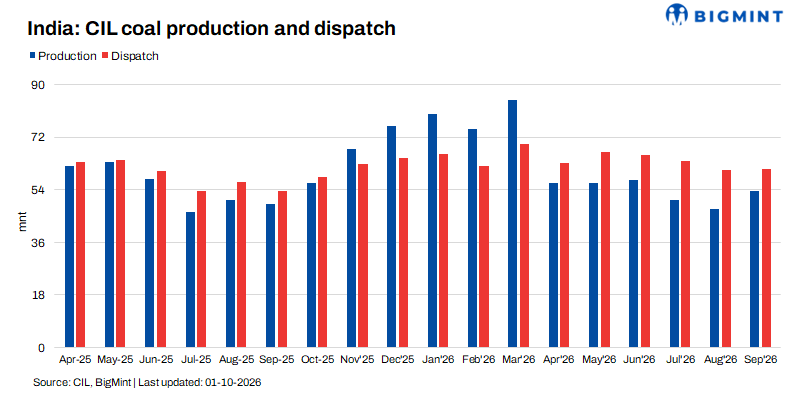
Coal India Ltd (CIL) recorded a strong m-o-m recovery in coal production in September 2026, with output rising to 53.5 million tonnes (mnt) from 47.5 mnt in August, an increase of 12.6% m-o-m. Production was also around 9.2% higher y-o-y compared with 49 mnt in September 2025.
However, dispatches continued to outstrip production. Dispatches stood at 61.2 mnt in September, up 1% m-o-m and 12.5% y-o-y. The continued gap between dispatch and production indicates that miners are drawing on available stocks to meet sustained demand from the power and industrial sectors.
MCL, SECL lead Sep production recovery
The September production increase was largely supported by Mahanadi Coalfields Ltd (MCL) and South Eastern Coalfields Ltd (SECL). MCL’s output rose to 17.6 mnt, up 23.9% m-o-m, while SECL production increased to 11.4 mnt, up 15.2%.
Western Coalfields Ltd (WCL) also recorded a strong recovery, with production rising 20.6% m-o-m to 4.1 mnt. Bharat Coking Coal Ltd (BCCL) and Central Coalfields Ltd (CCL) posted more moderate increases, while Eastern Coalfields Ltd (ECL) declined 5.4% m-o-m to 3.5 mnt. Northern Coalfields Ltd (NCL) remained unchanged at 8.5 mnt.
The recovery across major subsidiaries suggests that production constraints seen during the monsoon period have eased to some extent, allowing CIL to increase mining activity as operating conditions improve.
Dispatch growth continues to outpace production
Despite the production recovery, CIL’s dispatch remained strong at 61.2 mnt, leaving a production-dispatch gap of around 7.7 mnt during September. MCL accounted for the largest dispatch at 19.2 mnt, followed by SECL at 13.6 mnt and NCL at 8.9 mnt.
The strong dispatch indicates continued coal demand from the power sector, particularly as thermal power plants maintain higher coal requirements ahead of the peak-demand and post-monsoon period. Higher dispatch also suggests that CIL continues to prioritise supply to consumers even while production is recovering.
Six-month production remains under pressure
Despite the September rebound, CIL’s cumulative production during April-September FY’27 stood at 321 mnt, down around 2.5% y-o-y from 329.1 mnt during the corresponding period of FY26.
The decline has been concentrated among key producers. MCL’s six-month production fell 9.3% y-o-y to 87.5 mnt, while NCL declined 16.4% to 58 mnt and BCCL fell 12.5% to 13.8 mnt. These declines outweighed gains from CCL, SECL and WCL.
In contrast, cumulative dispatch increased 7.6% y-o-y to 384.2 mnt, compared with 357 mnt a year earlier. This widening divergence between production and dispatch highlights the importance of inventory availability in sustaining consumer supplies.
Key reasons behind current movement
- Post-monsoon production recovery: Improved mining and transportation conditions have supported the sharp September rebound in output.
- Strong power-sector demand: Higher coal requirements from thermal power plants have kept CIL dispatch elevated.
- Inventory drawdown: Dispatch remaining above production indicates continued dependence on available stocks to bridge the supply gap.
- Subsidiary-wise performance divergence: Strong gains at MCL, SECL and WCL in September helped lift overall production, although cumulative output at some major subsidiaries remains below last year.
- Higher pre-winter stocking requirements: Power utilities are likely to maintain coal procurement to strengthen inventories ahead of the upcoming higher-demand period.
Outlook
CIL’s near-term production outlook remains moderately positive, supported by improved post-monsoon mining conditions and efforts to ramp up output at key mines. However, sustained production growth will be necessary to bridge the cumulative deficit and rebuild inventories. Dispatch is expected to remain firm, particularly with continued coal demand from the power sector. Accordingly, the production-dispatch gap will remain a key market indicator, with a sustained surplus of production over dispatch required to ease supply tightness and replenish stocks.
Overall, September indicates an improvement in mining activity, although supply conditions remain relatively tight. The market outlook will depend on CIL’s ability to consistently increase production ahead of dispatch during the post-monsoon period.
Leave a Reply