- Steel inventories at CISA mills drop in late-March
- Low purchasing activity ahead of holidays
- HRC export offers stable w-o-w
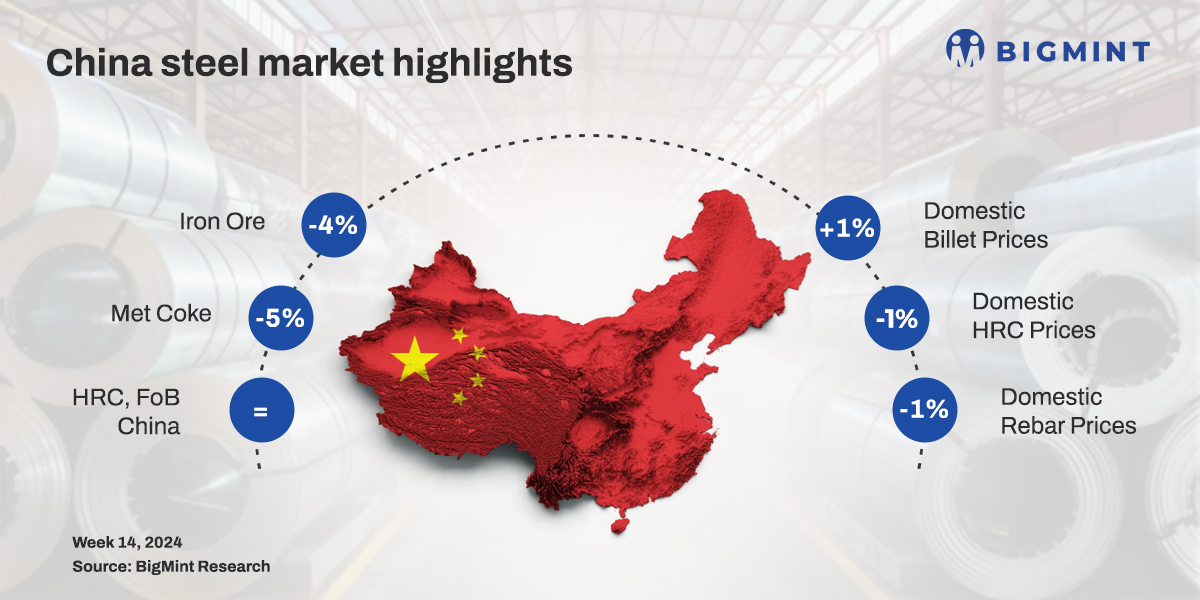
Chinese steel prices showed down this week before the Qingming Festival. Domestic prices of HRC, rebar, iron ore, coking coal and billets decreased significantly. However, HRC export prices remained stable amid reduced trading activities.
The China Iron and Steel Association (CISA) reported total steel inventory of key enterprises in late-March 2024 at 18.427 million tonnes (mnt), a decline of 1.106 mnt or 5.66% compared to 19.523 mnt in mid-March.
The average daily crude steel output of CISA-affiliated mills stood at 2.121 mnt in late-March, an increase of 3.63% from 2.048 mnt in mid-March. Also, output inched down by 0.4% m-o-m against 2.13 mnt in late-February.
1. Iron ore spot prices fall by $4/t: The benchmark iron ore fines price dipped $4/t to $98.5/ t CFR China on 5 April as against 28 March amid sluggish market sentiments and weak market fundamentals. Market participants are away from the market for the Qingming festival from 4 to 6 April. The NDRC of China, the Ministry of Industry and IT, and other authorities have initiated talks and strategic planning for regulating steel production in 2024.
Iron ore inventory at major Chinese ports inched down by 0.15 mnt to 141.95 mnt on 2 April compared to last week, according to SteelHome data.
a) Spot pellet premium drop w-o-w: Spot pellet premium for Fe 65% grade pellets decreased by $ 0.4/t w-o-w at $11.8/t on 3 April.
b) Spot lump premium fall: Spot lump premium decreased by 0.01 at $0.0510/dmtu on 5 Apr’24 against 28 March.
2. Coking coal prices decline w-o-w: Coking coal prices dropped by 9% w-o-w to $224/t FOB on 6 Apr’24 amid reduced offer levels.
3.Billet prices edge up by RMB 20/t ($3/t): Notably, prior to Qingming festival holidays, in the previous week, Chinese billet prices increased slightly by RMB 20/t ($3/t) w-o-w to RMB 3,300/t ($456/t) on 3 April against 29 March. Recovery in October delivery rebar futures and production cut news have provided support to billet prices. Meanwhile, Chinese SHFE rebar futures (Oct’24) rose by RMB 51/t ($7/t) w-o-w to RMB 3,463/t ($479/t) on 3 April as against 29 March.
4.HRC prices decrease w-o-w: Domestic HRC prices in China declined by RMB 30/t ($4/t) w-o-w to RMB 3,700/t ($512/t) against RMB 3,730/t ($516/t) previous week, following the downward trend in HRC futures and Qingming Festival holidays. SHFE HRC futures (May contract) fell by RMB 51/t ($7/t) w-o-w to RMB 3,692/t ($510/t) on 3 April compared to RMB 3,743/t ($517/t) on 27 March. However, Chinese HRC export offers remained stable for the week at $535/t.
5.Rebar prices decrease w-o-w: Chinese rebar prices went slightly down by RMB 20/t ($3/t) w-o-w to RMB 3,520/t ($487/t) compared to RMB 3,540/t ($489/t) a week ago. Moreover, SHFE rebar futures (May contract) remained range bound at RMB 3,509/t ($485/t) on 3 April.
China’s Shagang Steel has kept long steel prices unchanged for early-Apr’24 sales after reducing the prices for mid-Mar’24 and late-Mar’24 sales.Effective prices:
- Rebar (16-25 mm): RMB 3,920/t ($542/t)
- Wire rod (6-10 mm): RMB 3,970/t ($549/t)
- Coiled rebar (8-10 mm): RMB 3,960/t ($548/t)
All prices are ex-mill, including VAT
Steel producers are facing significant challenges. Steel prices are dropping and putting pressure on profits, but factories are overflowing with unsold steel. This is because even in the peak construction season, there is not enough demand due to limited project funding. As a result, steel production is expected to decline, and stockpiles might shrink slightly in April, but only if demand picks up.

Outlook: China’s steel production faces challenges in the near future. Reports indicate that the Ministry of Industry and Information Technology plans to organise a symposium involving major steel companies such as Baowu Group, Anshan Iron and Steel Group, Shougang Group, and Hegang Group. The objective is to delve into the challenges and underlying issues hindering the steel industry’s development, aiming to facilitate its smooth operation and sustainable growth.
While some improvement is possible with seasonal construction increase, long-term challenges remain due to weak real estate and limited infrastructure spending. Government policies could offer some support, but a significant turnaround seems unlikely.