- Steelmakers increase scrap usage to meet environment goals
- Ferrous scrap consumption to increase 23% by 2025
- Iron ore demand for steelmaking to drop by 2% this year
- Iron ore imports to fall further this year
As China is striving towards achieving net zero emissions by 2060, the steel producers in the country are gradually increasing the usage of local and imported scrap in crude steel-making to meet the decarbonisation goals.
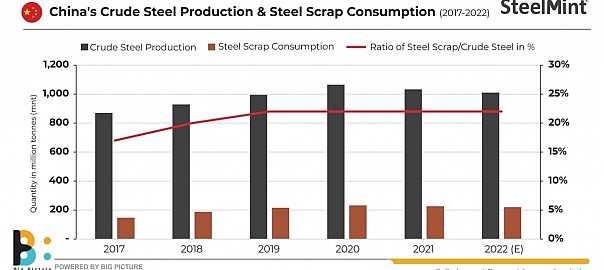
While global ferrous scrap consumption in crude steel-making was 610 million tonnes (mnt) in calendar year 2022 (CY22), China’s share in it was 37% at 225 mnt. The country’s consumption volume was more or less stable y-o-y as against 226 mnt in 2021.
Total ferrous scrap consumption in the country was around 250 mnt, down 17.4 mnt or 6.5% y-o-y, according to a report from China. The use of scrap was affected by several factors, including the surge in Covid infections followed by lockdowns in several key provinces in China, the economic downturn, taxation problems and high standards regarding the content of inclusions in relation to imported secondary raw materials.
That apart, China’s crude steel production inched down 2% y-o-y from 1.033 mnt in 2021 to 1.01 mnt in 2022 which also dragged down the overall scrap usage.
Meanwhile, as scrap usage in steelmaking dropped in the second half (H2) of 2022, demand for iron ore increased by more than 10.5 mnt.
Also, ferrous scrap generation, which had been steadily rising since the past few years, saw a 10 mnt or 4% y-o-y dip to 260 mnt from 270 mnt in 2021 because of the Covid surge as well as the severe winter which disrupted logistics movements.

Increasing scrap usage offsetting iron ore demand
China plans to increase its use of ferrous scrap by 23% to 320 mnt by 2025 and increase production of recycled non-ferrous metals, in an effort to be self-sufficient in domestic supplies and to also meet the country’s climate commitments.
It is expected that with the relaxation of lockdown restrictions, the activities of China’s Association for Scrap Recycling will revive.
According to the China Metallurgical Industry Planning and Research Institute (MPI) forecast, scrap production in China will grow to more than 340 mnt by 2025, increasing by 31% compared to 2020. At the same time, the China Iron and Steel Association (CISA) has set a goal to increase the use of scrap in crude steel-making to 300 mnt by 2025.
MPI also stated in its review report that the increase in scrap supplies is offsetting demand for 35 mnt of iron ore from China’s steel sector.
Iron ore demand to fall by 2% in 2023
As for iron ore, its consumption in the Chinese steel sector is expected to fall by 2.3% y-o-y to 1.33 billion tonnes (bnt) in 2023 compared to the previous year. This assumption is based on a projected reduction in the volume of steel smelting in the country by 1% to approximately 1 bnt compared to 2022.

In 2022, China’s iron ore imports inched down by about 2% y-o-y to 1.108 bnt, as per the General Administration of Customs. The slight drop in imports was on account of crude steel production curbs in the country. Secondly, higher run of mine (ROM) iron ore production in China also played a part in lowering imports y-o-y.
In 2023, iron ore import volumes into the country are expected to decrease further to 1.085 bnt. China, the largest buyer of raw materials in the world, is highly dependent on supplies from Australia and Brazil (world’s largest iron ore suppliers) to meet its needs.
At the same time, the supply of raw materials from India in 2023 is expected to increase by approximately 20 mnt after the export duties on Indian iron ore were removed in November 2022. Chinese mining companies are also aiming to increase iron ore output in the coming years. In addition, the Chinese government seeks to increase investments in foreign projects.

Leave a Reply