- Carbon measurement framework strengthens steel industry data transparency
- Domestic demand remains uneven amid elevated inventories
China’s steel industry is entering a new era of carbon measurement. The State Administration for Market Regulation, National Development and Reform Commission (NDRC), and Ministry of Ecology and Environment (MEE) have jointly issued the Guidance Catalogue for Carbon Emission Measurement Capacity Building (2026 Edition), tightening requirements for measurement equipment, testing standards and data traceability.
With steel now under national carbon-market compliance and facing growing EU CBAM pressure, the new framework is expected to shift carbon accounting from default emission factors toward actual measurement and verifiable data. This will help address gaps in metering, calibration and process-level data, strengthening carbon-data accuracy and supporting the industry’s green transition.
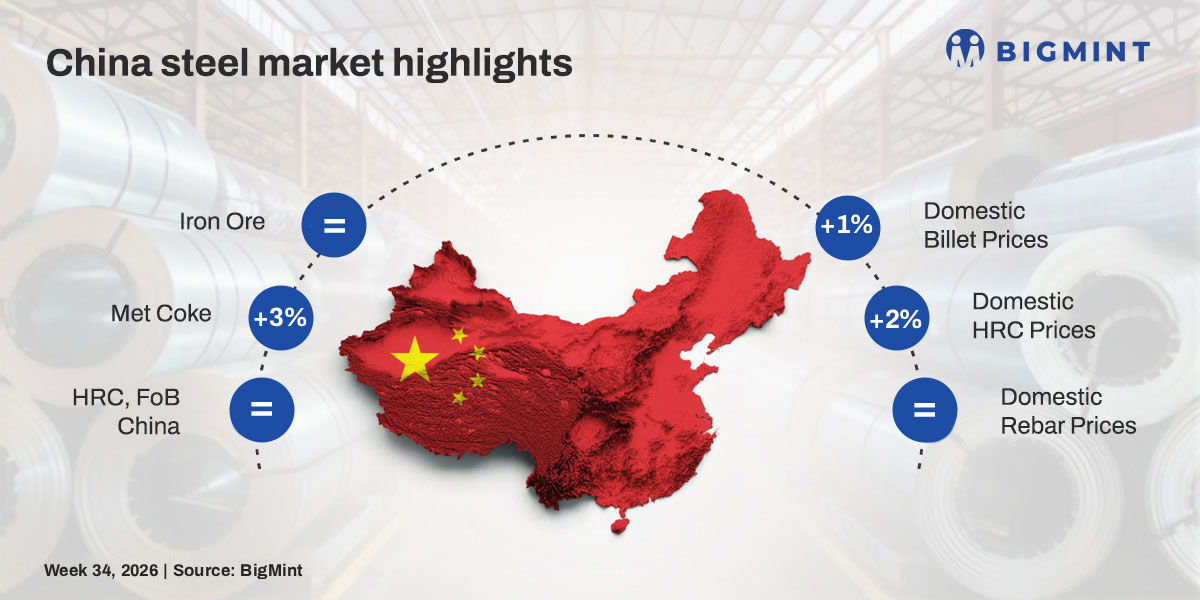
Looking at the market this week, firstly, there was some divergence in raw material prices, with coking coal and coke continuing to strengthen while iron ore prices stable, resulting in an overall stronger raw material market and some support for finished steel costs.
Steel price trend
Domestic HRC prices rise: China’s domestic hot-rolled coil (HRC) prices increased by RMB 60/t ($9/t) w-o-w to around RMB 3,210/t ($478/t) on 21 August, compared with RMB 3,150/t ($469/t) a week earlier. Furthermore, SHFE HRC futures (October 2026 contract) were up by RMB 30/t ($4/t) to RMB 3,298/t ($491/t) from RMB 3,268/t ($487/t) in the previous week.
China’s HRC market moved higher this week, with prices supported by tighter supply and firm raw-material costs. The market showed a regional divergence, with stronger conditions in the north and weaker sentiment in the south. Maintenance at northern mills tightened HRC availability, while manufacturing and export demand remained relatively resilient.
However, the demand recovery after the typhoon was weaker than expected, and high inventories continued to weigh on the market. Firm coking coal, coke and iron ore costs provided further support, but improving mill margins and easing production restrictions limited the scope for significant supply cuts. Overall, HRC prices remained supported mainly by costs and supply tightness rather than a strong demand recovery.
Meanwhile, Chinese HRC export offers remained stable w-o-w at around $495/t FOB Rizhao, as sellers maintained firm offers despite limited buying interest from overseas buyers.

Rebar prices unchanged w-o-w: China’s domestic rebar prices stood stable w-o-w at around RMB 3,140/t ($467/t) on 21 August. However, SHFE rebar futures (October 2026 contract) marginally up by RMB 19/t ($3/t) to RMB 3,037/t ($452/t) from RMB 3,018/t ($449/t).Spot prices remained largely stable as moderate trading activity and active selling by mills limited upward movement. Meanwhile, futures prices edged higher, supported by declining inventories, typhoon-related supply disruptions and expectations of tighter availability as maintenance reduced steel production. With blast furnace operations gradually recovering, the market is expected to remain rangebound in the near term.
China’s Shagang Steel has reduced its long steel prices by RMB 50/t ($7/t) for sales during 21-31 August, as weak construction demand and elevated inventories continue to weigh on the domestic market. The producer lowered its rebar (16-25 mm) price to RMB 3,250/t ($483/t), coiled rebar (8-10 mm) to RMB 3,380/t ($503/t), and wire rod (6-10 mm) to RMB 3,290/t ($489/t).
The reduction comes as China’s construction-steel market continues to face weak end-user demand, with high temperatures, heavy rainfall and typhoons disrupting construction activity and limiting near-term procurement. Although inventories have eased recently, stock levels still remain elevated, keeping pressure on mills and limiting scope for price increases.
Raw materials front
Iron ore spot prices steady w-o-w: Iron ore fines benchmark prices for Fe 61% remained rangebound w-o-w at $95/dmt CFR China on 21 Aug’26. The price support prevailed due to uncertainty around Australian supply, although the market remained largely cautious as buyers assessed the sustainability of the recent price rise. Most mills have already covered their immediate requirements, reducing the need for additional purchases in the near term.
Attention remained on the ongoing term contract discussions between China Mineral Resources Group (CMRG) and major Australian miners. Meanwhile, uncertainty around labour negotiations at Port Hedland also continued to influence market sentiment.
a) Spot pellet premium rise w-o-w: Spot pellet premium for Fe 65% grade pellet gained by $2.05/t to $25.85/t CFR China on 19 August.
b) Spot lump premium rose w-o-w: Spot lump premium edged up by $0.01/t w-o-w to $0.2810/t CFR China on 21 August.
Coking coal rally gains momentum on tight supply and stronger Chinese buying: China’s coking coal market remained firm on mine-safety curbs, tight domestic supply and restocking demand, while Mongolian supply constraints and higher auction prices added support. Chinese coke producers raised prices by Yuan 50–55/t amid rising raw-coal costs and stronger blast-furnace demand. Seaborne coking coal prices surged, with Australian PHCC up $23/t w-o-w to $248/t FOB and BigMint’s index up $20/t to $265/t CNF Paradip, driven by stronger Chinese buying and Shanxi supply disruptions.
Billet prices rise w-o-w as buying improves: Chinese billet and rebar prices strengthened in the week ended 21 August, supported by improving domestic buying, lower social inventories and firmer raw-material costs. Billet rose RMB 20/t ($3/t) w-o-w, although demand remained uneven.
Qian’an Tangshan billet prices increased to RMB 2,960/t ($440/t) on 21 August from RMB 2,940/t ($437/t) on 14 August. Prices rose twice during the week before stabilising.
EAF margins remained under pressure despite some improvement, while expectations of stronger September demand supported sentiment. In the export market, billet offers increased by $4-5/t to around $452/t FOB, while a weaker RMB made negotiations more challenging.
Outlook
China’s domestic steel market is expected to remain range-bound with a mild upward bias in the near term, supported by firm raw-material costs and tighter availability amid ongoing maintenance. However, uneven downstream demand and elevated inventories are likely to limit the scope for a sustained price rally. Market direction will largely depend on mill production, inventory trends and the pace of demand recovery.
Leave a Reply