- Early June inventories at key mills up 3% against end-May
- Iron ore stocks at Chinese ports rise by 1.4 mnt w-o-w
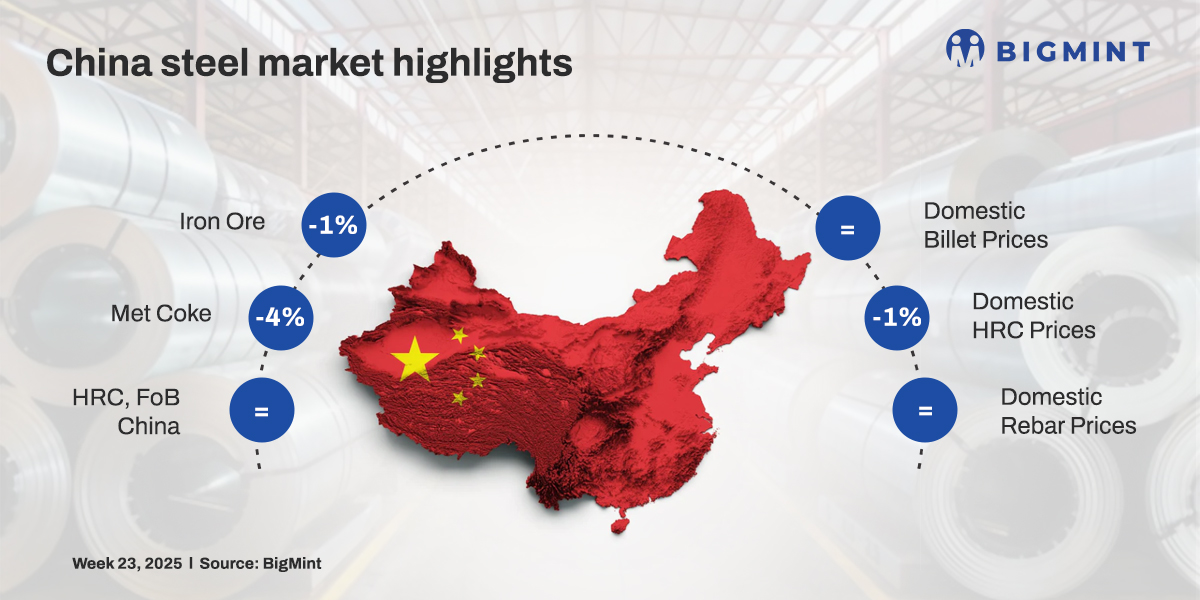
China’s steel market displayed a mixed picture for the week . Domestic prices of hot-rolled coils (HRC) and billets declined w-o-w, while, rebar remained stable. In the raw materials segment, spot iron ore and coking coal prices dropped over the week.
The China Iron and Steel Association (CISA) has announced that the total steel inventory at key Chinese enterprises was at around 15.79 million tonnes (mnt) in early-June 2025, up by 490,000 tonnes (t) or 3.2% as compared to 15.3 mnt in late-May 2025
1. Iron ore spot prices fall by $1/t w-o-w: The benchmark iron ore fines spot price fell $1/t w-o-w to $95/t CFR China on 13 June. Prices are under pressure due to higher supplies of medium-grade fines from Australia and Brazil and weak demand, as the market awaits clearer macro-economic guidance. Following the US-China negotiations, caution remains as the market looks for direction from the Chinese government. Increased iron ore shipments have eased supply concerns, reducing urgency in the market.
Iron ore inventory at Chinese ports increased by 1.4 mnt w-o-w to 133.4 mnt on 12 June, as per data published by SteelHome.
a) Spot pellet premium rise w-o-w: The spot pellet premium for Fe65% grade pellet inched up by $0.25/t w-o-w to $13.05/t CFR China on 11 June.
b) Spot lump premium decreases w-o-w: Spot lump premium edged down by 0.0045/t to $0.1600/dmtu on 13 June.
2. Coking coal prices decline w-o-w: Australia’s PHCC prices declined by $6/t w-o-w to $179/t FOB, weighed down by weak buying interest and abundant supply. In China, metallurgical coke prices dropped by RMB 150-185/t since mid-May, driven by sluggish steel demand and elevated inventories, adding further pressure to the seaborne coal market.
3. Chinese billet prices inch down by RMB 10/t ($1/t) w-o-w: Steel billet prices in Tangshan, China, edged down by RMB 10/t ($1/t) w-o-w to RMB 2,900/t ($404/t), including 13% VAT, on 13 June. Billet prices recorded a dip due to reduced production in the downstream sector, weakening domestic raw material tags and fall in rebar futures. Meanwhile, SHFE rebar futures (October 2025 delivery) dipped w-o-w by RMB 6/t ($1/t) to RMB 2,969/t ($414/t) on 13 June.
4. Domestic HRC prices decline w-o-w: China’s HRC offers declined by RMB 40/t ($6/t) w-o-w to RMB 3,060/t ($425/t) against RMB 3,100/t ($431/t) a week ago, following the decline in SHFE futures. SHFE HRC futures dropped by RMB 26/t ($4/t) w-o-w to RMB 3,071/t ($427/t) on 13 June as compared to RMB 3,097/t ($430/t) on 6 June. The Chinese steel market is grappling with weak supply-demand fundamentals, characterized by weak demand and consistent production. This has led to oversupply, putting downward pressure on prices due to sustained demand sluggishness.
Chinese HRC export offers remained stable w-o-w at $445/t.
Chinese steel giant Baosteel has rolled over HRC prices for July 2025 sales, continuing a trend of price stability for the fourth straight month, as per sources. Additionally, prices of hot-dip galvanised products remained steady. The price stability reflects weak domestic demand due to the Dragon Boat Festival, while overall market activity remained bearish.
5. Domestic rebar prices remain stable w-o-w: China’s rebar offers remained stable w-o-w at RMB 3,170/t ($440/t). This stability in prices is due to sluggish end-user demand. This weakness in demand is largely attributed to heavy rainfall in several regions, which led market participants to maintain a bearish outlook on both rebar demand and prices. SHFE rebar futures (October 2025 contract) stood at RMB 2,962/t ($412/t) on 13 June, down by RMB 20/t ($3/t) as compared to RMB 2,982 /t ($414/t) on 6 June.
China’s Shagang Steel rolled over long steel prices for mid-June sales. Prices of rebars, coiled rebars, and wire rods are as follows:
- Rebars (16-25 mm): RMB 3,250/t ($453/t)
- Coiled rebars (8-10 mm): RMB 3,410/t ($475/t)
- Wire rods (6-10 mm): RMB 3,320/t ($462/t)

Outlook
China’s steel market faces a challenging outlook. Persistent oversupply, weak domestic demand especially in construction, and rising inventories will likely keep prices under pressure. Export opportunities may also decline due to increasing global trade barriers.
Leave a Reply