- Iron ore spot prices rise amid active restocking
- Billet prices drop $3/t despite late-week rebound
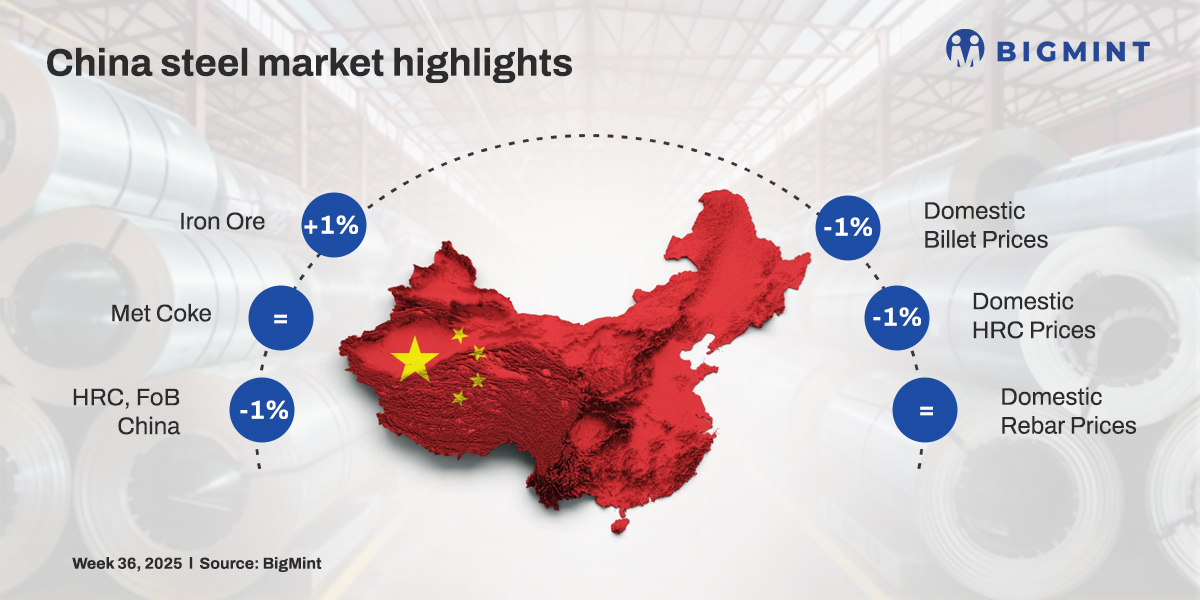
China’s domestic steel prices, including billets and hot-rolled coil (HRCs), declined w-o-w, while rebar increased. In the raw materials segment, trends were mixed, with iron ore prices rising and coking coal easing w-o-w.
The China Iron and Steel Association (CISA) has announced that the total steel inventory at key Chinese enterprises in late-August 2025 stood at 14.98 million tonnes (mnt), decreasing by 690,000 tonnes (t) or 4.4% compared with 15.67 mnt in mid-August 2025.
1. Iron ore spot prices rise w-o-w: The benchmark iron ore fines spot price increased by $1/dmt w-o-w to $105/dmt CFR China on 5 September. Prices rose on firm demand and active trading, supported by restocking expectations ahead of Golden Week and an anticipated demand recovery as mills resumed operations post-parade. Mills’ restocking added momentum, while portside prices strengthened on improved sentiment.
Iron ore inventory at Chinese ports rose by 1.19 mnt w-o-w to 131.52 mnt on 4 September, as per SteelHome data.
a) Spot pellet premium increases w-o-w: The spot premium for Fe 65% grade pellets inched up by 0.5/t w-o-w to $19.4/t CFR China on 3 September.
b) Spot lump premium rises w-o-w: The spot lump premium edged up w-o-w to $0.1850/dmtu on 5 September.
2. Coking coal prices edge down w-o-w: Australian premium HCC slipped $2/t w-o-w to $183/t FOB. Chinese met coke prices stayed flat on 2 September, as weak steel demand and lower rebar/HRC values curbed buying. Ningxia and Hebei mills cut coke bids by RMB 50-55/t ($7-8/t), with high stocks and softer coal costs fuelling expectations of further declines.
3. Billet prices drop $3/t w-o-w despite late-week rebound: Tangshan billet prices slipped RMB 20/t ($3/t) w-o-w to RMB 2,990/t. Early in the week, prices dropped RMB 60/t ($8/t) to RMB 2,950/t amid weaker raw materials, falling rebar futures, and fragile demand despite the peak season. Inventories climbed up to a 3-month high as steel output rose, while rebar demand stayed sluggish and exports to Southeast Asia and Africa slowed.
Mid-week stability was followed by a weekend rebound of RMB 30-50/t, supported by post-holiday restocking, firmer coking coal, and policy rumours. Still, flat steel buying outperformed longs, and uncertainty over September demand lingers with high stocks and muted construction activity.
4. Domestic HRC prices fall w-o-w: China’s domestic HRC offers fell by RMB 40/t ($6/t) w-o-w to RMB 3,180/t ($446/t) on 5 September 2025 from RMB 3,220/t ($451/t) a week ago amid falling SHFE futures. SHFE HRC futures fell by RMB 46/t ($6/t) w-o-w to RMB 3,320/t ($465/t) on 5 September, from RMB 3,366/t ($472/t) on 29 August.
In contrast, China’s HRC export offers declined by $5/t w-o-w to $475/t FOB, following concerns over a potential crackdown on non-VAT cargo exports.
5. Domestic rebar prices increase w-o-w: China’s rebar prices increased by RMB 10/t ($1/t) w-o-w to RMB 3,230/t ($453/t) against RMB 3,220/t ($451/t) a week ago amid rising SHFE futures. SHFE rebar futures (October 2025 contract) stood at RMB 3,126/t ($438/t) on 5 September, increasing by RMB 19/t ($3/t) as compared to RMB 3,107/t ($436/t) on 29 August.
Outlook
China’s steel market remains mixed, as billet prices eased despite a late rebound, HRC softened domestically and in exports, while rebar edged higher. Iron ore gained on restocking demand, but coking coal slipped amid weak steel margins. Inventories fell in late August, yet high port stocks and sluggish demand keep September price recovery uncertain.
Leave a Reply