- Pollution curbs, weak margins to limit hot metal output
- Prices to soften in 2nd half of Nov, first week may see hike
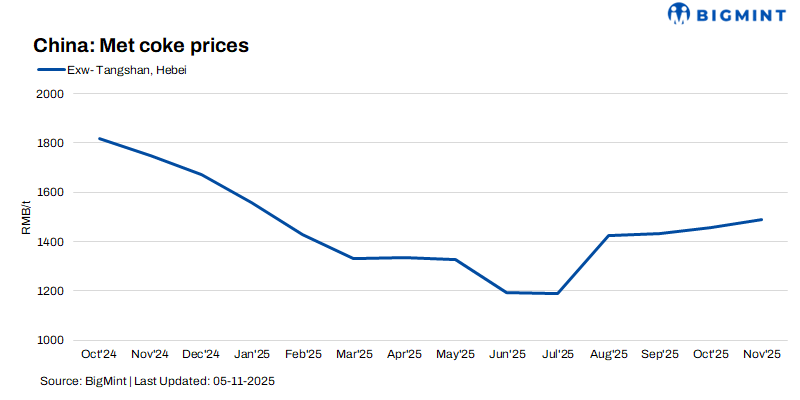
Mysteel Global: China’s metallurgical coke prices are expected to soften in the second half of November, as steelmakers’ demand for coke feed might weaken as further production cuts are predicted for this month, Mysteel’s latest monthly report on the commodity notes.
In October, surges in coking coal costs for China’s met coke producers had steadily eroded their profitability and encouraged them to press their steelmaker customers to accept higher met coke prices.
Separate price rises kicked in on 1 and 27 October, totalling RMB 100-110/tonne (t) ($14-15.4/t) for stamp-charged types and RMB 120-130/t for top-charged ones respectively, while a third increase is scheduled to take effect this Wednesday, five days later than the planned date of 31 October, according to market sources.
Consequently, as of 31 October, Mysteel assessed prices of Chinese quasi-first grade met coke for wet-quenching and dry-quenching types had risen by RMB 89.9/t and RMB 107.6/t, respectively, from late September to RMB 1,468.8/t and RMB 1,619.4/t.
During most of October, production of hot metal among the integrated steelmakers remained rather elevated, requiring a steady supply of coke feed to ensure that blast furnaces operated smoothly. It was this that provided the coke manufacturers with leverage during their price negotiations with the mills.
According to Mysteel’s survey of 247 blast furnace (BF) mills across the country, their average output of hot metal over October still hovered high at around 2.4 million tonnes/day (mnt/d), up 2.5% from the 2.34 mnt/d average a year ago.
However, their demand for met coke may gradually wane this month, according to Wang Jianhua, Mysteel’s chief analyst of steel products. The steelmakers’ hot metal production is expected to drop as the steelmakers grapple with thinning margins and because of government-mandated production curbs aimed at reducing airborne pollution, he suggests.
On 3 November, authorities in multiple cities in North China’s Hebei province, including the major steelmaking hub of Tangshan, once again required local sintering plants and BFs to reduce operations to tackle heavy air pollution. Similar production restrictions had been imposed by city authorities last week, leading to a 1.5% w-o-w decline in the average hot metal output among the 247 surveyed BF mills nationwide to 2.36 mnt/d, as Mysteel Global reported.
Meanwhile, the profitability of these 247 mills was also deteriorating, with only around 45% or 111 mills saying they could make some profits on steel sales as of 30 October, down by a significant 12 percentage points m-o-m and marking the lowest level in about a year, according to Mysteel’s survey.
During this month, poor profitability could likely cause steelmakers to reduce their hot metal production, a decision that would inevitably weigh on met coke prices.
Note: This article has been written in accordance with a content exchange agreement between Mysteel Global and BigMint.
Leave a Reply