- China’s exports fall 3% y-o-y to 75.2 mnt in 8M 2026, Aug shipments rise 6.8% y-o-y
- South Asia, CIS post double-digit growth; East Asia, MENA witness decline
- Price advantage supports exports, weak overseas demand limits growth
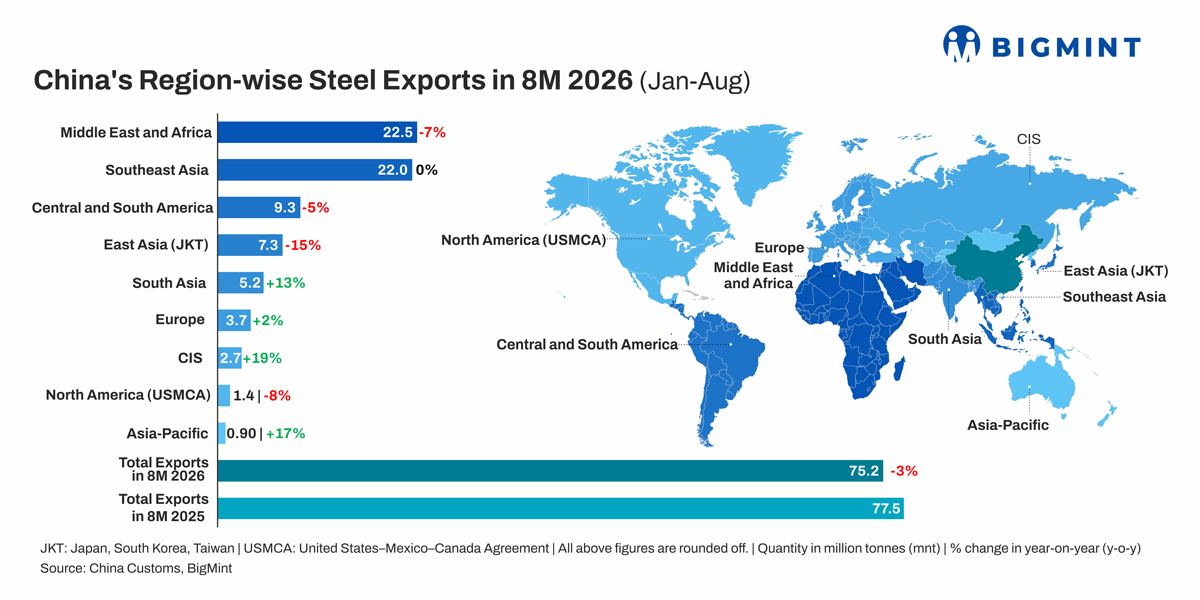
Morning Brief: China’s steel exports remained elevated in August despite softer overseas demand, with shipments reaching 10.155 mnt, up 6.8% y-o-y. January-August exports stood at 75.149 mnt, down 3% from 77.5 mnt a year earlier, although the cumulative decline continued to narrow. The regional mix shows a widening divergence with South Asia, CIS and Asia-Pacific recording double-digit growth, while East Asia and the Middle East and Africa posted declines.
South Asia and CIS gain share as major markets weaken
China’s exports to South Asia rose 13% y-o-y to 5.2 mnt in 8M 2026, led by higher shipments to India, Pakistan and Bangladesh. India received 1.87 mnt, up 29% y-o-y, while Pakistan imports rose 7% to 2.16 mnt and Bangladesh increased 8% to 0.86 mnt.
The CIS recorded an even stronger increase, with exports rising 19% to 2.72 mnt. Shipments to Uzbekistan rose 28% to 0.52 mnt and Ukraine increased sharply to 0.30 mnt from 0.08 mnt a year earlier. Russia remained broadly stable at 0.83 mnt.
Asia-Pacific also grew 17% to 0.90 mnt, although it remains a small destination compared with China’s major regional markets.
These gains partly offset weaker shipments to larger destinations. Exports to the Middle East and Africa fell 7% to 22.54 mnt, while East Asia declined 15% to 7.33 mnt and Central and South America fell 5% to 9.34 mnt.
Southeast Asia remains a core outlet despite flat growth
Southeast Asia remained China’s second-largest regional market, taking 21.97 mnt in 8M, broadly unchanged from 22.01 mnt a year earlier.
The regional total masks significant differences between markets. Vietnam remained the largest buyer at 5.84 mnt, although volumes fell 7% y-o-y. Thailand was nearly flat at 3.80 mnt, while Indonesia increased imports 2% to 3.18 mnt. Malaysia and the Philippines moved in opposite directions, with Malaysian imports rising 10% to 2.20 mnt while Philippine shipments declined 3% to 3.60 mnt.
Together, Southeast Asia and the Middle East and Africa accounted for around 44.5 mnt, or 59% of China’s total exports in the first eight months.
East Asia and the Americas remain under pressure
Exports to East Asia fell 15% y-o-y to 7.33 mnt, with shipments to South Korea down 18% to 4.18 mnt and Japan down 32% to 0.57 mnt. Taiwan’s imports declined 13% to 0.73 mnt.
Central and South America recorded a smaller 5% decline to 9.34 mnt, but country-level movements were uneven. Brazil imports fell 61% to 0.89 mnt and Chile declined 11% to 1.08 mnt, while Colombia increased 16% to 1.23 mnt and Peru rose 2% to 1.56 mnt.
North America remained a relatively small destination, with exports down 8% to 1.41 mnt. Shipments to the US increased 3% to 0.55 mnt, but Mexico fell 19% and Canada 5%.
Price advantage supports exports as trade barriers rise
China’s HRC FOB price was around $498/t at end-September, about $20/t below India, $67/t below Japan and $107/t below Turkiye.
The price advantage remains significant even as China’s new export order index for steel circulation enterprises fell to 46.8 in September, down 3.1 points m-o-m and remaining below the 50 threshold.
Trade protection is adding another constraint. Malaysia, Brazil and Indonesia launched new anti-dumping and anti-subsidy investigations into Chinese steel products during the month, while Vietnam, Australia, Canada and the US issued additional trade-remedy rulings. Rising overseas steel production and greater self-sufficiency are also reducing import requirements in some markets.
Outlook
China’s steel exports are expected to remain broadly stable at high levels in October as Chinese material retains a significant price advantage in overseas markets. HRC FOB prices were around $498/t at end-September, about $20/t below India, $67/t below Japan and $107/t below Turkiye. August shipments reached 10.155 mnt, up 6.8% y-o-y, even as January-August exports remained 3% below the year-earlier period.
The scope for further growth is narrowing, however, as weaker overseas orders and tighter market access offset price competitiveness. The new export order index for steel circulation enterprises fell to 46.8 in September, down 3.1 points m-o-m and below 50. Malaysia, Brazil and Indonesia have also initiated new anti-dumping or anti-subsidy investigations, while growing overseas steel production and self-sufficiency are reducing import requirements.
With competitive pricing supporting access to overseas markets but weaker orders and trade barriers constraining expansion, exports are likely to remain elevated without a significant increase in volumes.
Leave a Reply