- Weak global demand, rising trade barriers weigh on exports
- Geopolitical conflicts disrupt trade to key export destinations
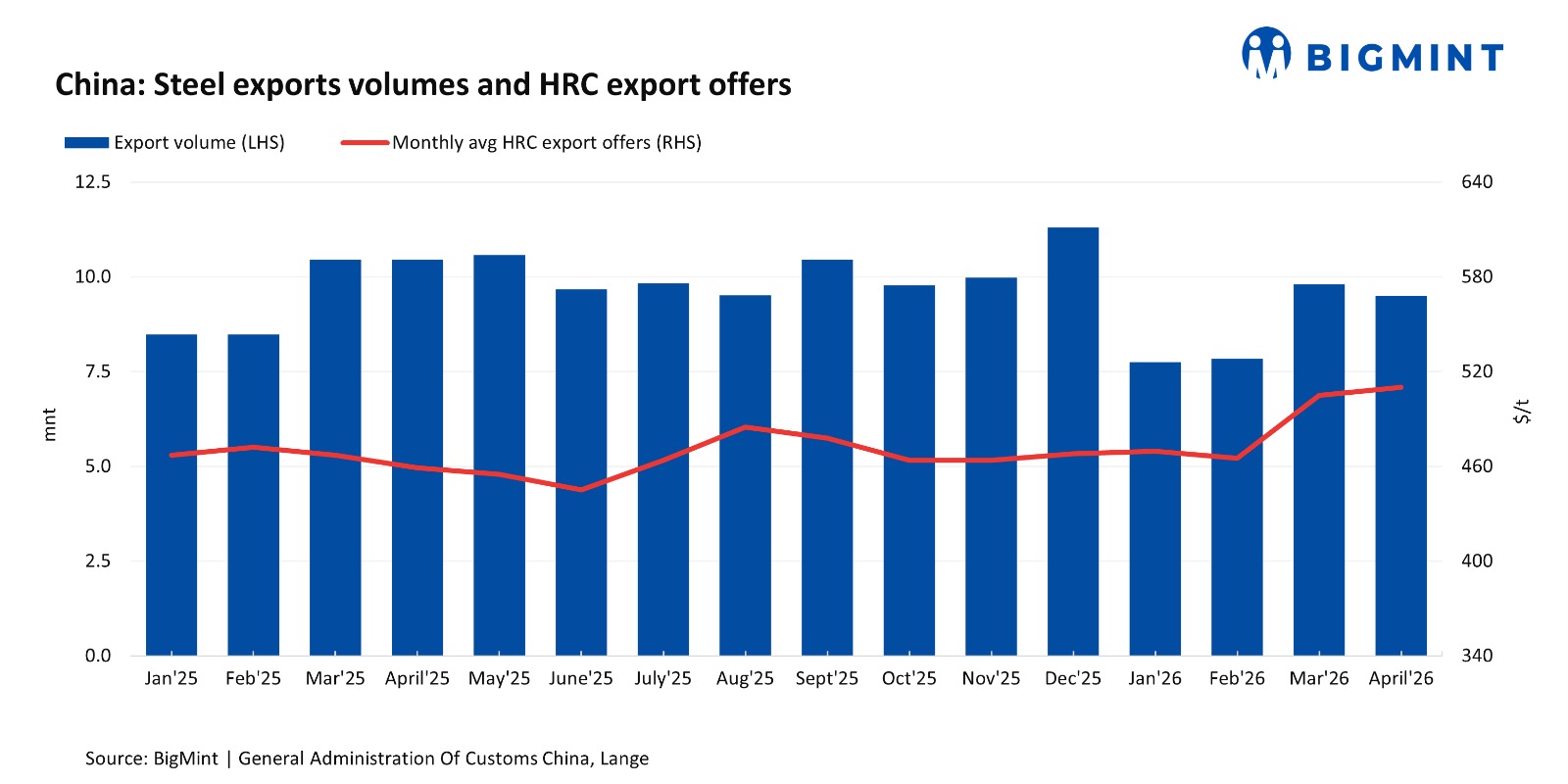
China’s finished steel exports declined by 9.7% y-o-y to 34.214 million tonnes (mnt) during January-April 2026, according to data from the General Administration of Customs.
In April alone, exports fell by 9.2% y-o-y to 9.498 mnt. While shipments were slightly higher than 9.135 mnt in March 2026 on a m-o-m basis, the broader y-o-y trend remains negative, indicating weaker global demand and reduced absorption of Chinese steel.
Factors influencing China’s steel exports
Middle East conflict disrupts trade flows: Escalating geopolitical tensions and ongoing conflicts in the Middle East have emerged as a key factor affecting China’s steel export performance. The region remains an important destination for Chinese steel shipments; however, conflict has disrupted shipping routes, increased uncertainty, and raised freight and insurance costs, adversely impacting trade flows.
Global steel demand remains weak: The World Steel Association Short Range Outlook indicates that global steel demand will remain in a weak phase through 2025-26, with growth projected at just 0.3%, reaching around 1,724 million tonnes (mnt) in 2026. The outlook describes demand conditions as “bottoming out” over 2025-26, following an extended period of softness since 2022, highlighting continued pressure in the global steel market. This reflects subdued industrial activity, a muted construction cycle, and uneven macroeconomic recovery across major economies, with only gradual stabilisation expected in 2026 rather than a strong rebound.
Rising trade barriers add further pressure: Increasing anti-dumping duties and protectionist measures imposed by several countries on Chinese steel products may have also contributed to the decline in export volumes. A growing number of nations, including Vietnam, Malaysia, India, South Korea, and Brazil, introduced trade remedies to protect domestic steelmakers from low-priced Chinese imports.
These measures increased costs for Chinese exporters and reduced the competitiveness of Chinese steel across these markets, thereby weighing on shipments. For instance, Vietnam imposed anti-dumping duties on certain hot rolled coil (HRC) imports from China in July 2025, following which Vietnam’s steel imports from China declined by around 1.29 mnt y-o-y to 5.5 mnt in July 2025-January 2026, compared with 6.79 mnt in the same period last year, underscoring the growing impact of trade protectionist measures on Chinese steel exports.
Export licensing rules weigh on shipments: The introduction of China’s new export licensing system in January 2026 also weighed on steel shipments in the initial months of the year. Under this policy, exporters are required to obtain export licences along with manufacturer quality certificates for around 300 steel product categories, adding an additional layer of administrative and compliance requirements. These measures likely slowed export activity in the early phase of implementation.
Outlook
China’s steel exports are expected to remain under pressure in May amid weak global demand, rising trade barriers, and ongoing geopolitical disruptions. While shipments may see short-term fluctuations on an m-o-m basis, the broader trend is likely to remain downward as global steel consumption remains subdued and is expected to grow only marginally. At the same time, increasing anti-dumping measures and other trade barriers are likely to restrict market access and continue to weigh on Chinese exports.
Leave a Reply