- 75% of copper scrap units remain unorganised
- Secondary copper recycling sees 2-3% arbitrage opportunity
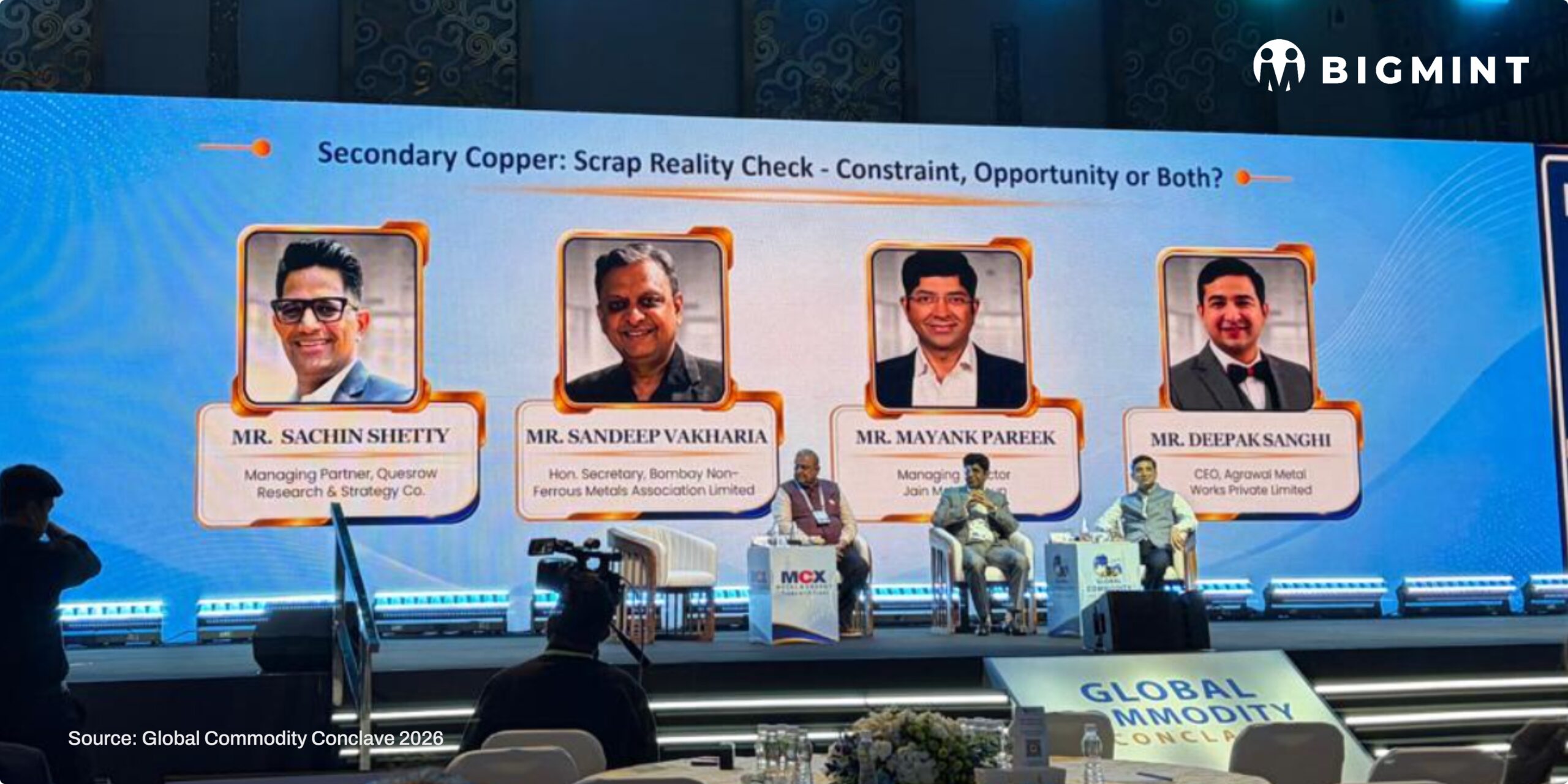
The Global Commodity Conclave (GCC) 2026, hosted by MCX with BigMint as the Event Partner, is being held from 12-14 August 2026 at the Jio World Convention Centre, Mumbai. Speaking at the session “Can formalising India’s secondary copper sector unlock a new source of supply?”, panelists highlighted that India’s secondary copper industry has significant potential to support rising copper demand, but remains constrained by informality, taxation, limited refining capacity and weak traceability across the value chain.
India’s secondary copper sector remains largely informal
India’s annual refined copper demand stands at around 1.8 million tonnes (mnt), while secondary copper production stood at around 0.46 mnt in FY’26. India also imported around 0.46 mnt of copper scrap during the year, according to BigMint data.
However, the actual size of the secondary market is difficult to assess as a large part of the scrap trade remains outside the organised economy. India has more than 2,000 copper scrap processing units, including brass processors, with over 75% estimated to operate in the unorganised sector. Around 60-70% of copper scrap transactions are also estimated to take place through informal, cash-based channels.
This creates a paradox: 95-99% of end-of-life copper is reportedly collected, reflecting the metal’s high intrinsic value, but a significant portion does not enter the organised recycling and refining ecosystem. As a result, formal production data may not fully capture the scale of India’s secondary copper market.
GST remains a key barrier to formalisation
Panelists identified the 18% GST on copper scrap and certain copper articles as a major hurdle in shifting scrap from informal to formal channels. Multiple layers between scrap generators, collectors, aggregators and recyclers, combined with working-capital and documentation requirements, can make formal transactions less competitive.
The International Copper Association (ICA) India has therefore recommended reducing GST on copper scrap and copper articles from 18% to 5%. The association believes a lower tax burden could encourage formal transactions, improve compliance, increase transparency and bring more scrap into the organised recycling sector.
Direct re-melting limits secondary copper quality
Informality also affects how scrap is processed. A substantial quantity is directly re-melted by small-scale operators rather than processed through modern secondary smelting and refining facilities. While this allows quick recovery, it does not necessarily deliver the purity required for higher-end applications.
Modern secondary refining can process more complex and lower-grade scrap into refined-grade copper, whereas direct re-melting remains more dependent on the quality of incoming material. Consequently, organised recyclers investing in advanced technologies can struggle to secure sufficient volumes of consistent-quality feedstock.
This limits the sector’s ability to convert collected scrap into refined-grade copper suitable for applications such as power infrastructure, renewable energy, electric vehicles and electronics.
Import dependence could become a concern
India’s dependence on imported raw materials makes domestic scrap availability increasingly strategic. Copper concentrate imports rose from 0.87 mnt in 2021 to 1.44 mnt in 2025, while imports reached around 0.60 mnt in the first four months of 2026, according to the Copper Vision Document.
At the same time, global competition for recyclable material is increasing as major scrap-generating economies seek to retain secondary raw materials domestically. This could make imported scrap less reliable for Indian recyclers.
Developing domestic collection and formal recycling channels can therefore provide an additional source of copper units and reduce pressure on primary raw material requirements.
Scrap economics and OEM demand create opportunities
Despite these challenges, secondary copper offers significant commercial opportunities. Copper processing is a low-value-add, low-margin business, and panelists noted that around 2-3% gate arbitrage can be sufficient motivation in some secondary copper applications.
Demand-side opportunities are also emerging. Global OEMs and electrical equipment manufacturers are increasingly focused on carbon footprints, Scope 3 emissions and recycled content, creating potential demand for higher-quality and traceable secondary copper.
Copper recycling also requires nearly 85% less energy than primary production, while around 83% of copper is used in an unalloyed form, supporting its recycling potential.
EPR needs stronger physical recycling
Panelists also highlighted Extended Producer Responsibility (EPR) as an important tool for developing India’s circular economy. However, EPR certificates alone cannot create a functioning recycling market. The physical ecosystem — including collection networks, aggregation centres, sorting facilities and formal recyclers — needs to develop alongside it.
The credibility of EPR will depend on whether certificates represent genuine physical recycling. Integrating India’s existing informal collector network into a traceable formal system could improve both collection efficiency and EPR verification. Vehicles scrappage and other end-of-life collection mechanisms could further support domestic scrap availability.
Traceability and policy coordination are critical
Traceability emerged as a key requirement for connecting India’s informal collection network with organised recycling. Tracking material from generator to collector, aggregator, recycler and final refined product could improve visibility, establish material origin, support GST compliance, strengthen EPR verification and give recyclers greater confidence over feedstock.
Panelists also called for greater coordination between tax authorities and environmental regulators. GST and income-tax barriers need to be addressed alongside EPR and recycling regulations, while investment is required in collection, aggregation, sorting, refining and financing infrastructure.
The ICA India’s proposal to reduce GST from 18% to 5% could therefore form part of a broader formalisation strategy rather than being viewed only as a tax-relief measure.
Outlook
India’s copper demand is expected to rise sharply with electrification, renewable energy, power transmission, electric mobility and manufacturing growth. The Copper Vision Document projects a sixfold increase in copper demand by 2047, making both primary and secondary supply essential.
The key challenge is therefore not simply whether India has enough copper scrap, but how much of the existing scrap can be brought into a formal, traceable and technically capable recycling ecosystem.
Reducing taxation barriers, integrating informal collectors, strengthening EPR verification and investing in modern secondary refining could gradually transform India’s fragmented scrap market into a strategic domestic source of refined copper. For a country facing rapidly rising copper demand, formalising the secondary sector could be as important as expanding primary production capacity.
The Global Commodity Conclave (GCC) 2026, hosted by MCX and partnered by BigMint

Leave a Reply