- Steel Ministry forms 14th taskforce to study biomass use in steelmaking
- Biochar can reduce PCI usage in BF, thermal coal in DRI production
- High costs, absence of supply chains major bottlenecks in India
Morning Brief:The Ministry of Steel, Government of India, has formed a separate taskforce to study the feasibility, prospects and challenges of utilisation of biomass derivatives in the production of iron and steel with the objective of reducing carbon emissions by way of partial replacement of coal and coke.
The Ministry had previously formed 13 taskforces to study different aspects of steel industry decarbonisation and the recommendations, already submitted to the Ministry by the different taskforces, will shortly be made public post ratification. The 14th taskforce has been entrusted with the task of investigating the usage of biomass, in the form of biochar, in the steel industry.
What is biochar?
Biomass is renewable organic material that comes from plants and animals, containing stored chemical energy. It can be burned directly for heat, converted to renewable liquid and gaseous fuels, or used in industrial processes such as steelmaking.
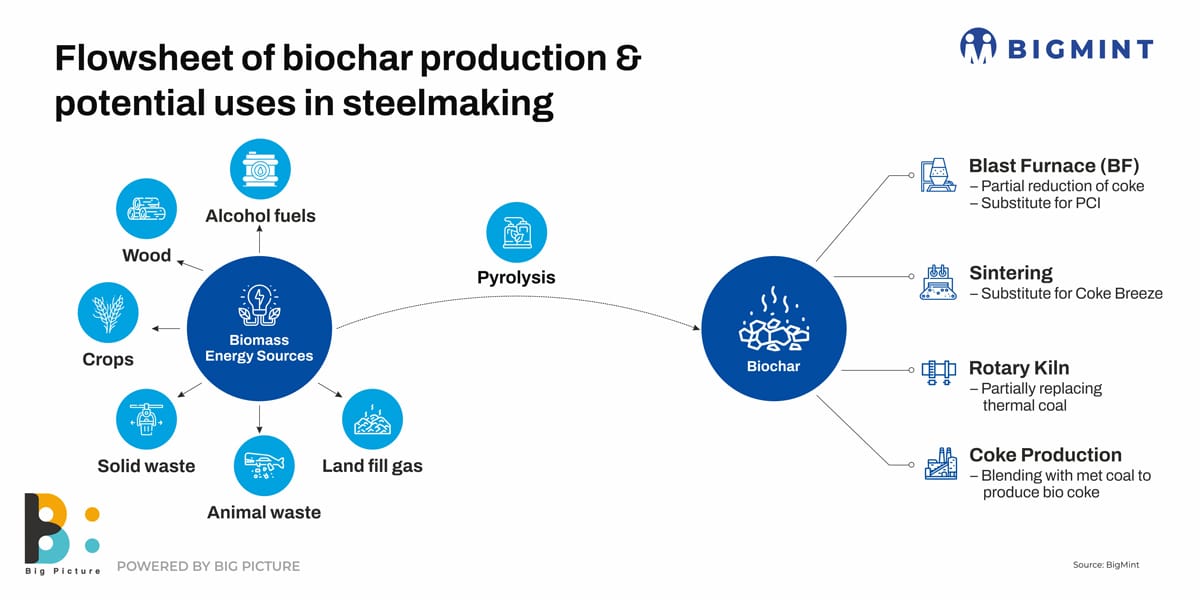
The charcoal made from organic wastes (biomass energy sources) is called biochar which is produced through a process known as pyrolysis. Biochar can play an important role by replacing a proportion of fossil carbon resources:
- As a reductant
- As a source of alloying carbon
- As a replacement for fossil energy in other processes
“Biochar has significant potential for reduction of emissions in blast furnace ironmaking as well as in rotary kilns for production of DRI without any change in equipment or design,” a senior Ministry of Steel official informed BigMint. So, how can biochar be used to reduce GHG emissions in the steel industry?
- Charcoal is currently used commercially to substitute a proportion of coal used in blast furnaces, primarily in Brazil. Some blast furnaces do operate entirely on biomass, but the relative strength of charcoal compared to coke means that these are smaller in size-mini BFs in industry parlance. In large blast furnaces, specific characteristics of coke blend are required to create enough strength of burden and keep the bed permeable. So, only partial substitution of metallurgical coke is possible.
- Biochar can potentially substitute coal used for pulverised coal injection (PCI) in the blast furnace and coke breeze in sintering. Work was undertaken to this end under the Australian CO2 breakthrough programme, which focussed on substituting PCI with sustainable biochar.
- Biogas could replace natural gas in heating furnaces and potentially in DRI production. Biochar can also replace coal or coke for injection into EAF bath for slag foaming.
Biochar cannot be viewed as a total replacement for coal within existing technologies but biomass properties can be engineered to ensure the removal of gangue. Research shows that wood-based biomass, with high carbon and lower ash content, can be a partial substitute in coke-making, while as a BF injectant it has immense potential to replace PCI.
In India, bamboo-based biomass has been identified as ideal. It also has the potential to substitute some of thermal coal in rotary kiln-based DRI production without any modifications required in existing process or equipment.
Challenges
- Cost:A steel ministry source told BigMint that one of the key challenges with adoption of biomass to replace a portion of thermal coal in DRI production is obviously cost. Thermal coal is cheaper, with global supply chains to boot. The cost of production, processing, transport of biochar and, especially, the thermal energy required in pyrolysis adds to the cost.
- Supply chains:“Robust supply chains exist to move large amounts of raw materials (such as coal, iron ore, lime, and scrap) required in modern steelmaking. Similar supply chains will need to be developed to collect biomass at volume, convert and process, and to deliver it reliably to steel manufacturing facilities,”a World Steel Association (WSA) whitepaper points out. Surely, this is a huge task.
- Competition for resources:The demand for bioenergy feedstock has multiplied over the years leading to conflicts related to land use. Competition for arable lands required for food and fibre production is another major issue concerning biomass production.
Outlook
Going forward, the government may make it mandatory for steel mills to use a certain portion of sustainable biomass-based products, as it has done for the power sector. This will be aligned with the Ministry of Steel’s overall ambition of cutting carbon emissions from steelmaking from a level of around 2.5 tonnes of CO2 equivalent/tonne of crude steel (tcs) currently to 2.4 tCO2e/tcs well before 2030.