- Chattogram mill secures Sep Kanto tender volume
- Weak downstream demand keeps mills selective
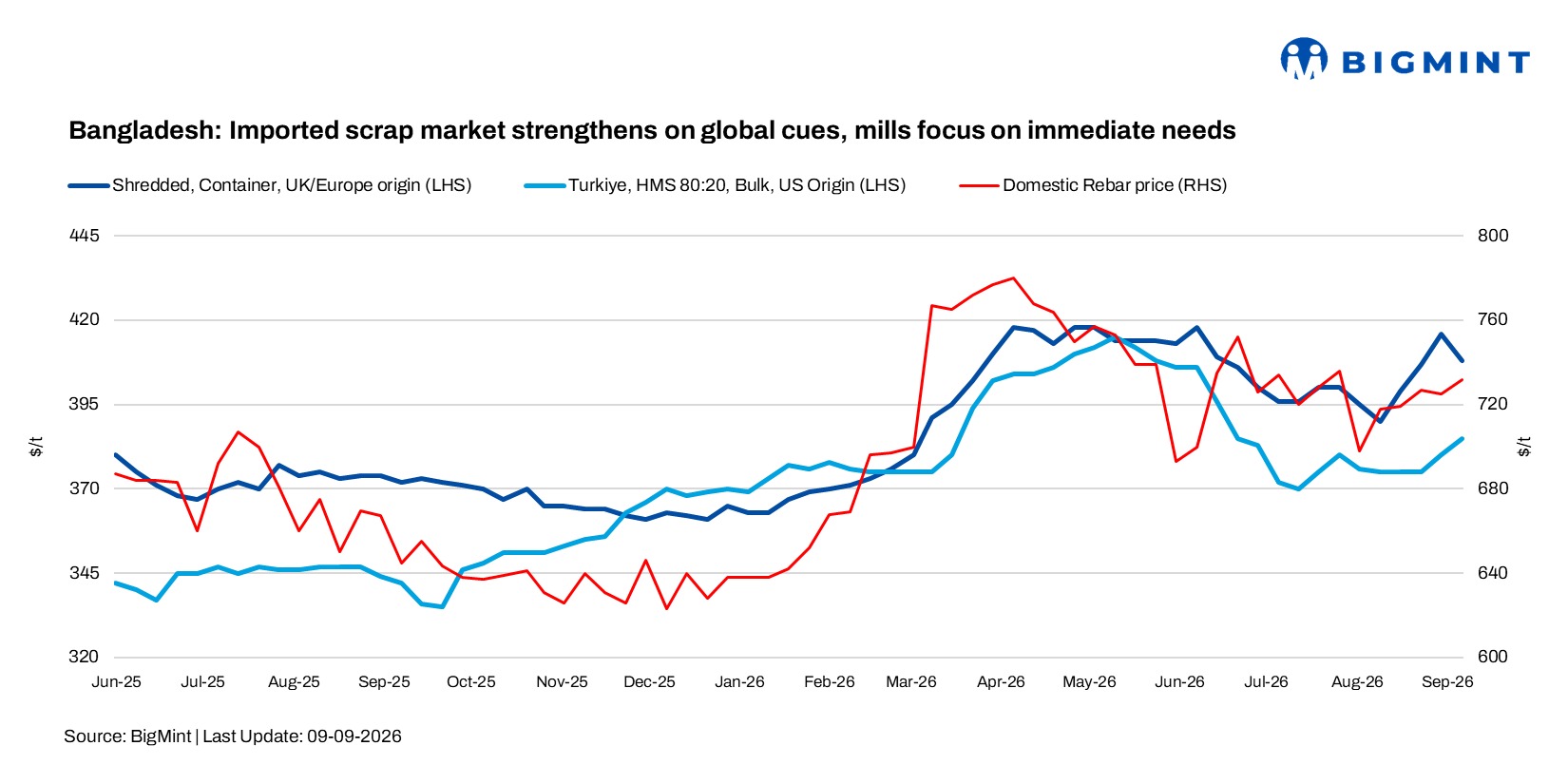
Bangladesh’s imported ferrous scrap market strengthened during the week ended 9 September, supported by firmer global scrap prices and increased international buying activity. However, weak domestic long-steel demand, limited liquidity, and currency fluctuations kept mills cautious, with buyers favouring competitively priced cargoes and immediate requirements.
Downstream demand for long steel remained weak, as sluggish real-estate activity and the absence of major government-funded construction projects continued to constrain steel consumption.
Deep-sea US HMS 80:20 offers were heard at $390-395/t CFR Chattogram, against bids of around $380-385/t CFR. Global sentiment was supported by recent US-origin bookings by Turkish mills at around $380-385/t CFR Turkiye.
In the recent Kanto scrap export tender for September, a Chattogram-based mill secured 20,000 t of H2 scrap at $313/t FAS Japan, equivalent to approximately $380-385/t CFR Chattogram.
BigMint’s weekly assessments, CFR Chattogram
- European-origin containerised HMS 80:20: $371/t, down $4/t w-o-w
- European-origin containerised shredded: $408/t, down $8/t w-o-w
- Japanese-origin bulk H2: $388/t, up $3/t w-o-w
- US-origin bulk HMS 80:20: $395/t, up $4/t w-o-w
Market scenario
Current offers included Australian shredded scrap at $390-400/t and Australian HMS 80:20 at $370-380/t, while Brazilian HMS 80:20 was indicated around $370/t. Japanese H2 was estimated at around $390/t CFR, although this level was considered unattractive by buyers.
A recent Singapore-origin bulk HMS 80:20 deal was reported at 10,000 t at $385/t CFR Chattogram. For comparison, similar cargoes were traded at $368/t CFR Cigading for 9,000 t and $365/t CFR Phu My for 9,000 t.
A Dhaka-based participant said, “US material remained attractive because of its relatively competitive pricing, prompting consumers to secure requirements from this origin. However, higher-priced Japanese and Singaporean cargoes faced greater resistance.”
The challenging demand environment has prompted mills to reduce production, while small and medium-sized producers are facing increasing financial pressure. Buyers therefore continued to cover immediate requirements rather than build inventories.
A Chattogram-based mill-side participant said, “International scrap activity had started to improve, with buyers returning to the market. This has strengthened expectations that Bangladesh prices could move higher if global buying momentum persists.”
Recent containerised scrap trades
- 1,000 t Hong Kong-origin shredded scrap at $400/t CFR Chattogram
- 500 t Philippines-origin PNS at $378/t CFR Chattogram
- 1,000 t Australia/New Zealand-origin shredded scrap at $400-410/t CFR Chattogram
- 2,000 t Australia/New Zealand-origin HMS 90:10 at $385-390/t CFR Chattogram
- 2,000 t Hong Kong-origin HMS bundles at $360/t CFR Chattogram
- 1,000 t Hong Kong-origin Galvanised iron bundles at $328/t CFR Chattogram
Domestic market
Local PNS prices were reported at around BDT 52,000/t ($423/t), while HMS 80:20 was assessed at BDT 49,000-50,000/t ($398-407/t). Rebar prices stood at around BDT 85,000/t ($691/t) in Dhaka and BDT 90,000-91,000/t ($732-740/t) in Chattogram.
LC constraints continued to weigh on import procurement for some mills, increasing reliance on domestic scrap and prompting buyers to remain selective on imported cargoes.
Currency fluctuations further reduced the competitiveness of imported raw materials against domestic alternatives. Market participants indicated that locally sourced scrap was comparatively cheaper for some mills, supporting greater reliance on domestic material.
Outlook
Bangladesh’s imported scrap market is expected to remain firm but selective during the coming week. Firmer global scrap prices and renewed international buying are likely to keep seller offers supported, particularly for US and Australia/New Zealand cargoes.
However, weak downstream steel demand, limited construction activity, financial pressure on smaller mills, and higher import costs linked to currency movements are expected to constrain buying appetite. Competitively priced bulk cargoes could attract mills covering immediate requirements, while higher-priced Japanese H2 and premium grades may face resistance.
Leave a Reply