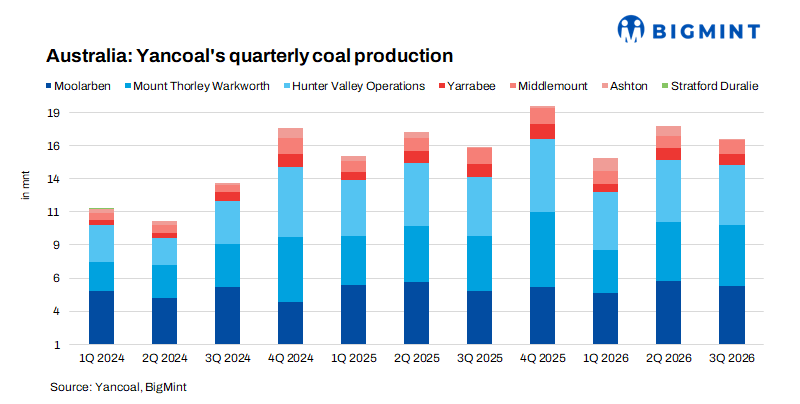
- Sales decline 23% q-o-q; realised prices rise 6%
- Diesel costs pressure margins; Kestrel adds metallurgical exposure
Yancoal’s September-quarter performance highlighted the competing forces shaping coal producers’ earnings: stronger selling prices supported cash generation, but lower production and shipment volumes limited the immediate benefit.
Attributable saleable coal production fell 13% quarter-on-quarter to 9.4 million tonnes (mnt), while sales declined 23% to 9 mnt. However, the average realised coal price increased 6% to A$170/t, helping the company generate a reported A$340 million increase in cash before dividend payments and funding for its Kestrel acquisition.
Compared with September 2025, production increased modestly, but sales fell 16%. Realised prices were substantially stronger, rising 21% year-on-year. The quarterly activities report does not disclose quarterly revenue, EBITDA, net profit or actual unit operating costs. Financial comparisons therefore centre on realised prices and the disclosed cash movement rather than a complete earnings comparison.
Production falls as underground operations face interruptions
Yancoal produced 16.6 mnt of run-of-mine coal and 12.4 mnt of saleable coal on a 100% basis during July-September 2026.
The quarterly decline was mainly attributable to a planned longwall relocation at Moolarben and difficult geological conditions at Ashton. Open-cut operations provided a partial offset.

Moolarben’s saleable output fell 19% q-o-q to 4.4 mnt, accounting for approximately 1 mnt of the group’s 1.4 mnt reduction in saleable production on a 100% basis. Its new longwall started in September, supporting expectations of higher December-quarter output.
Ashton’s saleable production fell 83% q-o-q to around 0.1 mnt as geological problems affected productivity, coal quality and processing-plant feed.
By contrast, Mount Thorley Warkworth and Hunter Valley Operations maintained saleable output at approximately 3.1 mnt and 3.7 mnt, respectively. Both exceeded their year-earlier performance. Middlemount’s saleable production also increased, although its output is excluded from Yancoal’s attributable production total.
The weakness was therefore concentrated in particular underground operations rather than spread across the entire portfolio.
Sales fall faster than production
Total attributable sales declined to 9 mnt from 11.6 mnt in the June quarter and 10.7 mnt a year earlier.
The company attributed the reduction to lower production and shipment timing. Sales fell considerably faster than attributable production, suggesting that the quarterly comparison also reflects when cargoes were shipped.
Production exceeded sales by approximately 0.4 mnt during Q3, reversing the June quarter’s position, when sales exceeded production by around 0.8 mnt. These rounded differences indicate changing production-to-sales timing, but do not establish an exact inventory movement.
Thermal coal remained dominant, contributing approximately 84% of quarterly sales.
Diesel costs limit the benefit of stronger prices
The company maintained its annual cash operating cost guidance of A$90-98/t, but expects costs towards the upper end because of higher diesel prices.
Consequently, stronger coal prices should not be interpreted as an equivalent improvement in profit margins. Fuel costs are absorbing part of the benefit, while lower quarterly output can also reduce the volume over which some operating costs are spread.
The reported A$340 million cash increase was before the A$92.4 million interim dividend and cash used for Kestrel. It should therefore not be treated as the net increase in cash after all distributions and acquisition payments.
Nine-month performance remains stronger
Despite the quarterly slowdown, Jan-Sep attributable saleable production increased 4% y-o-y to 29.2 mnt. Sales rose 6% to 28.8 mnt, while average realisations increased 9% to A$159/t.
Thermal coal sales increased 6% to 24.4 mnt, while metallurgical sales were broadly steady at 4.4 mnt. The nine-month comparison is therefore more favourable than Q3 alone: Yancoal sold more coal at higher average prices.
However, Moolarben’s attributable interest increased from 95% to 98.75% in October 2025, meaning attributable growth also includes an ownership effect.
Outlook
Yancoal expects existing operations to deliver production in the upper half of its 36.5-40.5 mnt annual guidance range, which excludes Kestrel.
The acquisition of an 80% interest in Kestrel was completed on 1 October for upfront consideration of US$1.85 billion, subject to adjustments. Its production and earnings will enter Yancoal’s results from Q4. Kestrel strengthens exposure to metallurgical coal, but a longwall relocation scheduled for Q4 will constrain its initial contribution.
BigMint assessment: Yancoal enters the December quarter with stronger prices and a pathway to recover production. The key test is whether higher output converts into shipments while diesel costs remain elevated. Kestrel broadens the earnings base, but neither its full production potential nor the complete benefit of stronger coal prices will necessarily appear immediately.
Leave a Reply