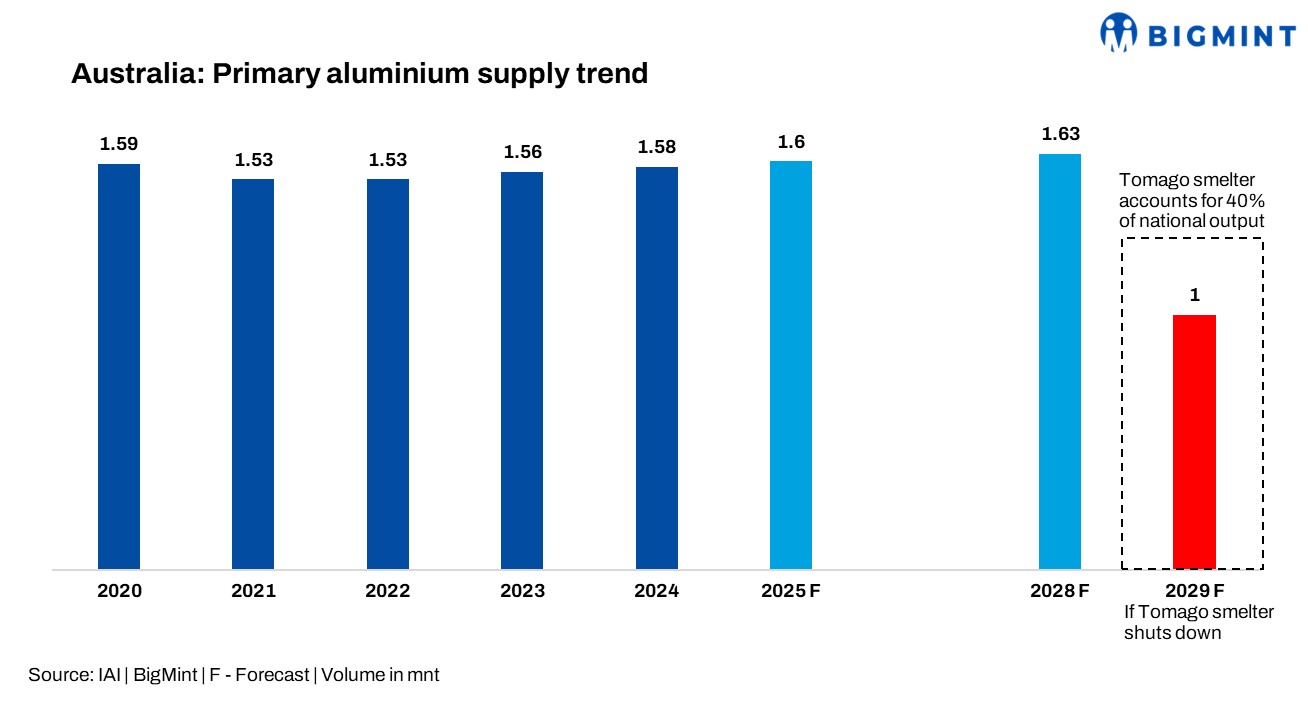
- Tomago produces 40% of national aluminium
- Major $1 billion smelter investment committed
The Australian government has moved to safeguard the future of the Tomago aluminium smelter beyond 2028, offering support to Rio Tinto and its subsidiary Tomago Aluminium through the development of a long-term, fixed-price power purchase agreement (PPA). The initiative comes after Rio Tinto warned in October that the 600,000 tpa smelter — the largest in Australia — may face closure when its current electricity contract expires at the end of 2028 due to unsustainable energy costs.
Under the plan, Tomago Aluminium will work with federal and New South Wales (NSW) officials over the coming months to secure a renewable energy-based supply arrangement. The agreement aims to ensure reliable, affordable power for the energy-intensive operation while accelerating the development of renewable generation and storage projects in NSW. As part of the partnership, Tomago Aluminium has committed to investing A$1 billion over the next decade in capital upgrades, maintenance, and decarbonisation.
Founded in 1983, the smelter produces up to 590,000 t of aluminium annually, accounting for nearly 40% of Australia’s aluminium output. It is jointly owned by Rio Tinto (51.55%), Gove Aluminium Finance (36.05%), and Norsk Hydro (12.40%), and directly employs about 1,000 people, alongside 200 contractors and 5,000 indirect workers. Despite energy uncertainties, the plant has continued normal operations, producing 426,000 t in January-September 2025, down 2.2% y-o-y.
Industry minister Tim Ayres said the PPA is critical to sustaining long-term investment and protecting jobs in the Hunter region, while Prime Minister Anthony Albanese reaffirmed the government’s commitment to securing industrial capability and supporting workers. The move aligns with broader efforts to assist strategic industrial assets, following support packages for Whyalla steelworks, Glencore’s Queensland copper operations, and Nyrstar’s lead and zinc smelters.
With calls mounting for similar assistance for Rio Tinto’s 190,000 tpa Bell Bay smelter in Tasmania, the government’s approach signals a renewed industrial strategy focused on securing low-carbon production, energy reliability, and long-term regional economic stability.
Leave a Reply