- Healthy demand, smoother operations lift exports
- Only Port Hay Point records slight drop in volumes
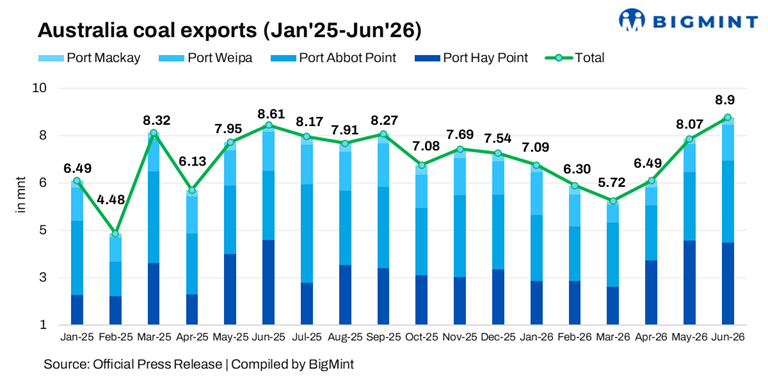
Australian coal shipments through major export ports totalled 8.9 million tonnes (mnt) in June 2026, increasing 10.3% m-o-m from 8.1 mnt in May. The growth was primarily driven by higher cargo throughput at Queensland’s key export terminals, supported by stronger loading and healthy demand for metallurgical coal from major Asian importers, particularly India. Higher vessel arrivals and smoother port operations also aided export volumes during the month, despite mixed sentiment in the global thermal coal market.
Port-wise export performance
- Port Hay Point handled 4.14 mnt of coal shipments in June, a drop of around 1.9% m-o-m against 4.22 mnt in May. Although volumes eased marginally from May’s elevated level, the port retained its position as Australia’s largest coal export gateway, supported by steady metallurgical coal loadings from the Bowen Basin and consistent shipments to Asian steelmakers.
- Port Abbot Point exported 3.1 mnt, registering a strong 18.8% m-o-m increase from 2.61 mnt in May. The rise was attributed to improved cargo availability and higher rail deliveries from Queensland’s coal mines, resulting in stronger vessel loading activity during the month.
- Port Weipa recorded the sharpest m-o-m increase, with exports rising 27.8% m-o-m to 1.38 mnt from 1.08 mnt in May. The increase reflected improved mining activity and stronger shipment schedules, contributing significantly to the overall rise in Australia’s coal exports.
- Port Mackay shipped 0.28 mnt of coal in June, surging 55.6% m-o-m from 0.18 mnt in May. Despite lower activity compared with larger Queensland terminals, the port continued to support regional coal exports through scheduled cargo movements.
Outlook
The near-term outlook for Australian coal exports remains broadly steady, underpinned by healthy production levels and efficient port logistics. While exports are likely to stay supported by ongoing Asian demand, seasonal weather risks, shipping congestion and changes in import requirements could lead to short-term fluctuations in shipment volumes.

Leave a Reply