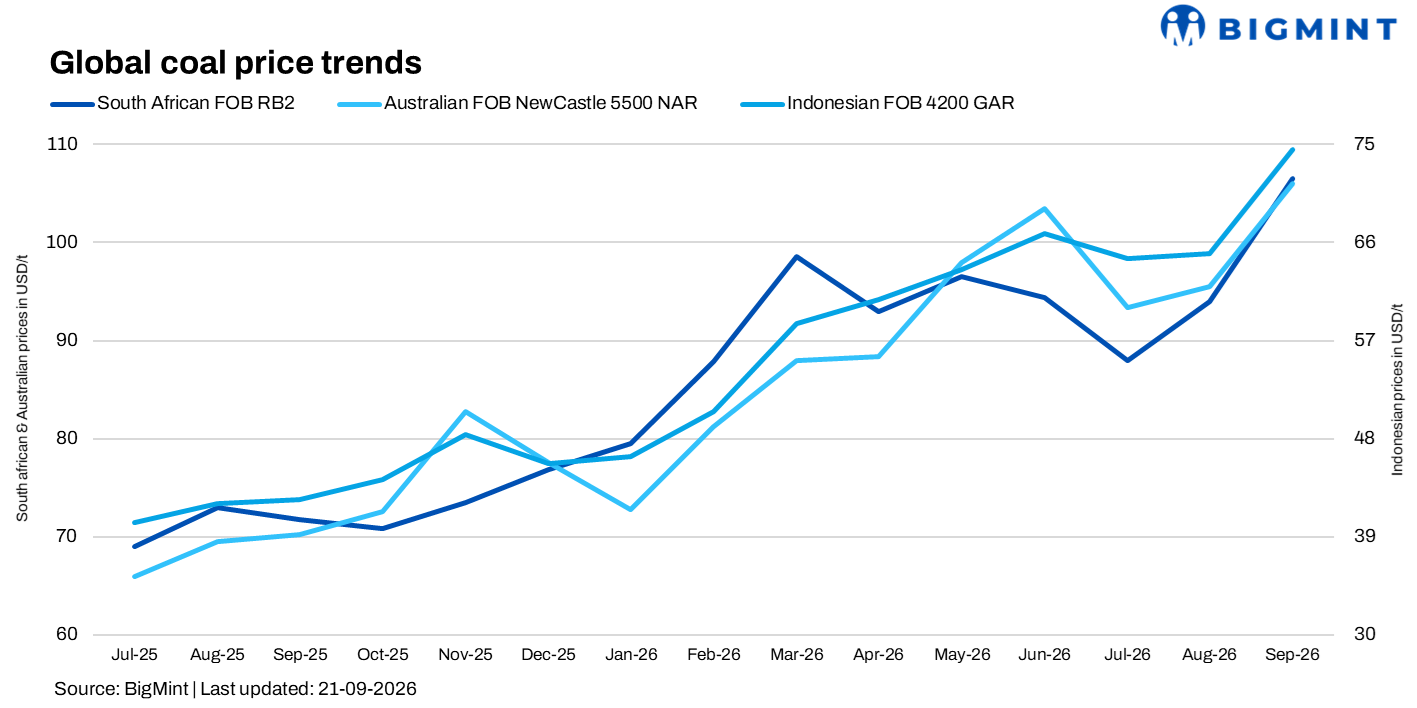
- Newcastle and Indonesian prices retreat but supply constraints limit correction
- India’s falling inventories support portside prices, China prepares to lift output
Asian thermal coal markets turned more selective in the week ended 18 September 2026. Australian high-CV prices corrected sharply, Indonesian low-CV coal retreated, and Chinese domestic prices eased modestly. However, logistical constraints in Indonesia and falling coal inventories in India prevented a broader decline.
Buyers across Asia are resisting elevated offers and purchasing largely against immediate requirements. Sellers, particularly in Indonesia, remain reluctant to discount aggressively because of uncertain prompt availability and continuing transportation disruptions.
Indicative Asian thermal coal prices

*Latest Indonesian trades were unconfirmed. Prices across different vessel sizes and delivery periods may not be directly comparable.
Newcastle leads correction
Newcastle 6,000 NAR recorded the clearest reversal. A 75,000-t November cargo traded at $139/t FOB, down $9.50/t from the previous week’s November trade. It was also well below the $151/t December trade reported a week earlier.
Australian 5,500 NAR Panamax offers softened to $108-110/t from $113-115/t, while bids were heard at $105-108.50/t. A separate 4,450 NAR offer from Abbot Point emerged at $88/t, highlighting the widening discounts for lower-energy Australian coal.
Reduced Chinese appetite for expensive imports contributed to the correction as domestic prices retreated from recent highs. Elevated freight also weakened the delivered competitiveness of Australian cargoes.
Indonesian prices retreat, supply remains constrained
Indonesian 4,200 GAR coal fell to unconfirmed traded levels of $76.25-78/t FOB from confirmed trades of $80.50-82/t a week earlier. Offers for 3,800 GAR/3,400 NAR coal also edged lower.
The decline remains contained by supply-side constraints. Low river levels are disrupting barge movements and restricting coal transportation from mines to loading terminals. Uncertainty over production availability and miners’ domestic-market obligations is also limiting prompt export supply.
Indonesia’s reference prices confirmed the loss of momentum. The 6,322 GAR benchmark fell 2.6% in the second half of September to $123.54/t, while the 5,300 GAR and 4,100 GAR benchmarks declined by 1.2% and 2.9%, respectively.
India’s inventory drawdown supports portside prices
Indian portside Indonesian coal prices remained stable w-o-w despite the correction in export-market indications. Tight domestic inventories and elevated replacement costs prevented sellers from reducing prices, while weak spot buying limited further increases.
Indonesian 5,000 GAR material was assessed at around INR11,900/t at Kandla and INR11,800/t at Vizag. The 4,200 GAR grade held at approximately INR10,000/t at Kandla and INR9,900/t at Vizag, while 3,400 GAR coal at Navlakhi remained near INR8,000/t.

India’s thermal coal inventories at major ports declined 3% w-o-w to 13.08 Mnt in week 37 from 13.48 Mnt in week 36. The fall reflected continued cargo evacuation from Kandla, Magdalla, Krishnapatnam and Dahej, partly offset by stock increases at Karaikal, Gopalpur and Gangavaram.
Power-plant stocks fell around 9% w-o-w to 23.4 Mnt on 17 September — equivalent to only about seven days of consumption — with nearly 72 plants reporting critical inventories.
These stock levels create underlying import demand, particularly if domestic coal supplies fail to recover sufficiently after the monsoon. However, high replacement costs have kept procurement need-based. Buyers are covering immediate requirements rather than rebuilding inventories aggressively, leaving portside activity subdued even as stocks decline.
China prepares to ramp up domestic production
China’s 3,800 NAR Indonesian tender offers declined to RMB657-676/t DDP from RMB678-696/t in the preceding week. One cargo was awarded at RMB638/t — RMB19-38/t below prevailing offers — indicating firm resistance from utilities.
Chinese authorities have now instructed major coal-producing regions to stabilise and increase production following a decline in domestic output. The measures include accelerating the restart of suspended mines that meet safety requirements and allowing certain mines that exceeded annual quotas to continue operating, subject to monthly production limits.
The recovery is unlikely to be immediate. Mine restarts will continue to require case-by-case safety approval, with compliant state-owned mines likely to return before private producers facing regulatory scrutiny. A more visible supply improvement may emerge after the National Day holiday on 1-7 October.
China has simultaneously encouraged additional imports where required, particularly into southern and eastern coastal regions, and called for a larger share of term import contracts. The policy therefore seeks supply security from both domestic production and seaborne coal.
Higher Chinese mine output represents the principal downside risk to Asian prices during Q4. However, if the recovery proves gradual, coastal utilities may continue importing, especially ahead of winter.
Outlook
Asian thermal coal markets are shifting from a broad rally to grade-specific consolidation. China’s planned production recovery and buyer resistance cap the upside, while Indonesian logistical constraints and India’s depleted inventories limit the scope for a deep correction.
India could become a more important source of demand after the monsoon, but a significant import surge will require either lower seaborne prices or a continued deterioration in domestic power plant stocks.
Leave a Reply