- Chinese utilities make selective purchases after recent price drops
- Indian import demand remains muted on ample domestic supply
Asian thermal coal markets showed signs of stabilising during the week ended 17 July after correcting through late June and early July. Chinese domestic coal prices rebounded across all major grades, Australian Newcastle premium coal found support around $130/t, and Chinese utilities returned to the market following the recent correction.
The recovery, however, remained uneven. Indonesian low-rank coal continued to lag at Indian ports, as the Indian market remained largely disconnected from strengthening international fundamentals, with abundant domestic coal availability and comfortable inventories continuing to suppress import demand.

Australian market stabilises
Australian premium thermal coal appears to have established near-term support around $130/t.
A physical August-loading Newcastle 6,000 NAR cargo traded at $129.75/t, following trades at $128.75/t and $131/t earlier this month. Buyers continued testing lower levels, but sellers largely concluded business close to the $130/t mark, suggesting the earlier correction has eased.
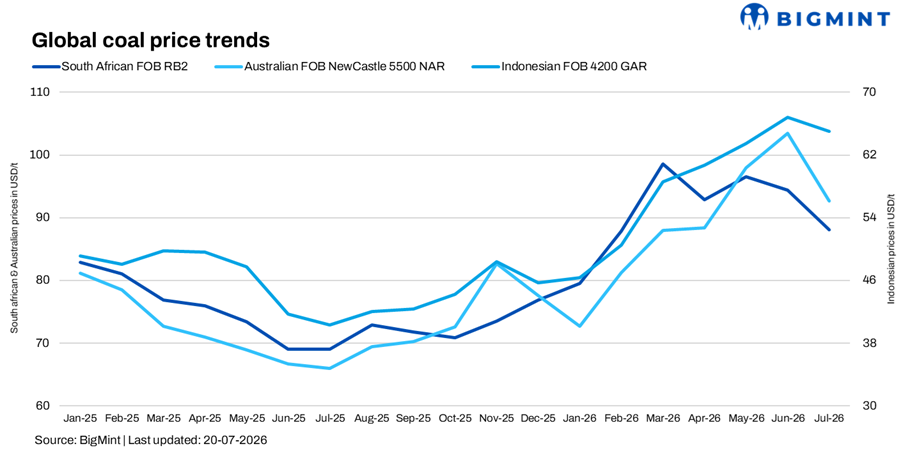
The Newcastle 5,500 NAR market also strengthened. Following unconfirmed trades around $90.75-91/t in early July, bids, offers and reported transactions improved to $94-97/t, reflecting gradually improving buying interest, particularly from Chinese participants.
Indonesian coal remains the weakest segment
Indonesian low-calorific coal continued to underperform the broader Asian market.
4,200 GAR coal traded around $62-63/t FOB, broadly unchanged from the previous week but well below late-June levels. Several August cargoes were reported around $63-63.15/t, indicating buyers remained unwilling to chase higher prices despite firmer replacement costs.
Although the pace of decline has slowed, the market has yet to show convincing signs of recovery, with weak spot demand continuing to weigh on lower-calorific Indonesian grades.
Chinese domestic prices rebound
The strongest development during the week was the recovery in Chinese domestic coal prices after three consecutive weeks of declines.
The Qinhuangdao 5,500 NAR benchmark rose $3.60/t w-o-w to $120.97/t, while 5,000 NAR, 5,800 NAR and 6,000 NAR grades all gained around $3.6-3.9/t.
Chinese utilities also broadened procurement activity, with reported awards covering grades from 3,000 NAR through 5,500 NAR, indicating selective replenishment after the recent correction. Although reported buying activity increased, available data do not suggest aggressive restocking, and procurement remained measured.
The rebound in Chinese domestic prices is significant because China continues to set the pricing tone for the wider Asian seaborne thermal coal market. Sustained gains would likely improve regional sentiment and support international prices.
Indian market remains subdued
Despite firmer international prices, Indian buyers largely remained on the sidelines.
Coal India continued supplying adequate domestic coal, while thermal power plants held around 42 million tonnes (mnt) of inventories, equivalent to roughly 13 days of consumption. Coal inventories at major ports declined 6.1% w-o-w to 14.15 mnt, reflecting lower import arrivals rather than stronger consumption.
Industrial demand also remained weak. Falling sponge iron prices continued to weigh on imported coal consumption, while cement and sponge iron producers increasingly favoured competitively priced domestic coal over imported material.
Consequently, Indian portside prices showed only modest movement despite stronger international offers.
RB2 (5,500 NAR) prices remained broadly stable at INR 10,450/t ($108.4), while RB3 (4,800 NAR) edged higher at Paradip, as per BigMint’s assessment. Indonesian-origin 5,000 GAR and 4,200 GAR coal softened because of weak industrial demand and competition from domestic coal, whereas 3,400 GAR prices rose to INR 7,000/t ($72.6) at Navlakhi, supported by tighter lignite availability and healthy demand from ceramic manufacturers.
The divergence between strengthening FOB markets and subdued Indian portside prices underscores the continued influence of abundant domestic coal supplies on import purchasing decisions.
Freight firms but demand remains weak
Freight markets strengthened during the week as higher bunker costs, stronger Australian cargo movements and improved Southeast Asian enquiries supported vessel demand.
Chinese coastal freights also increased, raising the cost of moving domestic coal to southern consuming regions and marginally improving the competitiveness of imported cargoes.
However, the higher freight environment mainly increased replacement costs for traders and was insufficient to revive Indian buying interest, which remained constrained by comfortable domestic supply and requirement-based procurement.
Outlook
Asian thermal coal markets appear to be moving from correction towards consolidation.
Chinese domestic coal prices have rebounded, Australian premium coal has stabilised around $130/t, and Chinese procurement activity has become more visible following the recent decline. These developments should provide near-term support to international thermal coal prices.
India, however, is expected to remain the outlier. Comfortable domestic coal availability, adequate power plant inventories, monsoon-driven demand softness and weak industrial consumption are likely to keep import buying subdued despite firmer global offers.
Unless domestic coal availability tightens or industrial activity improves materially, Indian portside prices are expected to continue lagging international market movements.
Overall, the Asian thermal coal market appears to have stabilised following its early-July correction. Whether this develops into a sustained recovery will depend on continued improvement in Chinese demand and a gradual revival in buying interest across major importing markets, particularly India.

Leave a Reply