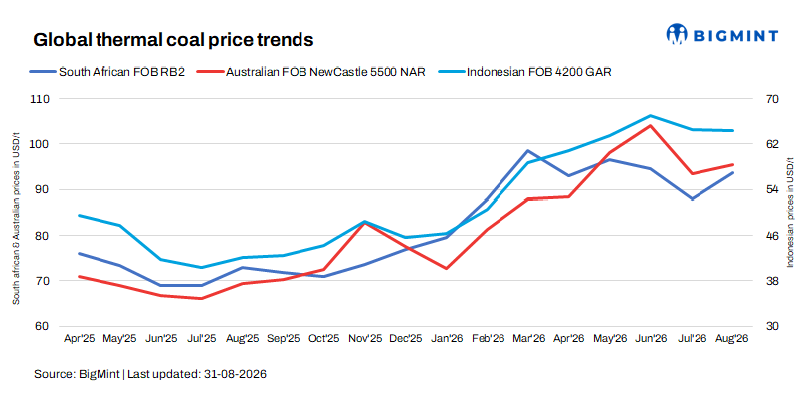
- Australian and Indonesian coal prices strengthen
- Supply tightness, not demand, drives late-August rally
Asian thermal coal markets strengthened markedly in late August, but the rally is more nuanced than a simple story of surging Chinese demand.
Prices have risen across Australian, Indonesian and South African coal. However, Chinese utility coal burn has softened under heavy rainfall and typhoon conditions, while coastal inventories remain relatively comfortable. The stronger price signal is instead coming from constrained Chinese domestic supply, limited prompt export availability and logistics disruptions across several origins.

Newcastle 6,000 NAR showed the strongest move, with October trades reported at $135.50/t FOB in the week ending 28 August versus $127.50/t a week earlier. Forward buying was firmer still, with November bids reaching $139/t and offers around $140-145/t.
China supports prices despite weaker coal burn
China remains central to the regional market, but the evidence does not support describing the rally simply as demand outpacing supply.
Coal burn at utilities across eight import-dependent coastal provinces averaged 2.33 mnt/day in the week to 20 August, below 2.35 mnt/day the previous week and 2.4 mnt/day a year earlier. Utility inventories remained at 35.1 mnt, above the corresponding 2025 level. Heavy rainfall and typhoons reduced cooling demand across southern and eastern China.
Yet domestic prices continued to rise. The QHD 5,500 NAR marker increased from $127.46/t to $130.63/t w-o-w, while 6,000 NAR reached $144.63/t.
The more persuasive explanation is tight domestic supply and limited prompt availability. Mine safety inspections have constrained output, while buyers continue to secure imports where landed economics remain viable.
This distinction matters: China’s thermal coal market is firm even though the immediate power-demand signal has softened.
Indonesian supply becomes increasingly important
Low-CV Indonesian coal also strengthened, although less dramatically than Newcastle.
GAR 4,200 material traded around $70-71/t FOB on a Panamax basis in late August, while geared Supramax values were around the mid-$60s/t.
Supply has been constrained by several factors. Some producers are still awaiting additional production approvals, while shallow water in the Barito River has disrupted barge movements in Central Kalimantan. Dry weather has also affected mining and transportation.
Chinese import tenders reinforce the trend. Offers for Indonesian 3,800 NAR coal moved from roughly RMB570-583/t in early August to RMB605-630/t by late August.
The Indonesian rally therefore appears to be driven by constrained export availability as much as incremental demand.
Newcastle develops high-CV scarcity premium
Australian coal has moved faster.
Newcastle 6,000 NAR increased much more sharply than Chinese domestic markers or Indonesian low-CV coal. The latest trades at $135.50/t represent a rise of about 8% from the $125/t level seen two weeks earlier.
This suggests a growing quality and availability premium for high-CV coal, rather than a uniform rise across all Asian grades.
Newcastle 5,500 NAR has also firmed, with late-August physical trades reaching around $100-102.50/t FOB.
Demand from northeast Asia and China is therefore competing for a relatively constrained pool of prompt Australian material.
India remains the key latent demand risk
India has so far not been the principal driver of the Asian rally, despite increasingly tight domestic power-sector coal inventories.
Thermal coal imports rose to around 11.2 mnt in July, up about 5% y/y, although January-July imports remained roughly 12% below the corresponding 2025 period. The July increase coincided with stronger coal-fired generation and declining utility coal stocks.
South African prices are already showing some effect from improving Indian buying. Richards Bay 5,500 NAR rose towards $96.25/t FOB, while a rail derailment simultaneously disrupted approximately 1.1 mnt of export flows, tightening the market further.
If Indian utilities and industrial consumers move more aggressively into post-monsoon restocking, this could become a much larger regional price driver.
Other Asian buyers reinforce the floor
Demand outside China and India is also providing support.
South Korea faces tighter Indonesian availability ahead of winter environmental restrictions, while coal-fired generation remains economically more attractive than gas in current fuel markets.
Bangladesh presents an even clearer fuel-switching story. Coal-fired generation averaged 5.23 GW during 1-25 August, 28% higher y/y, as lower LNG availability increased reliance on coal. Thermal coal imports rose 18.5% y/y during March-July.
Outlook
The late-August rally is therefore real but primarily supply-led rather than evidence of an Asian demand boom.
Chinese coal burn could remain subdued while heavy rainfall persists, limiting immediate upside. But constrained Chinese domestic supply, tight Indonesian availability and increasingly expensive high-CV Australian coal provide a firm price floor.
The biggest upside risk is the timing of Indian restocking.
If India begins buying more aggressively while China continues importing and South Korea prepares for winter, three major Asian demand centres could begin competing for a constrained seaborne supply pool.
That would leave Newcastle and Indonesian coal vulnerable to another upward leg into Q4. The key market indicator is therefore no longer Chinese demand alone. Asian thermal coal prices are increasingly being shaped by constrained supply, quality scarcity and the timing of regional restocking.
Leave a Reply