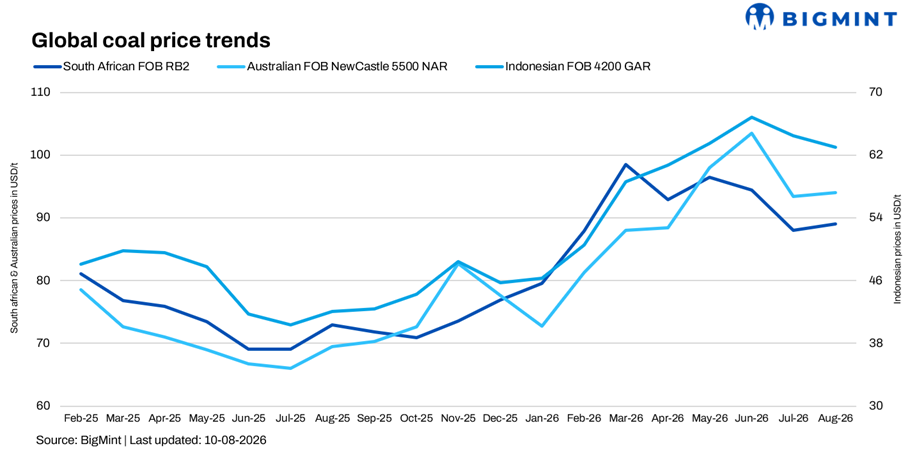
- Chinese domestic prices strengthen across all major coal grades
- Indonesian coal firms while Australian grades move in opposite directions
Asian thermal coal markets diverged during the week ended 7 August as strengthening Chinese domestic coal prices provided renewed support to the regional market, while buying activity remained highly selective across different coal qualities and importing regions. Indonesia continued to benefit from firmer Chinese and Southeast Asian demand, Australian coal displayed a growing divergence between premium and mid-calorific grades, and India remained largely absent from the seaborne market amid comfortable domestic coal availability and subdued industrial demand.
Chinese domestic market continues to strengthen
China remained the principal source of support for the Asian thermal coal market.
Domestic Qinhuangdao thermal coal prices increased across all major grades during the week, with 5,500 NAR rising to $125.33/t, 6,000 NAR increasing to $138.64/t, and 5,000 NAR climbing to $111.97/t. Over the past four weeks, domestic prices have risen by approximately 3-4% across the entire calorific spectrum.
The strengthening domestic market reflects tighter inland supply conditions during the peak summer period. However, imported coal inventories at Chinese power utilities remain comfortable, preventing a broad-based surge in seaborne purchases. Instead, buyers have continued to focus on competitively priced cargoes, particularly in the lower and mid-calorific segments.
Indonesian coal benefits from stronger regional demand
Indonesia remained one of the strongest-performing origins during the week.
FOB prices for lower-calorific Indonesian coal edged higher as demand from China and Southeast Asia strengthened. In addition to increased Chinese enquiries, buying interest from Vietnam and the Philippines remained healthy, while uncertainty surrounding Indonesian production quotas continued to limit supply visibility.
Chinese tender activity also reflected firmer pricing. Offers for Indonesian 3,800 NAR coal converged into a much narrower range during the week, while awarded prices also moved higher, indicating that buyers were increasingly willing to accept firmer price levels than those prevailing during July.
The combination of stronger regional demand and supply-side uncertainty continues to provide support to Indonesian FOB prices despite subdued Indian buying.
Australian market shows growing quality divergence
Australian thermal coal followed a different trajectory.
Premium Newcastle 6,000 NAR coal recorded a sharp correction during the week, with reported physical transactions falling to $124.50/t, well below levels seen a week earlier.
By contrast, Newcastle 5,500 NAR strengthened, recovering from the previous week’s lows as buyers sought relatively more competitive mid-calorific material.
The differing price performance illustrates that demand is becoming increasingly quality-specific. Buyers remain willing to purchase competitively priced mid-calorific coal while showing greater price sensitivity towards premium high-calorific cargoes.
India remains a secondary influence
India continued to play only a limited role in shaping regional thermal coal prices.
Comfortable domestic coal availability, healthy inventories across the power sector and seasonal weakness in industrial demand kept fresh import buying largely requirement-based. Imported Indonesian and South African coal therefore continued to face stiff competition from domestic supplies despite modest improvements in international freight economics.
Nevertheless, selective procurement activity began to emerge. Some traders started rebuilding inventories of lower-calorific Indonesian coal in anticipation of stronger post-monsoon industrial demand, although purchasing remained measured rather than aggressive.
South African thermal coal also remained under pressure from weak Indian sponge iron demand, with many consumers continuing to favour domestic coal on cost grounds.
Chinese market reopens import parity
The rise in Chinese domestic coal prices has significantly narrowed the gap between domestic and imported coal values, improving the economics of imported thermal coal into South China.
However, this has not translated into indiscriminate import buying. Chinese utilities continue to procure selectively, balancing comfortable inventories against higher domestic prices while favouring competitively priced lower- and mid-calorific imported coal.
As a result, Indonesia has benefited more than Australia from the recent improvement in Chinese buying interest.
BigMint Insight
The Asian thermal coal market is becoming increasingly segmented.
China’s strengthening domestic market is providing renewed support to regional prices, but buying remains selective rather than broad-based. Indonesian coal is benefiting from this environment through stronger Chinese and Southeast Asian demand, coupled with continuing supply uncertainty. Australia, meanwhile, is experiencing a growing divergence between premium and mid-calorific grades as buyers become increasingly price-sensitive.
India remains the notable exception. Comfortable domestic coal availability continues to limit seaborne import demand despite firmer regional prices, preventing the Indian market from contributing meaningfully to the current rally.
The result is a market where benchmark prices alone no longer tell the full story. Increasingly, price direction is being determined by coal quality, regional demand patterns and domestic market fundamentals, rather than by a single Asian benchmark.
Leave a Reply